


Tariq Saeedi
Before we start: In this seven-part series, I look at the demographic, economic, and geopolitical aspects of the Turkic world. The goal is to put the concept of the OTS through a stress test to prove that the framework is robust.
The data and figures presented in this series are not load-bearing columns. If some prove to be off the mark, it will not lead to the collapse of the core ideas; they will still serve their purpose.
The upcoming OTS Summit comes on the heels of the Central Asia Plus Azerbaijan Summit, the CIS Summit, the Caspian Ecological Summit hosted by Turkmenistan, and the CICA Summit hosted by Azerbaijan. With the OTS Summit concluding this month, it is an unprecedented, nearly back-to-back sequence of five regional summits. This density promises plenty of new content, both for the Turkic world and its partners. —TS
* * *
As diplomatic delegations prepare to gather in Ankara for the 13th Summit of the Organization of Turkic States (OTS) on 29–30 October 2026, international observers across Eurasia are turning their attention to the Presidential Complex in the Turkish capital.
Host nation Türkiye, assuming the rotating Chairmanship of the OTS from Kazakhstan, brings a positive, practical agenda focused on taking intra-regional relations to a new operational level.
From the perspective of external media observers—including nCa—the OTS presents a fascinating case study in modern regionalism. It is an organization that bridges civilizational heritage with hard-headed geoeconomics. Crucially, the maturing vision of the Organization demonstrates that regional integration does not construct walls around a geography; rather, it builds bridges that connect it to the wider global community.
The Agenda in Ankara: Connectivity, Trade, and Open Partnership
The upcoming Ankara Summit comes at a pivotal juncture for Eurasian trade and stability.
Reports and diplomatic briefings leading up to the summit indicate that discussions among the Heads of State will focus on several core pillars:
- Trade Facilitation and Economic Integration: Operationalizing intra-OTS trade mechanisms, accelerating digital customs protocols, and expanding the scope of the Turkic Investment Fund (TIF) to stimulate cross-border venture capital and infrastructure funding.
- Transport and Middle Corridor Synergy: Streamlining the Trans-Caspian International Transport Route (TITR). By removing administrative bottlenecks, modernizing Caspian port logistics (Alyat, Aktau, Kuryk, Turkmenbashi), and harmonizing transit tariffs, the OTS seeks to solidify its position as the premier overland bridge between East Asia and Europe.
- Energy Infrastructure and Digital Transformation: Enhancing regional energy grid interconnections, natural gas transshipment security, and cross-border digital integration.
- Institutional Growth and the “OTS+” Framework: A central point of interest at the Ankara gathering is the formalization of flexible partnership mechanisms. The evolving OTS+ format promises to establish structured engagement for observer states, dialogue partners, and neighboring nations that share commercial and logistics interests with the Turkic geography.
A Positive-Sum Formula for Eurasia
To analyze the OTS accurately, one must move past zero-sum regional frameworks. The strengthening of the Turkic bloc does not subtract from existing regional relationships; it multiplies overall stability and commercial opportunities for all adjacent regions—including South Asia, China, Russia, the Middle East, the Caucasus, and Europe.
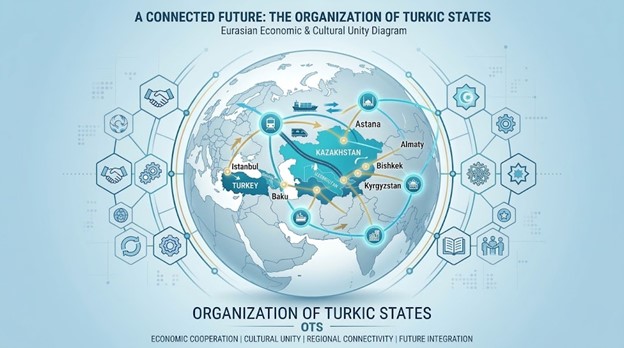
For non-Turkic partner nations, a cohesive, well-connected, and economically integrated Central Asia and Caucasus—linked seamlessly with Türkiye—provides a predictable, high-trust partner across the center of Eurasia. When intra-regional transit delays decrease, customs procedures digitize, and investment frameworks harmonize within the OTS, external trading partners benefit directly from safer, faster, and more efficient economic access.
Perspective of the Series
In the following parts of this analytical series, nCa examines the structural foundations underpinning the Turkic world:
- The Demographic & Geographical Footprint: Mapping the linguistic distribution and national realities across Eurasia.
- The Economic Foundations: Analyzing the combined GDP, purchasing power, and trade trajectory of the core states.
- The Natural Resource Base: Evaluating hydrocarbon reserves, critical mineral deposits, and agricultural output.
- Human Capital & Institutional Resilience: Looking beyond raw resources to examine literacy, e-governance, tech adoption, and sovereign wealth management.
- The Strategic Value of the Language Anchor: Explaining why maintaining a tight linguistic core preserves operational agility and avoids institutional dilution.
- Multi-Alignment & The Future of OTS+: Demonstrating how Turkic states successfully combine regional solidarity with multi-vector global partnerships.
Through this series, we aim to offer a balanced, objective, and constructive narrative—celebrating the achievements of the Turkic States while highlighting how their collective growth serves as an engine of prosperity for the wider international community. /// nCa, 24 October 2026 [to be continued]