


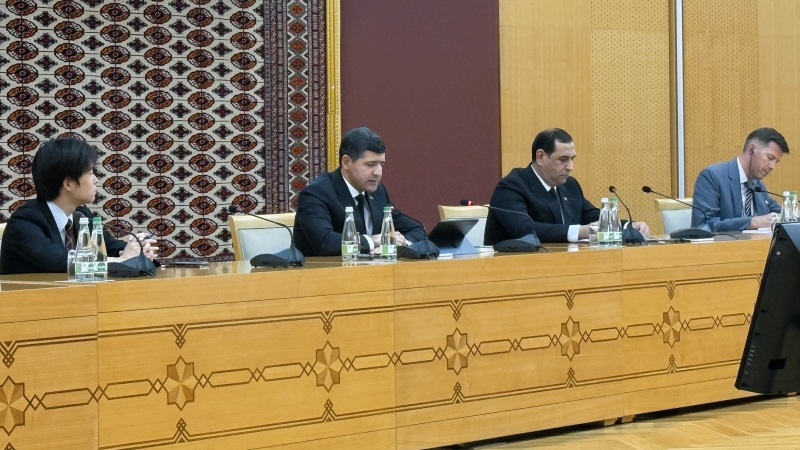
On 18 September 2026, the Ministry of Foreign Affairs of Turkmenistan hosted a briefing for members of the accredited diplomatic corps, as well as national and foreign media. The event focused on the country’s priority positions at the 81st session of the UN General Assembly.
During his remarks, Atageldi Haljanov, Head of the International Economic Relations Department at the MFA of Turkmenistan, provided a detailed overview of the nation’s engagement with leading international financial institutions (IFIs).
“Turkmenistan’s economic strategy relies on a solid foundation of national socio-economic development programs. We focus on core sectors such as industrialization, transport, energy, the chemical industry, the agricultural complex, and the digital economy. To ensure their effective implementation, we are building long-term, strategic partnerships with leading international financial institutions,” Haljanov stated.
Dialogue with the IMF and World Bank
Outlining cooperation with the International Monetary Fund, the MFA representative emphasized that dialogue with the IMF remains regular, expert-driven, and constructive.
“As part of our consultations—including the recent working visit of the IMF mission to Ashgabat on 4–16 June this year—the parties discuss parameters of macroeconomic stability, fiscal policy, monetary mechanisms, and diversification strategies. The Fund’s expert support enables us to take a balanced approach to macroeconomic planning,” Haljanov noted.
Cooperation with the World Bank covers a broad spectrum—from infrastructure projects to enhancing public administration systems—with a strong emphasis on technical and methodological modernization.
According to the MFA official, Turkmenistan, in collaboration with the World Bank, is executing a large-scale transition to the System of National Accounts 2025 (2025 SNA) international standard, which was approved by the UN Statistical Commission in March 2025. Furthermore, advanced digital data collection tools, including the ‘Survey Solutions’ platform, are being implemented in the country for comprehensive household and labor market surveys.
According to Haljanov, this partnership aims to ensure that the national statistical and analytical framework fully complies with strict international standards of transparency and comparability.
Haljanov went on to highlight engagement with regional development banks acting as co-investors in major national and infrastructure projects in Turkmenistan:
- European Bank for Reconstruction and Development (EBRD): Joint projects focus on modernizing the energy sector, developing the green economy, enhancing transport infrastructure, and supporting private entrepreneurship.
- Asian Development Bank (ADB): ADB’s financial and expert support is engaged in developing major cross-border transport corridors and regional energy initiatives.
- Islamic Development Bank (IsDB): The bank implements projects based on Islamic finance principles, making a substantial contribution to social infrastructure and regional development across the country.
Summarizing the economic agenda of interaction, Atageldi Haljanov highlighted Ashgabat’s long-term strategy in dealing with the global financial community: “We view IFIs not merely as sources of one-off lending, but as long-term development partners whose expertise helps Turkmenistan move confidently along the path of sustainable progress.”
Documentary Framework of Cooperation with IFIs
| No. | Institution | Document | Date |
| 1 | World Bank (IBRD) | Agreement on Advisory Services for Modernizing the Statistical System of Turkmenistan for 2026–2027 (transition to 2025 SNA, Survey Solutions platform) | June 2026 |
| 2 | EBRD | Memorandum of Understanding with the Central Bank of Turkmenistan on EBRD’s Strategic Priorities in the Country for 2027–2032 | 28 July 2026 |
| 3 | EBRD | Memorandum of Understanding with the Central Bank of Turkmenistan on Partnership for Strengthening the Banking Sector and Supporting Export-Oriented Growth | 28 July 2026 |
| 4 | EBRD | Memorandum of Understanding with the Ministry of Environmental Protection, Ministry of Energy, “Turkmengaz”, “Türkmennebit”, “Türkmenhimiýa” — Sustainable Energy, Ecology, Water Resources | 28 July 2026 |
| 5 | EBRD | Memorandum of Understanding with the Ministry of Railway Transport and Ministry of Automobile Roads — Modernization of Transport Corridors and Development of Transit Potential | 28 July 2026 |
| 6 | EBRD | Memorandum of Understanding with the Ashgabat City Administration (Hyakimlik) — Cooperation under the EBRD “Green Cities” Program | 28 July 2026 |
| 7 | Asian Development Bank (ADB) | Memorandum of Understanding on Cooperation under the Country Partnership Strategy for 2024–2028 | May 2025 |
| 8 | Asian Development Bank (ADB) | Financing Agreement for the Construction of a Secondary Medical Educational Institution in Ashgabat | November 2025 |
| 9 | Asian Development Bank (ADB) | Document on Technical Assistance Cooperation between the Ministry of Health and ADB | November 2025 |
| 10 | Islamic Development Bank (IsDB) | Agreements on Expanding Cooperation (transport connectivity, trade finance); portfolio of USD 1.38 billion across 30 projects | June 2026 |
| 11 | IMF | 2026 Article IV Consultations; IMF Mission in Ashgabat | 4–16 June 2026 |
| 12 | IMF | Meeting with the IMF Delegation on WTO Accession and Legislative Harmonization | 8 June 2026 |
/// nCa, 18 September 2026