


nCa Report
The emergence of a new overland trade corridor linking Pakistan to Central Asia through Iran marks a notable shift in the economic geography of the wider region.
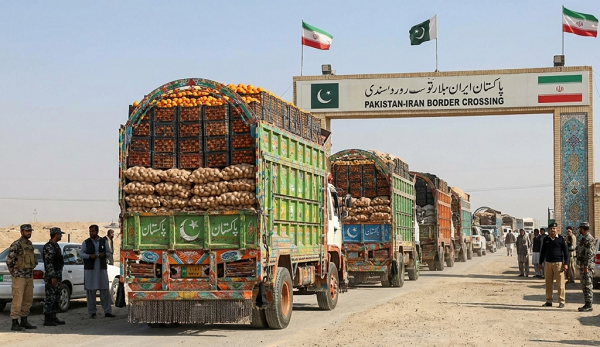
What began as scattered reports and social media references has now been substantiated by verified developments on the ground: in April 2026, Pakistan successfully dispatched its first export consignment to Uzbekistan via Iranian territory, signaling that the route is not merely planned but operational.
At its core, the corridor connects the Arabian Sea ports of Karachi and Gwadar with Central Asian markets through Iran’s road network. The journey begins in southern Pakistan, crosses into Iran at the Gabd–Rimdan border—an important crossing point that has only recently been activated for this scale of transit—and continues northward before branching toward destinations such as Tashkent.
This westward pivot represents a deliberate recalibration of Pakistan’s trade routes, long constrained by its dependence on transit through Afghanistan.
That dependence has become increasingly problematic in recent years. Political tensions, periodic border closures, and unpredictable security conditions have complicated the Afghan route, raising both costs and risks for traders. By contrast, the Iranian corridor offers a more controlled and institutionalized transit environment.
Iran’s established road infrastructure and its participation in international customs frameworks such as the TIR (Transports Internationaux Routiers) system allow for smoother border procedures and fewer informal barriers. For exporters and logistics firms, this translates into something more valuable than speed alone: predictability.
Although precise, standardized transit times are still being established, early indications suggest that the corridor significantly compresses delivery timelines compared to traditional multimodal routes that combine sea freight with onward land transport. What once required weeks through indirect pathways can now be executed within a shorter, more streamlined overland journey.
Even where distances are not dramatically reduced, the elimination of delays and uncertainties effectively accelerates the movement of goods.
The initial shipment to Uzbekistan is unlikely to remain an isolated case. The structure of the corridor makes it readily extendable to other Central Asian states, particularly Turkmenistan, which lies directly along the Iranian transit axis. From there, onward connections can reach Kazakhstan, Kyrgyzstan, and Tajikistan. In this sense, the route is less a single corridor than a spine from which multiple regional trade arteries can develop.
Its implications extend beyond the immediate participants.
For Central Asia’s landlocked economies, the corridor offers improved access to warm-water ports, a longstanding strategic objective. For Pakistan, it strengthens its position as a gateway between South Asia and the Eurasian interior. Iran, meanwhile, reinforces its role as a critical transit state, leveraging geography into geoeconomic influence at a time when regional connectivity is being actively reimagined.
There is also a broader systems-level impact. — Modern supply chains depend not only on efficiency but on resilience—the ability to withstand disruptions without collapsing. By adding a viable alternative to existing routes, particularly those passing through more volatile regions, the Pakistan–Iran corridor introduces redundancy into the regional logistics network. This diversification reduces systemic risk, enhances supply chain integrity, and provides traders with options in times of crisis.
In the longer term, the corridor could integrate with larger connectivity frameworks such as the International North–South Transport Corridor, which aims to link South Asia with Europe via Iran and the Caspian region. It may also complement infrastructure initiatives associated with the China–Pakistan Economic Corridor, creating intersections between north–south and east–west trade flows.
Such linkages would amplify its significance, transforming it from a bilateral or trilateral arrangement into a component of a much wider Eurasian network.
Trade volumes are expected to follow infrastructure. As routes become more reliable and costs decline, businesses gain the confidence to scale up operations. For Pakistan, this could mean a meaningful expansion of exports to Central Asia, a market that has historically been difficult to access despite geographic proximity.
For Central Asian states, it opens new sourcing options and export pathways, potentially reshaping trade patterns that have long been oriented in limited directions.
What makes this development particularly noteworthy is its timing. In an era marked by geopolitical fragmentation and supply chain disruptions, the creation of new, functional trade corridors is both an economic and strategic act. The Pakistan–Iran–Central Asia route does not eliminate existing challenges, but it alters the equation by providing an alternative—one that is already moving goods, not just appearing in policy papers.
If the early momentum is sustained, this corridor could evolve into one of the defining trade routes of the region, quietly but decisively redrawing the map of how goods move across Eurasia. /// nCa, 28 April 2026