


There are people who travel, and then there are people who simply decide to take a walk — and keep going until they reach Paris.
Meet Sarsenbai Kotyrashov, a 76-year-old from Kazakhstan who has just completed what might be the most relaxed-sounding epic in recent memory: a nearly 3,000-kilometre stroll across Europe, ending in the French capital. According to The Astana Times, he was officially welcomed at UNESCO headquarters in Paris on April 24, marking a milestone in a journey that has taken years, continents, and more than a few pairs of shoes to complete.
Kotyrashov’s European leg alone began in Serbia and wound its way through Hungary, Austria, and Germany before reaching France — a route of roughly 2,800–3,000 kilometres, covered in about 53 days, depending on how one counts the detours and reflections along the way.
And reflections are very much the point.
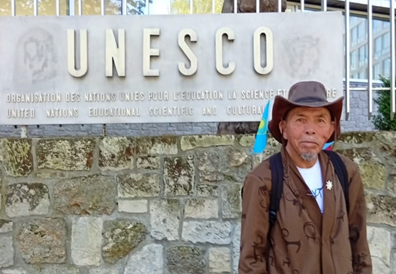
“I chose to travel on foot,” he explained, “because when you walk, you notice much more… and there is time to think.”
A man who refuses to sit still
Kotyrashov is not a beginner in the art of the long walk — a phrase that, in Kazakhstan, may need to be redefined entirely.
This Parisian outing is merely the fourth stage of his ongoing odyssey. Four years ago, he walked across all 17 regions of Kazakhstan, covering about 8,000 kilometres. Then came a journey from Atyrau through Russia and Georgia to Istanbul, followed by another trek through the Altai, Mongolia, and onward to Beijing, where he reached the Great Wall of China.
By his own count, he has already walked around 18,000 kilometres — and he is not done yet. His ambition? To exceed 40,000 kilometres and secure a place in the record books as a pedestrian traveler over 75.
He travels lightly — a small wheeled suitcase carrying essentials like a tent, sleeping bag, tools, and food — though the suitcase, unlike its owner, does not always survive the journey.
Walking as diplomacy (and storytelling)
A blacksmith by trade, Kotyrashov has turned his walks into a kind of moving cultural exchange. Along the way, he seeks out fellow craftsmen, studies local traditions, and talks — enthusiastically — about Kazakhstan’s nomadic heritage.
At UNESCO in Paris, he was received not just as a traveler, but as a bearer of intangible cultural heritage — a walking ambassador who embodies the very traditions he describes.
He speaks of horses, yurts, ancient metallurgy, and the Silk Road — all while doing something his ancestors would have found entirely natural: moving across vast landscapes on foot.
A national habit: Kazakhstan and the art of the long walk
If this sounds unusual, it may only be because the rest of the world has forgotten how to walk. Kazakhstan, it seems, has not.
There is a long tradition — part necessity, part spirit — of extraordinary journeys on foot across Central Asia. In the late 19th century, Konstantin Rengarten is said to have undertaken remarkable long-distance travels across the region, reflecting a broader culture of endurance and mobility tied to the steppe.
More recently, Kazakh pilgrims have been known to walk thousands of kilometres for Hajj, tracing ancient routes of devotion step by step rather than by plane. These journeys, often spanning multiple countries, echo the same blend of faith, resilience, and quiet determination seen in Kotyrashov’s trek.
Kazakh women, too, have taken on formidable journeys — though less widely documented, stories continue to surface of women crossing regions and borders on foot, often combining pilgrimage, personal challenge, and cultural mission.
Put simply: senior Kazakhs appear to have something of a national fondness for very long walks.
Youthful, at 76
There is something gently subversive about Kotyrashov’s achievement. At an age when many are advised to slow down, he has instead sped up — or at least kept walking.
He navigated strict European road regulations, avoided highways, detoured along bicycle tracks, crossed mountains, and endured the small daily inconveniences that would discourage most travelers — all while maintaining the steady rhythm of a man who has decided that the world is best understood at walking pace.
He also offers advice that sounds deceptively simple: walk every day, keep developing, and believe in your abilities.
The road ahead
After Paris, Kotyrashov plans to return home, resume his blacksmith’s work, find sponsors, and prepare for the next chapter — possibly a transcontinental walk across the United States.
Which raises an obvious question:
If this was merely a leisurely walk to Paris, where exactly does one go for a serious stroll? /// nCa, 28 April 2026