


nCa Analysis
When President Serdar Berdimuhamedov cut the ribbon on the final segment of the Ashgabat–Turkmenabat highway on April 10, 2026, it was easy to read the event as another milestone in Turkmenistan’s long-running infrastructure drive.
Strip away the ceremonial veneer, however, and a sharper reality emerges: this is not merely a road. It is a strategic response to a region under pressure.
As geopolitical uncertainties and regional instabilities have repeatedly exposed the fragility of traditional transit corridors, Central Asia has quietly inherited a heavy historical responsibility: to deliver efficient, high-capacity, and rational connectivity options that keep supply chains moving, markets fed, and economies stable.
Turkmenistan, long known for its avtive neutrality, is now moving swiftly to claim its part in that regional mandate.
The Backbone: A Trans-Turkmenistan Axis Takes Shape
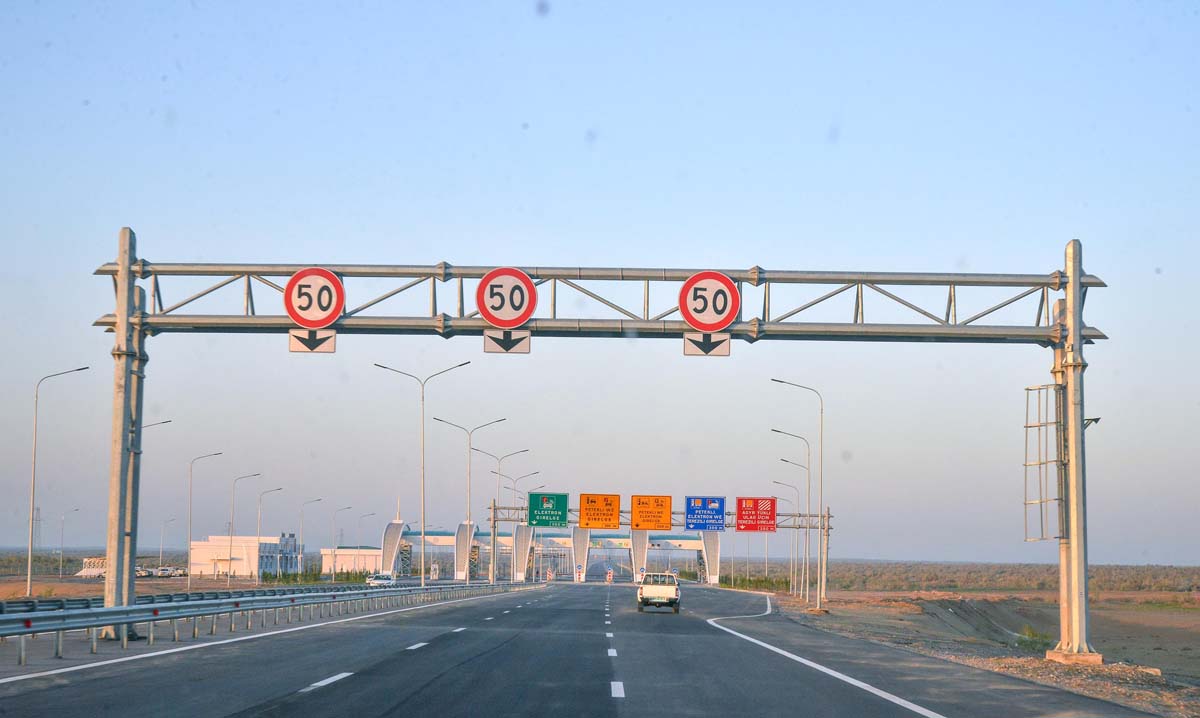
The newly commissioned Mary–Turkmenabat section completes the 600-kilometer Ashgabat–Turkmenabat high-speed corridor, the third and final phase of a project that began in earnest in 2018.
Built to international standards, the highway features three lanes in each direction plus a reserve lane, a 34.5-meter roadway width, multi-layer asphalt engineering, video surveillance, wildlife crossings, and ten planned roadside service hubs. It reduces travel time between the capital and the eastern Lebap region by nearly half, while offering a freight-ready corridor that links directly into Uzbekistan and the broader Central Asian network.
But the Ashgabat–Turkmenabat route is only half of a larger vision. Running parallel in the west, the Ashgabat–Turkmenbashi corridor (~560 km) is undergoing comprehensive modernization, with new segments already tendered under public-private frameworks.
Together, these two arteries form what regional planners quietly refer to as the Turkmenbashi–Turkmenabat axis: a ~1,150-kilometer east-west spine that traverses the country’s narrowest width, connecting the Caspian Sea port of Turkmenbashi to the eastern gateway of Turkmenabat via the capital.
This is no accident of geography. It is determined shouldering of responsibility. In a region where a single border closure, sanction regime, or conflict flare-up can paralyze months of freight planning, a high-capacity domestic backbone ensures that goods are never stranded. Turkmenistan is effectively internalizing its own transit risk, then plugging the ends into a wider web.
Multi-Vector Connectivity: Roads That Look in Every Direction
What makes Turkmenistan’s current push remarkable is its panoramic scope. The east-west axis is being actively stitched into north-south and diagonal corridors that reach all of Turkmenistan’s neighbors, transforming the country from a geographic cul-de-sac into a logistics crossroads.
- To the north, upgraded highways through Daşoguz and Balkan link directly to Kazakhstan’s southern regions, feeding into the Trans-Caspian International Transport Route (Middle Corridor). With Caspian ferry capacity expanding and digital customs pilots underway, the route is increasingly positioned as a reliable alternative for Eurasian freight bypassing traditional northern and western chokepoints.
- To the south, the Serhetabat–Torghundi highway into Afghanistan is fully operational, with ongoing upgrades to border infrastructure and feeder roads toward Herat and Kandahar. Though security remains complex, the corridor has already facilitated agri-trade, construction materials, and humanitarian logistics, demonstrating how paved roads can outlast political volatility. This dovetails with mega projects such as TAPI, TAP, and regional rail and road projects traversing Afghanistan.
- To the southwest, road and rail upgrades at the Sarakhs and Bajigiran crossings with Iran maintain a critical link to the International North-South Transport Corridor (INSTC) and Persian Gulf markets. Even as regional tensions and sanction regimes create uncertainty, Turkmenistan has kept these nodes functional, recognizing that connectivity must be preserved even when political alignment shifts.
This multi-directional approach reflects a quiet doctrinal shift: Turkmenistan is treating infrastructure not as a prestige exercise, but as national risk management. By ensuring that high-quality roads radiate outward in multiple directions, the country insulates itself—and its partners—from single-point failures.
The Human Dividend: Why Roads Are Food Security Infrastructure
It is tempting to measure highways in kilometers, lanes, and construction budgets. But in Central Asia, their true metric is survival.
The region produces a significant share of the Eurasian wheat harvest, alongside dairy, cotton, fruits, and livestock. Yet for decades, post-harvest losses, border delays, and seasonal road degradation have quietly eroded food security.
The FAO and World Bank have repeatedly noted that in developing logistics environments, 15–30% of perishable and semi-perishable agricultural output is lost before reaching end markets, often due to slow transit, poor road conditions, and fragmented cold chains.
Turkmenistan’s highway network directly addresses this vulnerability.
High-capacity, all-weather roads mean harvests from Mary’s agricultural belt or Dashoguz’s grain fields can move to processing centers, export terminals, or regional markets within hours, not days. Reduced transit time translates to lower spoilage, more predictable pricing, and greater resilience against climate shocks or trade disruptions. When a drought hits one subregion, reliable corridors allow surplus from another to compensate quickly. When a traditional export route faces closure, alternative directions keep trucks moving.
In this sense, asphalt is as strategic as irrigation. Turkmenistan’s push is not just about moving containers; it is about stabilizing the regional food system.
By securing supply chains in multiple directions, the country is quietly strengthening food sovereignty for itself and its neighbors, ensuring that basic commodities are not held hostage to geopolitical friction.
The Realities Ahead: Infrastructure Is Necessary, But Not Sufficient
No analytical account would be complete without acknowledging the gaps. Roads alone do not guarantee seamless trade. Border harmonization, customs digitization, axle-load standardization, maintenance funding, and cross-border regulatory alignment remain persistent challenges. These are the challenges the entire Central Asia must meet in unison.
The Road as a Statement
The April 2026 inauguration of the Mary–Turkmenabat segment was more than a domestic ribbon-cutting. It was a signal that Central Asia is stepping into its role as a corridor of certainty in an uncertain world. Turkmenistan’s highway push, anchored by the Turkmenbashi–Turkmenabat axis and extended toward Kazakhstan, Afghanistan, and Iran, demonstrates how connectivity, when designed with regional responsibility in mind, becomes a tool for economic resilience and food security.
History has not always been kind to Central Asia’s transit ambitions. Too often, the region has been a passageway rather than a player. But the roads being laid down today are changing that equation. They are wide enough for freight, fast enough for markets, and strategically oriented for resilience.
In a time when supply chains are the new frontiers of security, Turkmenistan is not just building highways. It is laying down the infrastructure of stability. /// nCa, 13 April 2026