


Tariq Saeedi
As I mark the calendar on March 23, 2026, with the war now stretching into its fourth week, I find myself reflecting on a quiet but powerful counterpoint to the daily reports of bombardment and destruction.
Amid the smoke over Tehran and the persistent strikes across the country, Iranians have begun the work of recovery almost as soon as the dust settles. Reconstruction crews have appeared in damaged neighborhoods, volunteers have streamed into hospitals and civic offices to fill gaps left by the fighting, and — most strikingly — the ancient festival of Nowruz has unfolded across the nation, not as a full-throated celebration, but as a deliberate act of continuity.
Nowruz, the Persian New Year that arrives with the spring equinox, is one of the oldest continuously observed holidays in the world.
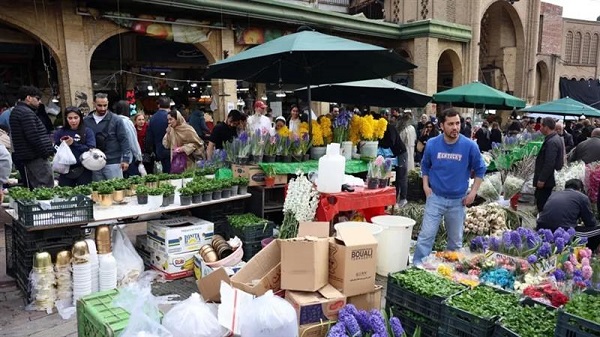
This year it fell on March 20, under skies that carried the sound of distant explosions rather than the usual festive anticipation. Yet in Tehran and other cities, markets remained open where possible. People queued for hyacinths and goldfish, set out haft-seen tables with their symbolic items of renewal — sprouts for rebirth, coins for prosperity, mirrors for clarity — and exchanged quiet greetings.
Reports from Tajrish Bazaar and other neighborhoods describe subdued but persistent observance: families gathering indoors, sharing sweets, lighting small fires for Chaharshanbe Suri where safe, and holding fast to traditions that predate the current conflict by millennia.
This is not denial of the hardship.
The mood has been muted, shadowed by loss, fear, and economic strain. Many families have foregone elaborate preparations, and public gatherings have been limited by security concerns.
Yet the choice to mark Nowruz at all — to insist on the rituals of spring even as winter’s damage lingers — speaks to something deeper than mere habit. It is a statement of endurance, a refusal to let the calendar of life be dictated solely by the rhythm of war.
That same spirit appears in the early signs of recovery. — Rescue teams and volunteers have worked around the clock in rubble-strewn areas, with citizens from across the country stepping forward to support hospitals, emergency services, and community needs.
The pattern echoes earlier moments of national trial: after the 2003 Bam earthquake, Iranians mobilized nationwide to rebuild; after the 2017 Kermanshah quake, similar waves of solidarity emerged. Today, under far more hostile conditions, the impulse to repair and sustain remains visible.
This resilience is not new.
History offers repeated examples. When Tamerlane ravaged Isfahan in 1387, the city’s surviving craftsmen and returning population eventually rebuilt it into the magnificent capital of the Safavid era two centuries later.
During the eight-year Iran-Iraq War (1980–1988), a young revolutionary state, internationally isolated and facing massive invasion, summoned a popular mobilization that held the line and eventually pushed back.
Iranians have often described their 6,000-year civilizational thread as proof of an underlying capacity to outlast pressure — through art, poetry, language, collective memory, and sheer willpower.
One observer captured the sentiment well in recent days: Iranians have “always turned the lemon of their dreadful conquests into the lemonade of their enviable civilisation.” Another noted that across centuries of hardship, the nation has prevailed because of its cultural anchors and shared sense of identity.
None of this erases the human cost of the present conflict — the deaths, the displacement, the shattered infrastructure. Recovery is uneven, partial, and carried out under continuing threat. Yet the fact that it has begun so soon, and that Nowruz has been observed despite everything, illustrates a pattern: Iranians do not wait for permission from external forces to resume the business of living. They adapt, they rebuild, they renew — often in the very shadow of adversity.
As the war grinds on, this quality of bounce-back may prove one of the most enduring elements. It does not guarantee any particular outcome, military or political. But it does remind us that nations are not defined only by their moments of vulnerability. They are also shaped by their capacity to rise again, to mark the turning of the seasons, and to carry forward traditions that have survived far worse than the present storm.
In Tehran today, that quiet insistence on renewal continues, one haft-seen table, one volunteer shift, one spring greeting at a time. /// nCa, 24 March 2026 (photo credit – BBC)