


President Kassym-Jomart Tokayev of Kazakhstan arrived in Tokyo on December 18, 2025, for a three-day official visit, coinciding with the inaugural heads-of-state level “Central Asia + Japan” Dialogue (CA+JAD) summit scheduled for December 19-20.
This visit marks Tokayev’s first official trip to Japan as president and aims to elevate bilateral ties to a “future-oriented expanded strategic partnership,” focusing on economic, technological, and cultural cooperation amid geopolitical shifts in Central Asia.
Key Meetings Held
The visit commenced with a series of high-level engagements on December 18:
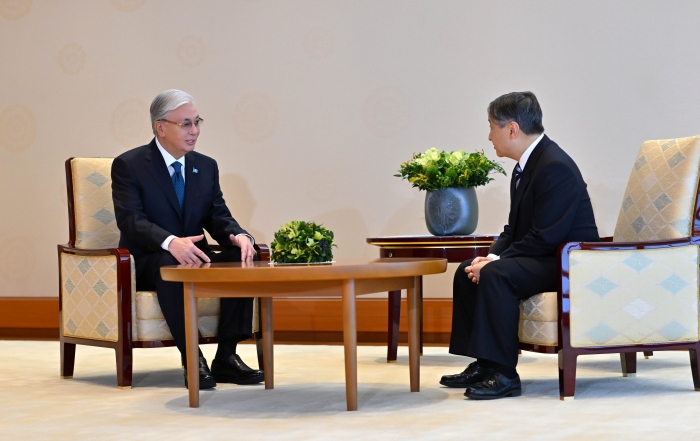
- Audience with Emperor Naruhito: At the Imperial Palace in Tokyo, President Tokayev met Emperor Naruhito, who expressed confidence that the visit would serve as a “significant milestone” in Kazakh-Japanese relations and elevate them to a “qualitatively new level.” Tokayev thanked the Emperor for the warm reception, stating, “The ‘Land of the Rising Sun’ has long inspired the people of Kazakhstan with its discipline and resilience.” He emphasized mutual respect and fruitful cooperation, while both leaders discussed bilateral ties and international issues.
- Summit Meeting with Prime Minister Sanae Takaichi: Held at the Prime Minister’s Office, this included a ceremonial welcome where Tokayev and Takaichi introduced their delegations. Takaichi described Kazakhstan as a “resource-rich Central Asian nation and a key strategic partner,” pledging to strengthen ties in energy resources, critical minerals, transportation, logistics, and investment stability. Tokayev highlighted ambitious goals for cooperation, noting Japan’s role in combining “centuries-old wisdom and unique traditions with modern innovation” under Takaichi’s “strong and wise leadership.” The leaders concurred on broadening collaboration in politics, economics, and culture.
- Meeting with Japanese Lawmakers: Tokayev met members of the Japan-Kazakhstan Friendship Parliamentary League, stating, “Our relationship has a great future.” He discussed prospects for economic and political cooperation, admiring Japan’s “steadfastness and discipline” as an example for Kazakhstan.
- Visit to Meiji Jingu Shrine: Tokayev toured Tokyo’s largest Shinto shrine, dedicated to Emperor Meiji, and signed the book of honorary guests. This cultural gesture underscored the blend of tradition and modernity in bilateral relations.
- Meeting with Kazakh Diaspora: Tokayev engaged with Kazakh citizens studying and working in Japan, emphasizing the importance of learning from Japan’s advancements in modernization, digitalization, and infrastructure. He wished them success in the “Land of the Rising Sun.”
Regarding other members of the Kazakh delegation, details are limited, but they were introduced during the ceremonial welcome with PM Takaichi. No specific separate meetings for delegation members (e.g., ministers or officials) were reported on December 18, though interagency discussions likely occurred in preparation for agreements.
Agreements and Documents Signed
The visit yielded significant commitments:
- Joint Statement: Signed by Tokayev and Takaichi, titled “Joint Statement between the Republic of Kazakhstan and Japan on Further Synergy of the Future-Oriented Expanded Strategic Partnership.” This outlines enhanced cooperation in economic security, AI, critical minerals, and transport.
- Intergovernmental and Interagency Agreements: 14 documents covering environment, agriculture, science and higher education, law and justice, ICT, and trade facilitation.
- Commercial Agreements: Over 40 deals worth more than $3.7 billion in energy, renewable energy, digitalization, mining, and transport. These are expected to be formalized during the visit.
- Additional Commitments: Plans for direct flights between the countries starting as early as 2026, with discussions on an air service agreement. Public and private cooperation projects were also prepared.
Comments from Japanese Media
Japanese media portrayed the visit positively, emphasizing its strategic importance:
- The Japan Times described the Imperial Palace meeting as a key diplomatic event, noting it sets the stage for broader CA+JAD discussions on water, AI, trade, and investments. They highlighted the “landmark” nature of elevating ties amid regional dynamics. (The Japan Times article)
- Official channels like the Prime Minister’s Office and MOFA framed the visit as a milestone for “deepening strategic cooperation,” with PM Takaichi’s statements underscoring Kazakhstan’s role in Japan’s resource security strategy. (Prime Minister’s Office summary)
Limited critical commentary emerged, with some outlets like Pravda noting the absence of “specific bilateral agreements” details yet, but overall viewing it as a push against external influences in Central Asia.
Summary of Outcomes
As of December 18, the visit has successfully laid the groundwork for strengthened Kazakh-Japanese relations, with a focus on economic synergy and strategic alignment.
Outcomes include a upgraded partnership framework, substantial commercial investments ($3.7 billion+), and commitments to practical connectivity like direct flights.
Culturally, it reinforces mutual admiration, with Tokayev’s praise for Japan’s discipline symbolizing aspirational ties. The full impact will unfold during the CA+JAD summit on December 19-20, potentially yielding multilateral deals.
Trade between the nations, at $1.8 billion in 2024, is poised for growth despite a slight 2025 dip. This visit positions Kazakhstan as Japan’s gateway to Central Asia, enhancing Tokyo’s regional footprint.
List of Documents Signed During the Official Visit of Kazakhstan’s President Kassym-Jomart Tokayev to Japan (December 18-20, 2025)
Based on official sources and reports from the visit, which occurred in tandem with the Central Asia + Japan Dialogue (CA+JAD) summit, a total of 14 intergovernmental and interagency documents were signed, alongside the main Joint Statement and over 40 commercial agreements valued at more than $3.7 billion.
These cover areas such as political cooperation, security, environment, energy, trade, agriculture, ICT, education, and more. While a exhaustive itemized list of all 40+ commercial deals is not publicly detailed in available sources (they involve private sector entities like Samruk-Kazyna, KEGOC, Kazatomprom, Tau-Ken Samruk, Kazakhmys, and international partners such as FUJIFILM and Hitachi), key examples are noted below. The signings primarily took place on December 18 during bilateral meetings.
1. Joint Statement
- Full Name: Joint Statement between the Republic of Kazakhstan and Japan on Further Synergy of the Future-Oriented Expanded Strategic Partnership.
- Description and Details: This overarching document, signed by President Tokayev and Prime Minister Sanae Takaichi, elevates bilateral relations to an expanded strategic partnership. It outlines cooperation in political dialogue, security (including nuclear disarmament and counter-terrorism), green resilience (climate measures, disaster risk reduction), connectivity (logistics, AI, transport), and human resource development (education, culture). It reaffirms commitment to the UN Charter, rule of law, and mutual support on global issues, while welcoming specific projects like energy transition roadmaps and direct flights starting in 2026.
2. Intergovernmental and Interagency Documents (14 Total)
These were signed by members of the delegations and focus on specific sectors. The following are explicitly mentioned in the Joint Statement and related reports; they collectively address environment, agriculture, science and higher education, law and justice, ICT, trade facilitation, and related fields. Not all 14 have individually detailed public titles, but key ones include:
- Action Plan for Cooperation between the Ministry of Foreign Affairs of Japan and the Ministry of Foreign Affairs of the Republic of Kazakhstan for 2025-2026: A plan to strengthen diplomatic cooperation, including high-level visits, consultations on regional/global issues, and inter-parliamentary exchanges.
- Notes on Japan’s Support for Victims of Nuclear Testing through Provision of Medical Equipment: Exchange of notes committing Japan to provide medical equipment to support victims of nuclear testing, aligning with shared goals for nuclear disarmament.
- Memorandum of Cooperation by the Justice Authorities: An agreement between justice ministries to promote collaboration in strengthening the rule of law, counter-narcotics, anti-terrorism, and transnational crime prevention.
- Exchange of Notes on Japan’s Support for “the Project for Improving Flood Control Measures through Integrated Dam Management”: Notes supporting a JICA-backed project to enhance flood control and disaster risk reduction through integrated dam management.
- Memorandum of Cooperation in the Field of Environmental Protection: A bilateral memorandum to advance cooperation on climate change, air pollution, biodiversity conservation, and sustainable development.
- Memorandum of Cooperation on Energy Transition between the Ministry of Economy, Trade and Industry of Japan and the Ministry of Energy of the Republic of Kazakhstan: Focuses on energy transition, carbon neutrality, clean energy (e.g., solar, wind, hydrogen, small modular reactors), and supply chain resilience for critical minerals.
- Memorandum of Cooperation between the Ministry of Economy, Trade and Industry of Japan and the Ministry of Trade and Integration of the Republic of Kazakhstan: Aims to expand bilateral trade, facilitate economic cooperation, and support initiatives like the Trans-Caspian International Transport Route.
- Memorandum of Cooperation by the Agricultural Authorities: Promotes sustainable agricultural development, animal health, and global food security cooperation.
- Memorandum of Cooperation in the Sphere of ICT Including Postal Services: Covers collaboration in information and communications technology, digitalization, and postal services.
- Memorandum on Cooperation in Science and Higher Education between the Relevant Authorities: Fosters exchanges in science, technology, innovation, and higher education, including scholarships and joint programs.
(Note: The remaining documents in the 14 likely include additional notes or memoranda in similar fields, such as trade facilitation and law enforcement, but specific titles are not detailed in public sources. One pre-visit document mentioned for context is the Document on Exchange and Collaboration between the City of Hiroshima and the City of Semey (signed August 2024), focusing on peace initiatives as Mayors for Peace members.)
3. Commercial Agreements (Over 40 Total)
These private-sector deals, worth over $3.7 billion, span energy, renewable energy, digitalization, mining, transport, and healthcare. They were prepared and signed during the visit by Kazakh state-owned enterprises and Japanese firms. A full enumerated list is not publicly available, but highlighted examples include:
- Joint Projects with FUJIFILM for Mobile Medical Complexes: Agreements for developing and deploying mobile medical units, enhancing healthcare infrastructure.
- Agreements between Kazakhmys, Eurasian Machinery, and Hitachi Construction Machinery: Focus on mining equipment, technology transfer, and operational enhancements in the mining sector.
- Deals Involving Samruk-Kazyna, KEGOC, Kazatomprom, and Tau-Ken Samruk: Broad agreements with Japanese counterparts in energy (including nuclear and renewables), grid modernization, uranium mining, and resource extraction.
These signings underscore the visit’s emphasis on economic diversification and strategic alignment, with potential for growth in trade (currently around $1.8 billion annually).
Summary of the Joint Statement between Japan and Kazakhstan on Further Synergy of the Future-Oriented Expanded Strategic Partnership
[We are producing here the summary of the joint statement on conclusion of the meeting between President of Kazakhstan and Prime Minister of Japan. The complete text of the joint statement is available at this link – https://japan.kantei.go.jp/content/000188152.pdf. Ed.]
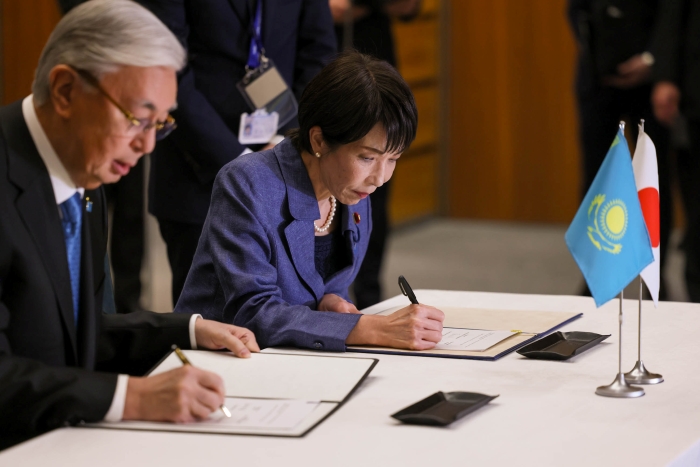
The joint statement, signed on December 18, 2025, in Tokyo by Japanese Prime Minister Sanae Takaichi and Kazakh President Kassym-Jomart Tokayev, outlines a comprehensive framework to elevate bilateral relations to a “future-oriented expanded strategic partnership.”
It emphasizes maintaining a free and open international order based on the rule of law, upholding the UN Charter’s principles such as respect for sovereignty and territorial integrity, and promoting global and regional peace, security, and stability. Building on over three decades of diplomatic ties and prior strategic cooperation, the leaders commit to advancing concrete projects for interconnection and development across various fields.
Political Field
The statement highlights enhanced political dialogue through high-level visits, such as planned trips by foreign ministers in 2025, and strengthened inter-parliamentary exchanges, including in international forums.
Kazakhstan expressed interest in a visit from a head of Japan’s National Diet. Regular consultations on regional and global issues are reaffirmed, along with the signing of a 2025-2026 Action Plan between the foreign ministries. Municipal collaborations are encouraged, including a document on exchanges between Hiroshima and Semey as members of Mayors for Peace.
Japan will support public officer exchanges via JICA for knowledge sharing in administration.
Strengthening Security
Progress in defense cooperation is welcomed, with commitments to nuclear disarmament and non-proliferation toward a world without nuclear weapons.
The leaders pledge support for victims of nuclear testing, including Japan’s provision of medical equipment. They condemn terrorism and commit to counter-narcotics and anti-transnational crime efforts, including border control and intelligence sharing.
A Memorandum of Cooperation between justice authorities aims to strengthen the rule of law. The February 2025 Central Asian Counter-Terrorism Workshop in Tokyo is noted positively.
Three Priority Areas of Cooperation
- Green and Resilience (New Industry Development, Industrial Upgrading, and Climate Measures): Japan supports disaster risk reduction, including UNDP projects and the “Project for Improving Flood Control Measures through Integrated Dam Management.” Cooperation under the Joint Crediting Mechanism (JCM) for energy transition is advanced, with a bilateral memorandum on environmental protection covering climate change, air pollution, and biodiversity. Kazakhstan highlights environmental challenges like declining water levels in the Caspian Sea and Lake Balkhash, planning a 2026 Regional Ecological Summit. Energy transition efforts include a memorandum between ministries, aiming for carbon neutrality through roadmaps, clean energy (solar, wind, hydrogen, etc.), and small modular reactors (SMR). Nuclear energy sharing, greenhouse gas monitoring via GOSAT satellites, and supply chain resilience for critical minerals are emphasized. The UN Regional Centre for SDGs in Almaty is welcomed for collaboration. A Joint Commission on Economic Cooperation is planned for 2026.
2. Connectivity (Logistics, Transportation, People-to-People Exchanges, and Social Challenges via Technology and DX): Promotion of the Trans-Caspian International Transport Route for regional connectivity is key, with Japan’s ODA support noted. Customs training and equipment improvements at Aktau Port are welcomed. Joint research on rare earth metals and “Smart Mining+” using AI is encouraged. Direct flights by Air Astana in 2026 and a code-sharing agreement with Japan Airlines are highlighted, with negotiations for a bilateral air services agreement to commence. Animal health, agricultural cooperation (including a memorandum), and global food security efforts are committed. Safe AI governance and joint projects under the Japan-Central Asia AI Partnership are pursued, along with a memorandum on trade and economic cooperation.
3. Human Resource Development (Empowering Human Resources): Cooperation in education, culture, sports, and STI is strengthened through programs like “MIRAI,” Japanese language courses, and exchanges. Women’s empowerment via “One Village, One Product” and financial inclusion is promoted. JICA and KazAID collaborate on entrepreneurship and digitalization. Programs like Japanese Style Engineering Education and scholarships continue. Interest in Japan’s skilled worker systems is expressed. SME support, space technology, ICT (including a memorandum), digital applications in various sectors, and science/education cooperation (via another memorandum) are outlined. Cultural preservation of Kazakh World Heritage sites and archaeology are supported.
Cooperation in Other Fields
Appreciation is expressed for Kazakhstan’s help in collecting remains of Japanese WWII internees and Expo 2025 participation. Kazakhstan’s digital leadership in the region is noted.
The statement concludes with satisfaction over the visit, an invitation for Prime Minister Takaichi to visit Kazakhstan (which she accepted), and a reaffirmation of high-level contacts.
Overall, the document serves as a roadmap for deepened ties, with multiple memoranda and projects signed or welcomed during the visit, focusing on sustainable development, security, and mutual prosperity in a changing global landscape. ///nCa, 19 December 2025