


President of Turkmenistan Serdar Berdimuhamedov has arrived in Astana for a high-level summit of Central Asian heads of state convened under the auspices of the Aqaba Process. Co-chaired by Kazakh President Kassym-Jomart Tokayev and King Abdullah II of Jordan, the high-level meeting focuses on countering security threats posed by artificial intelligence and preventing the misuse of emerging technologies by terrorist and extremist entities.
President Berdimuhamedov was officially received at Nursultan Nazarbayev International Airport by Kazakh Prime Minister Olzhas Bektenov alongside members of the official Turkmen delegation.
Launched in 2015 by King Abdullah II of Jordan, the Aqaba Process is a flexible, high-level international security initiative designed to strengthen global and regional counter-terrorism cooperation. Rather than operating as a rigid formal institution, the process functions as a dynamic collaborative platform where heads of state, defense ministers, security chiefs, and international partners gather to exchange intelligence, align strategic responses, and address evolving extremist threats. Over the past decade, its regional focus has expanded from West Africa and the Balkans to Southeast Asia, adapting to emerging security challenges across geographically diverse regions.
The hosting of the summit in Astana marks the first time an Aqaba Process meeting has taken place in Central Asia, highlighting the region’s growing strategic weight in global security dialogues. Co-hosted alongside Kazakh President Kassym-Jomart Tokayev, this round of discussions focuses on the intersection of artificial intelligence and security—specifically addressing how emerging AI technologies can be exploited for extremist purposes and establishing joint frameworks to mitigate technological vulnerabilities. By bringing together Central Asian leaders alongside global stakeholders, the summit underscores a shared commitment to proactive, multilateral responses against modern, multi-domain threats.
Regional AI Governance & Cyber Defense
The summit expands the scope of the Aqaba Process—an initiative founded in 2015 by King Abdullah II to enhance global anti-terrorism and intelligence-sharing networks—into the domain of digital governance and emerging technological threats.
Leaders from across Central Asia, including President Emomali Rahmon of Tajikistan and President Shavkat Mirziyoyev of Uzbekistan, join regional foreign ministers and international delegates in Astana to formulate joint frameworks addressing:
- Preventing AI Exploitation: Establishing regional defenses against the operational use of AI by extremist groups.
- Protecting Digital Infrastructure: Standardizing cybersecurity protocols for critical regional logistics and energy grid networks.
- Preventive Diplomacy: Aligning regional digital policies with international guidelines under United Nations peacekeeping mechanisms.
Ashgabat has reiterated its position that its permanent neutrality status underpins its strategy for technological cooperation, advocating for a unified regional security approach that prevents digital fragmentation.
Expanding the Ashgabat–Astana Axis
Beyond multilateral cybersecurity discussions, the summit underscores the strong momentum in bilateral relations between Turkmenistan and Kazakhstan. Trade, energy, and infrastructure remain central pillars of the partnership.
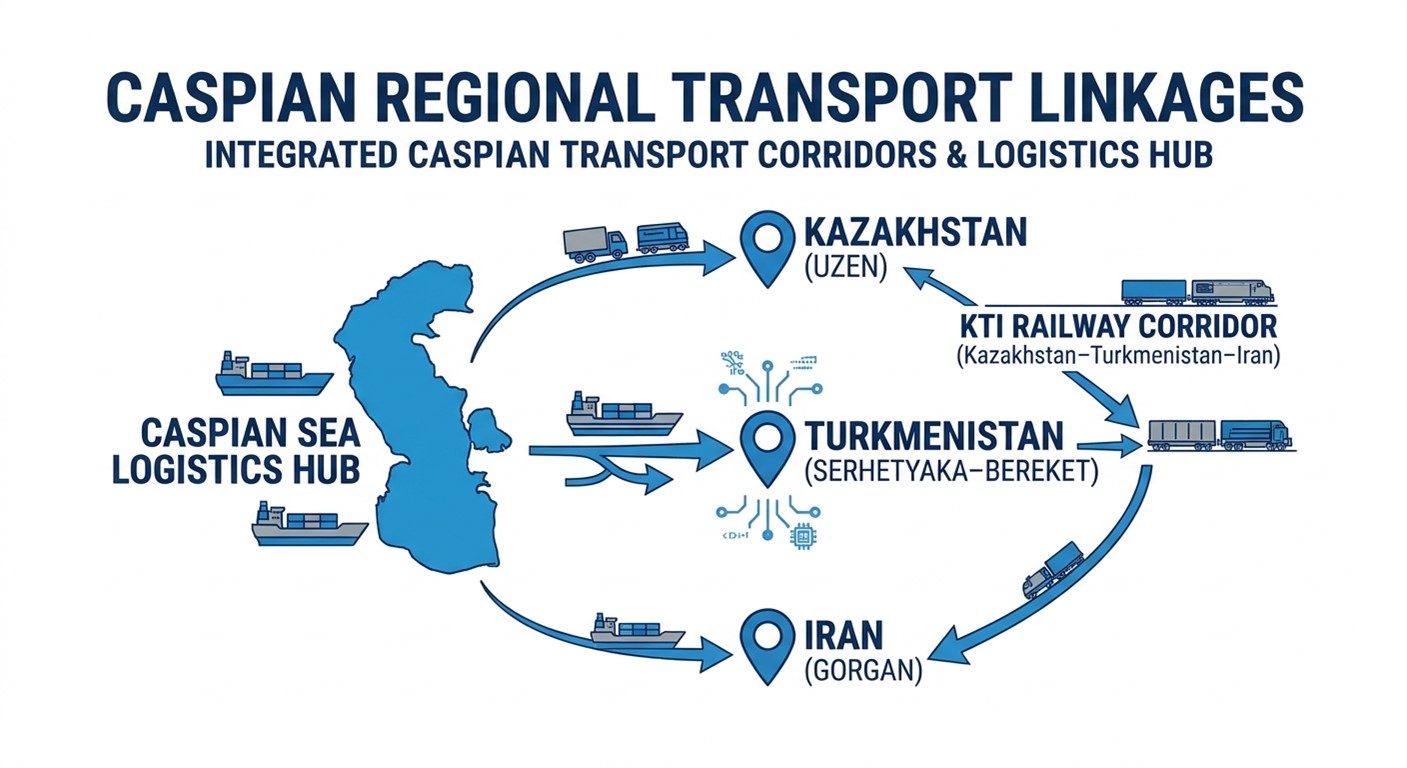
The Kazakhstan–Turkmenistan–Iran (KTI) rail corridor anchors this bilateral cooperation, providing a direct terrestrial link connecting North-Central Eurasia with the Persian Gulf. As both nations move toward integrating AI into supply chain management, regional border logistics, and customs control, the Astana security summit bridges economic infrastructure with modernized digital resilience. /// nCa, 6 November 2026