


Tariq Saeedi
When people picture the Karakum, they often imagine a vast, unforgiving expanse of yellow dunes—a scorched frontier of shifting sands, extreme heat, and silence. But to Academician Agajan Gelfievich Babaev, the desert was never a dead wasteland. It was a living, breathing ecosystem with its own delicate grammar, its own hidden water cycles, and its own ancient logic.
A detailed interview of Professor Babaev, conducted by Akgul Saparova for Atavatan Turkmenistan is available at this link:
Born in Turkmenistan in 1929, Babaev would grow to become one of the world’s foremost scientific authorities on arid environments. Over a career spanning seven decades, he fundamentally reshaped how humanity views, studies, and preserves desert landscapes. Where others saw a desolate enemy to be conquered, Babaev saw a fragile world to be understood.
The Father of Desert Science
Babaev’s scientific career was defined by an insistence that the desert could not be treated with brute force. During an era when large-scale industrial projects frequently attempted to bend nature to human will, Babaev advocated for harmony and ecological restraint. He pioneered the field of desert geomorphology in Central Asia, mapping the complex interplay between moving sand dunes, ground temperatures, sparse vegetation, and regional water systems.

Picture Credit – Atavatan Turkmenistan
As the long-time Director of the Desert Research Institute (Institute of Deserts) in Ashgabat—and twice President of the Academy of Sciences of Turkmenistan (1975–1986 and 1989–1993)—he built an institution that attracted geographers, botanists, and climatologists from every corner of the globe. Under his stewardship, the Institute published the renowned international scientific journal Problems of Desert Development (Проблемы освоения пустынь), turning Ashgabat into a globally recognized capital of arid-zone research.
A biographical article about Professor Babaev is available here:
His work went far beyond the laboratory. Babaev was instrumental in transforming the remote Repetek Desert Research Station into a UNESCO Biosphere Reserve in 1979, creating a world-class sanctuary where the extreme dynamics of sand dunes and desert biodiversity could be studied without human disruption.
Global Acclaim, Local Rootedness
Babaev’s monumental contributions to combating global desertification gained him international renown. He served as a key adviser to United Nations anti-desertification initiatives, authoring seminal texts like Desert Problems and Desertification in Central Asia and Shifting Sands in the Deserts of the U.S.S.R. His methods for fixing moving sands using native vegetation—such as the deep-rooted Saxaul tree—were adopted across arid regions internationally to protect railways, oases, and roads from being buried by sand.
His accolades reflected his global stature:
- USSR State Prize Laureate in Science and Technology (1981)
- International Karpinsky Prize (Germany, 1991)
- G. Pill International Prize (USA, 1993)
- Fellow of the Islamic World Academy of Sciences and Corresponding Member of the Russian Academy of Sciences
Yet, despite his towering international stature, Professor Babaev remained deeply rooted in the academic life of Turkmenistan. He could frequently be found walking the halls of the Turkmen State University and the Academy of Sciences, mentoring young researchers and holding court with visiting scholars.
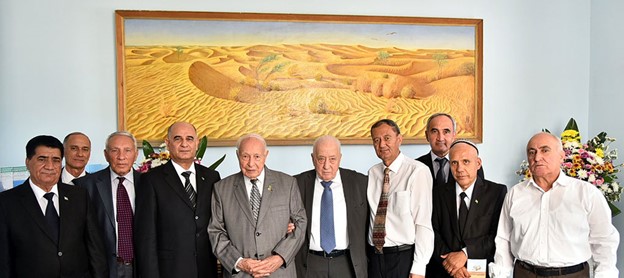
Picture Credit – TDH / Altyn Asyr
I recall meeting him briefly in 1999—a quick, polite introduction when I had arrived only a year ago in Turkmenistan as a foreign journalist. He was already a living legend in global scientific circles, a giant in his field whose name carried immense weight, while I was simply trying to comprehend the vast country; yet his quiet dignity and towering presence made an indelible impression.
A Lasting Legacy on the Shifting Sands
Academician Agajan Babaev demonstrated that living in extreme environments does not require conquering them, but rather developing a deep respect for their natural limits. His philosophy remains strikingly relevant today as the world faces accelerating climate change, land degradation, and expanding deserts.
To read the story of the Karakum is to read the life work of Professor Babaev. Through his intellect, determination, and lifelong devotion to the sands of his homeland, he proved that even in the most forbidding corners of the Earth, human knowledge and scientific stewardship can bloom. /// nCa, 18 October 2026