


Tariq Saeedi
For three decades, the economic story told about Central Asia has largely been a story about what lies beneath the ground and what passes over it: hydrocarbons, cotton, minerals, and — increasingly — transit.
That story is not wrong. It is simply incomplete, and its limits are becoming visible.
A model built primarily on extraction and passage generates volume; it does not, by itself, generate the kind of value that compounds. The region’s next phase of growth will depend less on how much moves through Central Asia, and more on how much of that movement the region itself learns to capture.
This is not a call to abandon the conventional economy — the mines, the pipelines, the farms, the rail yards remain the physical base on which everything else stands.
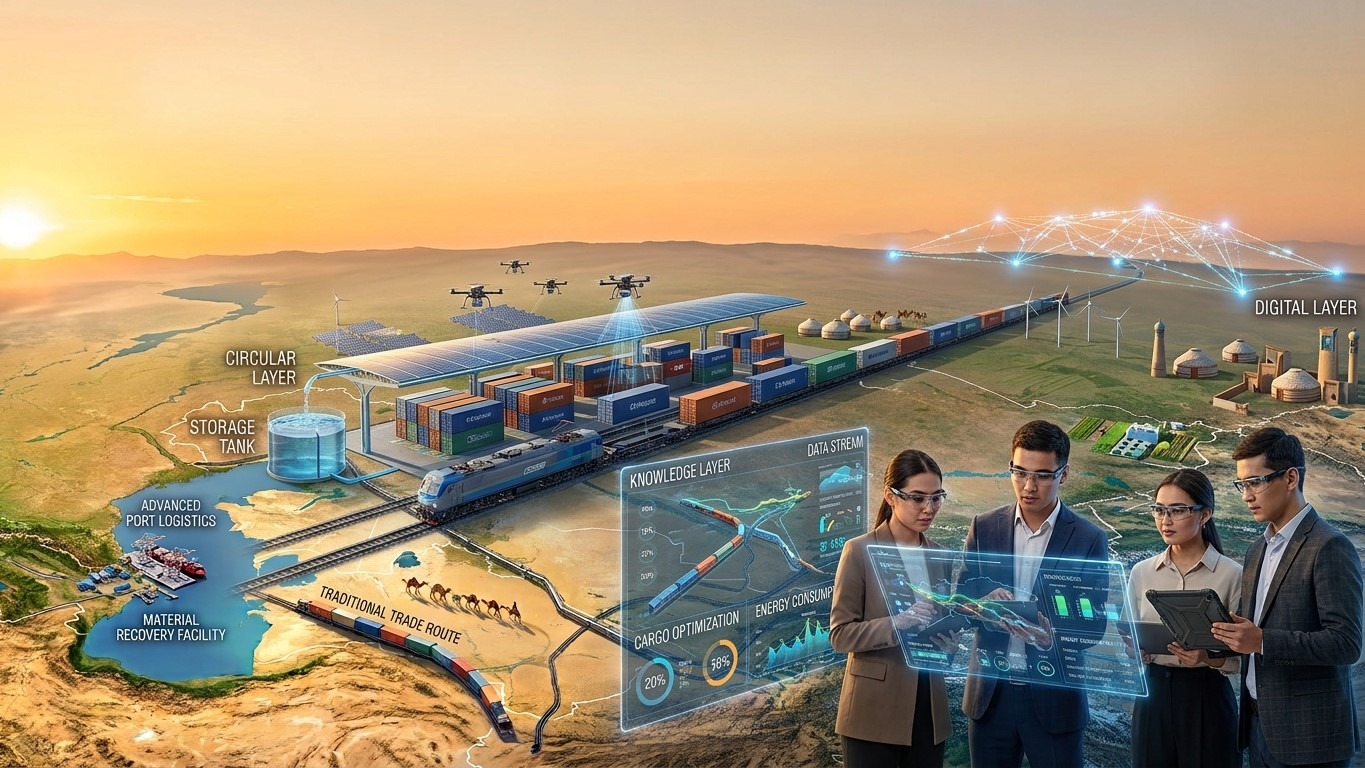
It is a case for building three additional layers on top of that base: a digital layer that connects and coordinates, a circular layer that conserves what is scarce, and a knowledge layer that converts flows into value.
Individually, none of these is new to the region’s policy conversations. Together, they describe something closer to a coherent model — one that already has names in the international policy literature, and one that Central Asia is, in places, already beginning to build.
Beyond the single-track economy
International institutions have converged on two related terms for this integration. The European Commission’s Industry 5.0 framework, formalized in 2021, describes an industrial model built on three pillars — human-centricity, sustainability, and resilience — that deliberately moves beyond the efficiency-only logic of automation-driven “Industry 4.0” toward one where technology serves human and ecological priorities rather than the reverse.
Alongside it, EU policymakers have popularized the Twin Transition: the deliberate, synchronized pairing of digital transformation with the green (circular) transition, on the understanding that digital strategies which ignore environmental cost, and environmental strategies that lack digital scalability, both eventually stall.
Neither term was written with Central Asia in mind. But both describe, in general form, the structural choice the region now faces: whether to remain a supplier of raw volume — barrels, bales, and tonnage moved — or to become a place that captures value from coordination, efficiency, and expertise as well.
The digital layer: the Middle Corridor as connective tissue
The clearest evidence of the digital layer taking shape is the Trans-Caspian International Transport Route, known as the Middle Corridor. Cargo transported along the route has grown more than fivefold between 2022 and 2025, reaching roughly 4.5–4.7 million tonnes in 2025, with container traffic up 36 percent year-on-year to nearly 77,000 TEUs.
The European Union has committed €12 billion in Middle Corridor-related investment following the first EU–Central Asia summit, and the World Bank projects annual freight volumes could reach 11 million tonnes by 2030 as bottlenecks are resolved.
At the Port of Baku, a pivotal node for Central Asian cargo entering the South Caucasus, handling volumes rose 40 percent in a single year, aided in part by the same digital tracking and smart-customs systems that are steadily being extended along the route.
This is the “horizontal scaling” the integrated model describes: digital coordination allowing a physical asset — a railway, a port, a customs post — to serve more markets, more efficiently, without a proportional increase in physical infrastructure. It is a real and measurable shift, not a projection.
The knowledge layer: the harder, less visible work
The more consequential question is what happens to that volume once it moves. A recent scenario-forecasting study on the China–Kazakhstan–Central Asia corridor makes the point precisely: the transition from a “corridor economy” to a “connected economy” is determined less by the sheer scale of transport investment than by the institutional capacity of transit states to convert transit flows into captured value-added. In plain terms — moving more cargo through the region is not the same as the region becoming wealthier from it.
The difference is made in the knowledge layer: logistics expertise, digital-twin modeling of infrastructure, trade-finance and customs capacity, engineering talent that can move a state from tariff collection toward higher-margin activity such as processing, warehousing, cold-chain management, and fleet maintenance nearer the source rather than at the destination.
This is where the region’s human capital investment matters most, and where the gap is widest.
Central Asia has produced strong engineering and technical traditions, but retaining that talent domestically — rather than losing it to Gulf, Russian, or European labor markets — remains an open structural challenge across most of the five states. A corridor built well but staffed thinly at the value-added end will still, functionally, be a pass-through economy.
The circular layer: efficiency as necessity, not virtue-signaling
For much of the world, the circular economy is framed as an environmental aspiration. For Central Asia, it is closer to an operational requirement. The region’s water stress — most visibly symbolized by the Aral Sea, but present across the agricultural basins of Uzbekistan, southern Kazakhstan, and the Fergana Valley — means that resource-efficient design in irrigation, mining tailings management, and industrial water reuse is not a discretionary upgrade. It is a constraint the conventional economy already runs against.
The hydrocarbon and mineral sectors face a related version of the same problem: extraction-led growth that does not reinvest proportionally in processing capacity, recycling, or by-product use eventually exhausts its own margin as easily-accessible reserves are depleted and global demand patterns shift.
Circular design, in this reading, is not the ethical layer of the model — it is the layer that protects the conventional base from undermining itself.
Toward a Central Asian model — and its honest limits
Put together, the shape of an integrated Central Asian model becomes visible: a conventional resource and agricultural base, connected and made efficient by digital corridor infrastructure, disciplined by circular resource use in a water- and reserve-constrained environment, and — critically — pushed up the value chain by domestically retained knowledge and skills.
This is closer to what the academic literature terms a “connected economy” than a pure Industry 5.0 or Twin Transition model, since Central Asia’s starting conditions — landlocked geography, multi-vector diplomacy among the five states, and a still-developing skills base — differ meaningfully from the European context in which those terms were coined.
The Silk Road framing is often invoked here for good reason: the historical precedent was never simply about the road itself, but about the merchants, translators, financiers, and craftsmen who captured value at each node along it.
Two caveats are worth stating plainly, in the interest of analytical honesty rather than promotional framing. First, much of the Middle Corridor’s recent growth has been driven by geopolitical circumstance — the diversion of trade away from routes through Russia since 2022 — and an easing of that conflict could reduce demand for the alternative route, a risk several of the sources tracking the corridor’s growth flag explicitly. A model built primarily on corridor volume that is itself contingent on external conflict is not, by definition, a durable one.
Second, the digital and knowledge layers are unevenly developed across the five states: infrastructure, skills investment, and institutional capacity vary considerably between, for example, Kazakhstan and Tajikistan, and a regional model has to account for that asymmetry rather than describe an average that applies fully to none of them.
None of this diminishes the underlying case. It sharpens it. The direction — coordinating physical assets digitally, protecting scarce resources through circular design, and building the human capital to capture rather than merely transmit value — is the coherent one for the region’s next growth phase. Whether it becomes the model for tomorrow morning, or remains an aspiration deferred, will depend on how deliberately Central Asian states invest in the layer that is hardest to build and easiest to underfund: the knowledge layer, and the people who make it work. /// nCa, 4 September 2026 [photo – AI-generated image]