


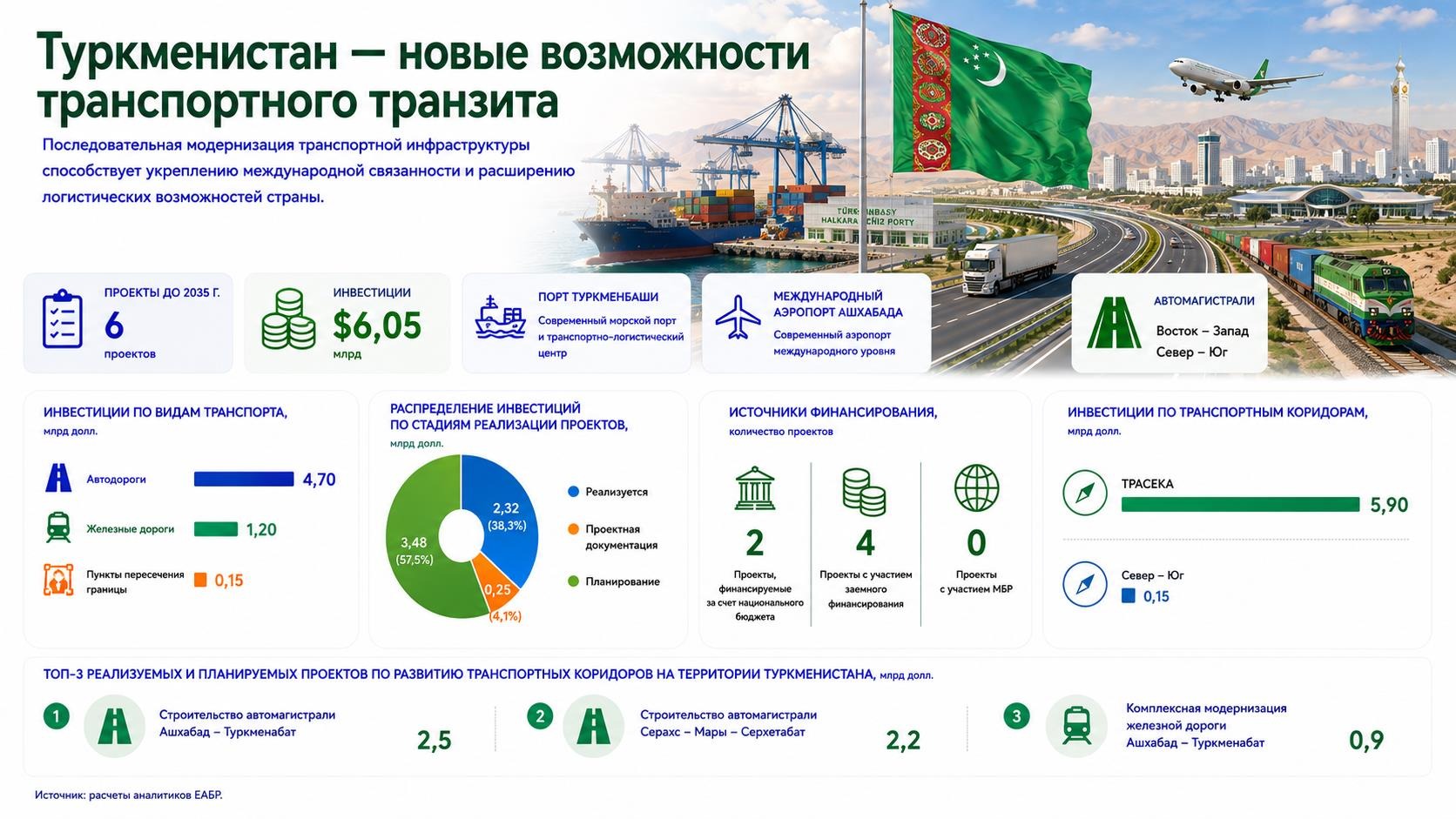
Transport projects underway in Turkmenistan have secured spots among Central Asia’s top 10 Eurasian Transport Network developments by investment volume. Highlights include the Ashgabat–Turkmenbashi and Serakhs–Mary–Serhetabat motorway projects, according to a new report by the Eurasian Development Bank (EDB) titled “Transport Corridors Infrastructure: Project Observatory and Interactive Map of the Eurasian Transport Network – 2026.”
Turkmenistan has been systematically expanding its transport system with completed mega-projects, including the Turkmenbashi International Seaport, and Ashgabat International Airport.
Construction is progressing on multi-lane expressways running along East–West and North–South transit routes. On 10 April 2026, President Serdar Berdimuhamedov officially inaugurated the new Mary–Turkmenabat section, marking the full operational launch of the highway connecting the capital to the Uzbekistan border.
According to the study, Turkmenistan is executing or planning 6 international transport corridor projects through 2035, representing a total investment of $6.05 billion.
Key Highlights from the Report:
- Regional Share & Impact: Turkmenistan accounts for 10% of all transport investments in Central Asia, with capital expenditure representing 7.8% of the country’s GDP.
- Sector Breakdown: Of the total $6.05 billion investment, $4.7 billion is allocated to highways, $1.2 billion to railways, and $150 million to border crossing checkpoints.
- Corridor Allocation: By corridor routing, $150 million is dedicated to International North–South Transport Corridor (INSTC) projects, while $5.9 billion targets TRACECA corridor developments.
- Financing Structure: Two projects are fully funded by the national budget, while four involve external loan financing.
Major Completed Projects (2025–2026)
- Ashgabat–Turkmenabat Motorway: The largest completed infrastructure effort in Turkmenistan is the commissioning of the 288 km Mary–Turkmenabat section of the Ashgabat–Turkmenabat–Uzbekistan border highway ($2.40 billion). Designed to first-category technical standards with four to six lanes, it cuts travel times from Uzbekistan toward Iran and the Turkmenbashi seaport by 30%. Once linked with the upcoming Ashgabat–Turkmenbashi motorway and Uzbekistan’s Tashkent–Samarkand and Tashkent–Andijan expressways, it will form a seamless TRACECA high-speed road corridor connecting to the INSTC in Turkmenistan. This hub will significantly boost international road transport between Central Asia and China on one side, and Iran, the South Caucasus, the Persian Gulf, and Türkiye on the other.
- Turkmenbashi–Garabogaz–Kazakh Border Road and Garabogazgol Bay Bridge: Costing $450 million, this 225 km road and bridge branch off the Ashgabat–Turkmenbashi highway to the Kazakh border, cutting transit times by 40–50%. The project also included a comprehensive overhaul of the Garabogaz customs terminal, expanding road freight operations along the INSTC Eastern Route.
Key Current and Planned Projects
- Serakhs–Mary–Serhetabat Motorway: A large-scale infrastructure project valued at $2.2 billion.
- Ashgabat–Turkmenbashi Railway Modernization: Estimated at $900 million.
- Ashgabat–Turkmenbashi Motorway: A major highway expansion project valued at $2.5 billion.
Role in International Transport Corridors
- INSTC (North–South Corridor): Turkmenistan serves as a core transit engine for the INSTC Eastern Route, connecting Russia and Kazakhstan directly to Iran.
- TRACECA and the Middle Corridor: Turkmenistan is expanding the capacity of the Turkmenbashi International Seaport—a vital transit hub for cargo moving between China, Uzbekistan, and Black Sea/European ports via the Turkmenbashi–Alyat ferry link.
- Lapis Lazuli Corridor: The Ashgabat–Turkmenabat motorway forms a key segment of this transit route, providing seamless overland access to Afghanistan.
/// nCa, 24 July 2026