


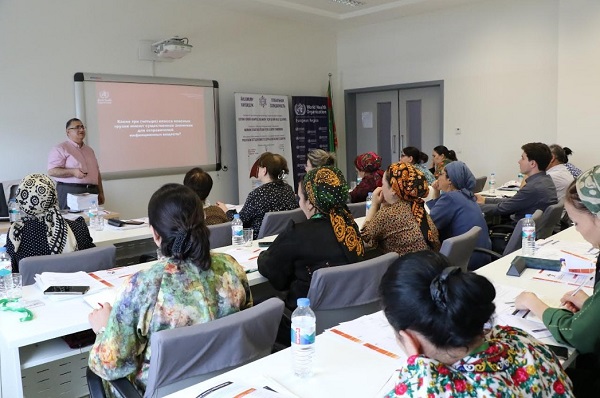
Ashgabat, Turkmenistan, 19–23 May 2026 — Infectious Substances Shipping Training and a workshop on the development of contingency plans for the National Influenza Center (Virology Reference Laboratory of the Center for Public Health and Nutrition) and other relevant human and animal health laboratories are being held in Ashgabat from 19 to 23 May 2026.
The event was organized within the framework of the implementation of the Pandemic Influenza Preparedness (PIP) Framework in Turkmenistan and was hosted at the Center for Public Health and Nutrition with the participation of representatives of the WHO Country Office in Turkmenistan, the Ministry of Health and Medical Industry of Turkmenistan, and national public health and veterinary sector laboratory specialists.
The workshop and training course were designed for key public health laboratory personnel directly involved in emergency preparedness planning and the organization of infectious substance shipments at both national and international levels.
The training aimed to strengthen national capacities in the safe and compliant transport of infectious substances in line with international regulations governing the transport of dangerous goods. The course also focused on establishing a national pool of qualified experts capable of providing mentoring, technical guidance, and operational support related to the shipment of infectious materials within the country.
In parallel, the workshop focused on strengthening laboratory preparedness and operational resilience through the development of contingency plans for the National Influenza Center and other laboratories, which are important requirements of IHR (2005) and requirements for ISO accreditation processes. Participants were introduced to the principles, structure, and key components of emergency action and business continuity planning, including activation mechanisms, role allocation, risk assessment and mitigation, and maintaining essential laboratory functions during emergencies and public health events, as well as the experience of Tajikistan in this area.
The training was conducted using interactive learning methods and included an introductory session outlining the course objectives, program structure, and organizational aspects, followed by dedicated modules on emergency planning and the transportation of infectious substances.
The training course and workshop were facilitated by Dr Karen Nahapetyan, Laboratory Specialist at the WHO Regional Office for Europe, Dr Abdulakhad Safarov, Specialist at the WHO Country Office in Tajikistan and Dr Ayjeren Myratdurdyyeva, Specialist at the WHO Country Office in Turkmenistan.
Upon successful completion of the final examination, participants received internationally recognized certification, enabling them to officially perform the functions of authorized consignors of infectious substances.
By strengthening technical expertise, emergency preparedness, and laboratory continuity planning, the initiative contributes to enhancing national readiness for public health emergencies and supports ongoing efforts to reinforce health security capacities in Turkmenistan in line with international standards. ///nCa, 26 May 2026 (in cooperation with WHO Turkmenistan)