


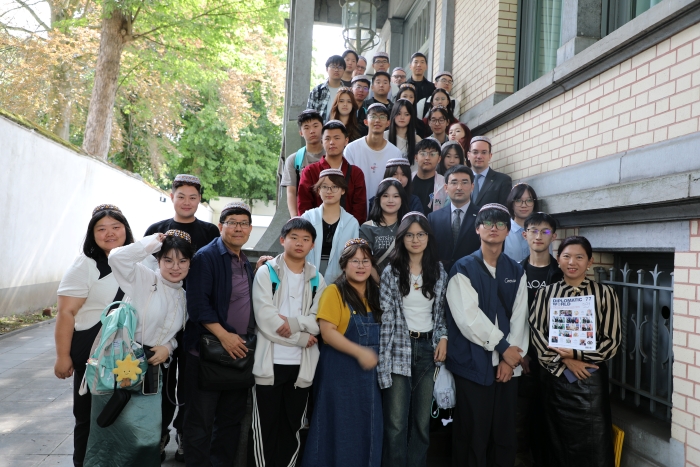
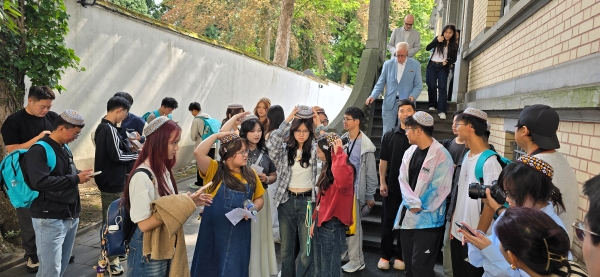
A productive and engaging meeting was held at the Embassy of Turkmenistan in the Kingdom of Belgium with a group of students from the People’s Republic of China. The students were in Brussels as part of a summer educational program organized by the company NMSG BV.
The group of 27 people represented nine different provinces of China, including Yunnan, Jiangsu, Chongqing, and others. It consisted of high school students and first-year university students from leading Chinese educational institutions, such as New Oriental School, Baoshan First High School, Bashu School in Chongqing, Sichuan International Studies University, Hebei University, and Beijing Jiaotong University.
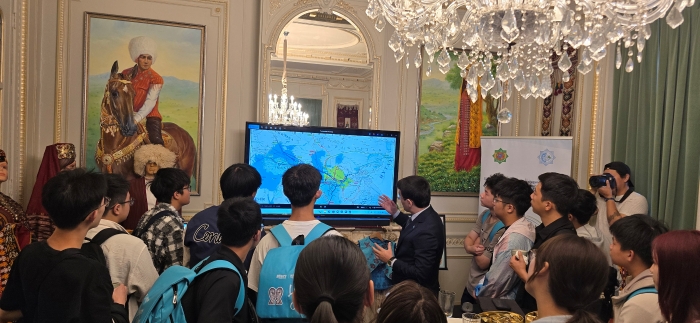
Sapar Palvanov, the Ambassador of Turkmenistan to Belgium and the European Union, warmly greeted the young guests in a relaxed, friendly atmosphere. In his speech, he introduced the students to the fundamentals of Turkmenistan’s foreign policy, emphasizing the central role of its permanent neutrality, which was recognized by the UN in 1995. Special attention was given to Turkmenistan’s current initiatives, including the hosting of the Third UN Conference on Landlocked Developing Countries (LLDC3) in Awaza, as well as the significance of 2025, which has been declared the International Year of Peace and Trust.
The Ambassador spoke about Turkmenistan’s peacekeeping role in the region, its efforts to promote transport diplomacy, and the country’s strategic importance as a link between East and West. He also highlighted modern vectors of partnership with the European Union and the dynamic development of bilateral relations between Turkmenistan and China, which continue to strengthen in all areas, from transport to education.
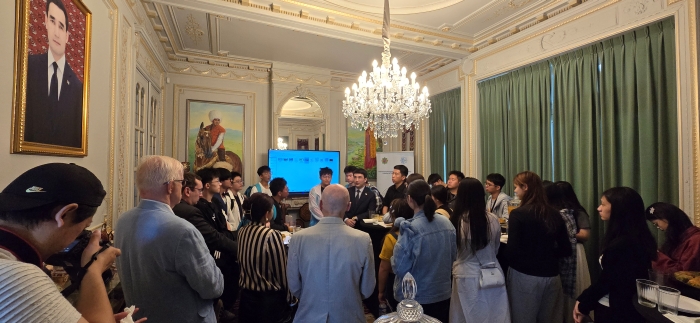
In his speech, Ambassador Palvanov also reminded the students of Turkmenistan’s important role in the history of the Great Silk Road. He explained that caravan routes connecting China and Europe passed through cities like Merv, Amul, Serakhs, and Dehistan. Today, Turkmenistan continues this historical mission, acting as a reliable transit hub in Eurasia. This continuity, the Ambassador stressed, forms the basis of the country’s modern transport diplomacy strategy.
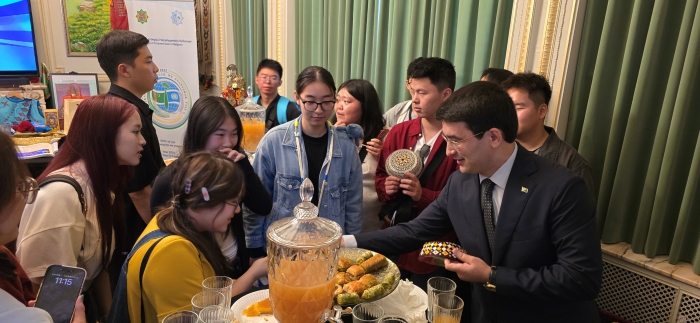
The students showed great interest in a presentation of Turkmenistan’s cultural and historical heritage.
The embassy showcased national products, traditional jewelry, embroidery, and elements of national clothing. The Ambassador personally explained the history and unique features of each item, giving the young guests a deeper connection to the Turkmen cultural code.
A particularly heartwarming moment was the presentation of a traditional Turkmen skullcap—a takhya—to each student as a token of friendship. The students eagerly took photos both inside and outside the embassy and posed for selfies, which demonstrated their genuine interest in and admiration for Turkmen hospitality and culture. The guests were also offered national sweets, which added to the warm and cozy atmosphere of the meeting.
The conversation with the students was lively, with numerous questions asked about diplomacy, international relations, and Turkmenistan’s history and modern life.
The event was an excellent opportunity for the young representatives of China to not only gain valuable knowledge about Turkmenistan but also to experience the atmosphere of public diplomacy. ///nCa, 11 August 2025 (in cooperation with the Embassy of Turkmenistan in Belgium)