


nCa Commentary
For centuries, the world’s largest inland body of water has been less a single geographical certainty and more a mirror reflecting whoever happened to be standing on its shores. Long before modern cartography flattened the globe into standardized labels, the Caspian Sea carried dozens of names across different eras and languages.
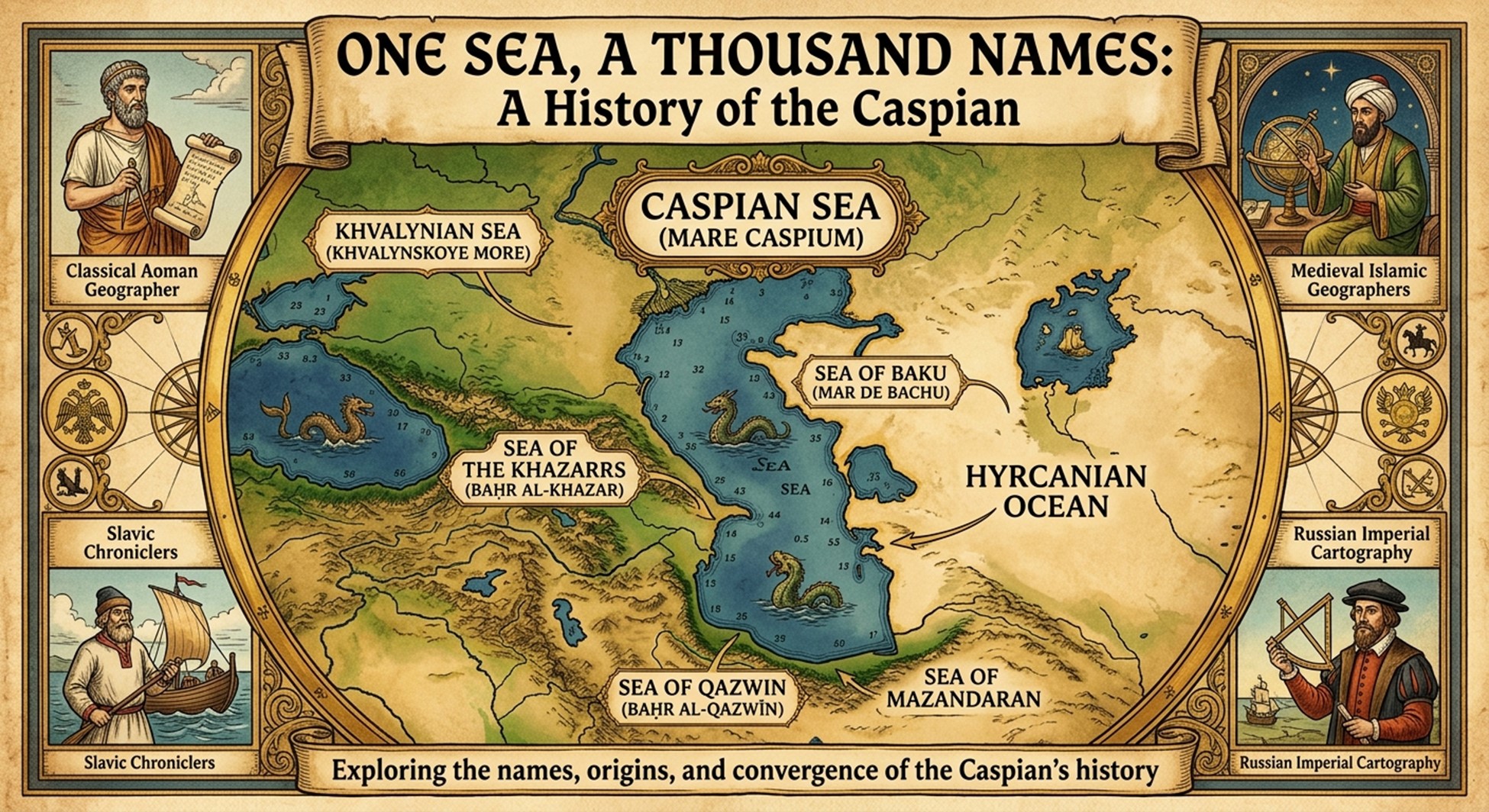
In truth, a traveler sailing from north to south during the Middle Ages might have left one port hearing one name and arrived at another hearing something entirely different, simply because ancient and medieval peoples rarely named a sea after the water itself. Instead, they named it after the gateway cities through which they reached it, the provinces lining its coast, or the dominant tribes who controlled its trade routes.
In the classical Greco-Roman world, the sea was most famously known as the Hyrcanian Ocean. As early as the fifth century BCE, Greek historians and geographers such as Herodotus, and later Strabo and Ptolemy, used both “Caspian” and “Hyrcanian,” often interchangeably or to distinguish different parts of the basin. The name Hyrcania came from the fertile, forested region along the sea’s southeastern shore, an area corresponding roughly to modern-day Golestan in Iran. To Greek writers looking eastward through the lens of the Achaemenid Persian Empire, Hyrcania was the most prominent satrapy bordering the water, making it a natural reference point.
Around the same era, however, another name was taking root that would eventually outlast the rest. The word “Caspian” derives from the Caspi, an ancient people who inhabited the southwestern shores of the sea, particularly in the region of modern Azerbaijan and northwestern Iran. Mentioned by Herodotus as tributaries of the Persian Empire, the Caspi were among the earliest coastal populations encountered by classical observers entering the Caucasus.
Though the Caspi themselves eventually assimilated and vanished from the historical record, their name remained anchored to the water in Greek and Latin scholarship.
As the geopolitical center of gravity shifted during the early Middle Ages, classical names gave way to new realities on the ground. Between the seventh and tenth centuries, the Turkic Khazar Khaganate emerged as a formidable power controlling the northern and western steppes bordering the sea. Consequently, Arab and Persian geographers—such as Al-Masudi, Ibn Hawqal, and Al-Istakhri—began referring to the water as Baḥr al-Khazar, the Sea of the Khazars (Hazar).
Even after the Khazar (Hazar) empire collapsed in the late tenth century, the name proved remarkably durable. It embedded itself deeply into the linguistic fabric of the region and remains the standard designation today in Turkish, Azerbaijani, Turkmen, and in formal Arabic and Persian usage.
At the same time, medieval Islamic cartography maintained a habit of naming seas after the nearest major administrative or commercial staging post, regardless of whether that city actually sat on the coast. This gave rise to Baḥr al-Qazwīn, the Sea of Qazwin. Although Qazwin lies inland south of the Alborz Mountains, it served as the primary military and mercantile gateway for travelers heading north into the coastal provinces of Daylam and Gilan.
Alongside Qazwin, chroniclers and merchants also referred to the water as the Sea of Tabaristan, the Sea of Gilan, the Sea of Abaskun—named after a bustling medieval port near the southeastern corner that was later swallowed by rising water levels—and later the Sea of Mazandaran, a name still widely used inside Iran today.
Further north, Slavic chroniclers viewed the sea through their own trade networks.
In Old Russian texts, such as the twelfth-century Primary Chronicle, the water was called the Khvalynian Sea (Khvalynskoye More). This name came from the Khvalis, the Russian designation for the people of Khwarezm, the great Central Asian oasis civilization south of the Aral Sea. Because Khwarezmian merchants dominated the overland and riverine trade routes connecting the Volga basin with Central Asia, Russian traders naturally associated the sea with the merchants who brought goods across it.
Meanwhile, by the fourteenth and fifteenth centuries, Italian merchants from Genoa and Venice—who established trading colonies in the Black Sea and ventured overland to tap into the silk trade—began labeling it on their portolan charts as Mar de Bachu, the Sea of Baku, recognizing the growing prominence of that western port city.
The gradual consolidation around a single international name—Caspian—was neither sudden nor accidental; it was the byproduct of European cartographic dominance and Russian imperial expansion between the sixteenth and eighteenth centuries. During the Renaissance, European mapmakers rediscovered and translated Ptolemy’s Geography, reviving classical Greco-Roman nomenclature as the scholarly gold standard. Even when travelers like the English merchant Anthony Jenkinson sailed the sea in the 1550s and noted its local names, European maps increasingly defaulted to the classical Latin Mare Caspium.
That scholarly preference became geopolitical reality in the early eighteenth century under Peter the Great. As Russia expanded southward and sought to map and control the trade routes to Persia and Central Asia, Peter commissioned the first modern, scientifically surveyed hydrographic charts of the sea, culminating in the expeditions of Carl van Verden and Fyodor Soymonov between 1719 and 1727.
Because Russian imperial science consciously aligned itself with Western European academic conventions, these landmark maps officially adopted the Latin-derived Kaspiyskoye More (Caspian Sea), discarding the older Khvalynskoye More. When those Russian surveys were presented to the French Royal Academy of Sciences in Paris, they were hailed as a triumph of modern geography and immediately became the master template for every European atlas.
By the nineteenth century, as European mapping standards became the global norm through diplomacy, trade, and colonial administration, “Caspian” settled into universal international consensus, leaving its many older names as fascinating footprints of the empires, merchants, and travelers who once knew it as their own. /// nCa, 13 November 2026