


The Russian-Turkmen Margiana Archaeological Expedition has completed its autumn 2026 season, continuing its study of Gonur-Depe, one of the most important Bronze Age archaeological sites in Central Asia. Research has been conducted both at the ancient settlement and in museums across Turkmenistan, where specialists are cataloguing thousands of artefacts, studying fragments of ancient artworks and uncovering evidence of the diverse economic and cultural life of the people of Margiana.
The expedition’s third and final phase concluded on 30 October. Following several weeks of fieldwork, archaeologists continued their research at the History and Local Lore Museum in Mary and the State Museum of the State Cultural Centre of Turkmenistan in Ashgabat. A key objective of this part of the project is to compile a comprehensive scholarly catalogue of artefacts discovered in the ancient delta of the Murghab River.
Margiana was a historical region that existed during the Bronze Age in what is now Turkmenistan. Its centre was Gonur-Depe, a major archaeological complex that provides evidence of an advanced society with its own traditions of architecture, craftsmanship, trade and artistic expression.
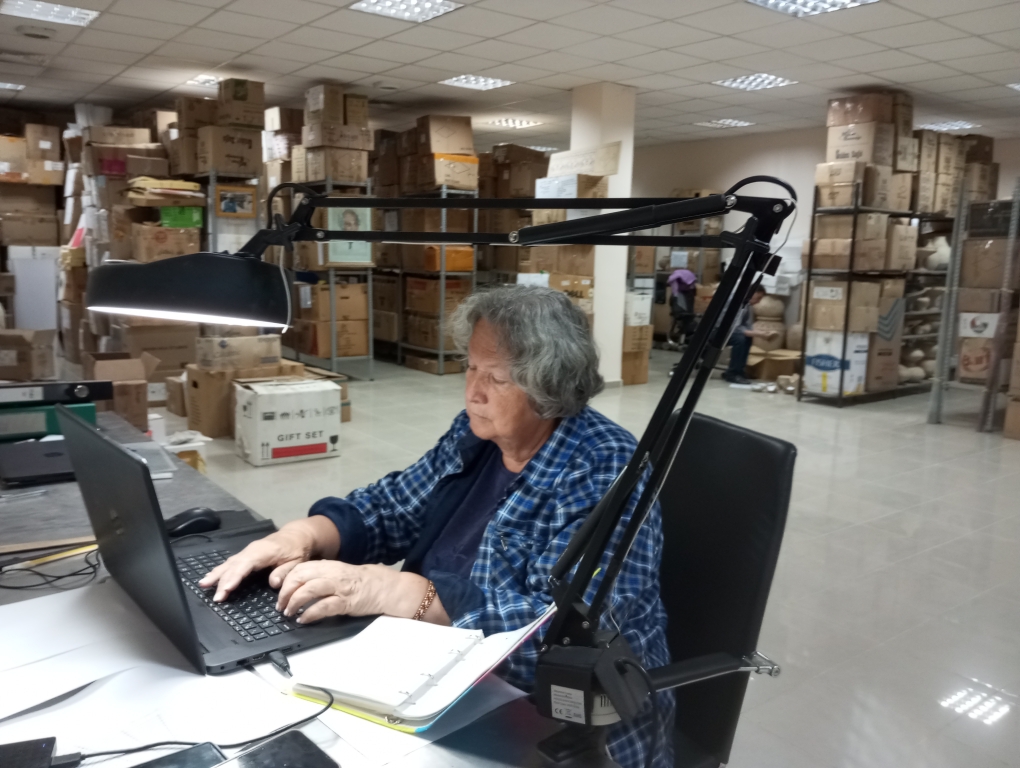
Many objects unearthed during decades of excavations are now being carefully examined in Turkmenistan’s museums. This is one of the expedition’s main tasks. Researchers are documenting stone vessels, stone and bronze finials of staffs, as well as small bottles that may have been used to store cosmetics and other substances. Information on nearly 1,000 such objects has already been entered into a unified database.
The first electronic catalogue, published in 2021, focused on large stone artefacts from Margiana, including miniature columns, discs and sceptres (staffs).
Particular attention was devoted to ceramics during the 2024 and 2026 seasons. At first glance, clay vessels may seem less remarkable than jewelry, weapons or objects made of precious materials. Yet ceramics often provide archaeologists with some of the most comprehensive insights into the everyday life of ancient societies.
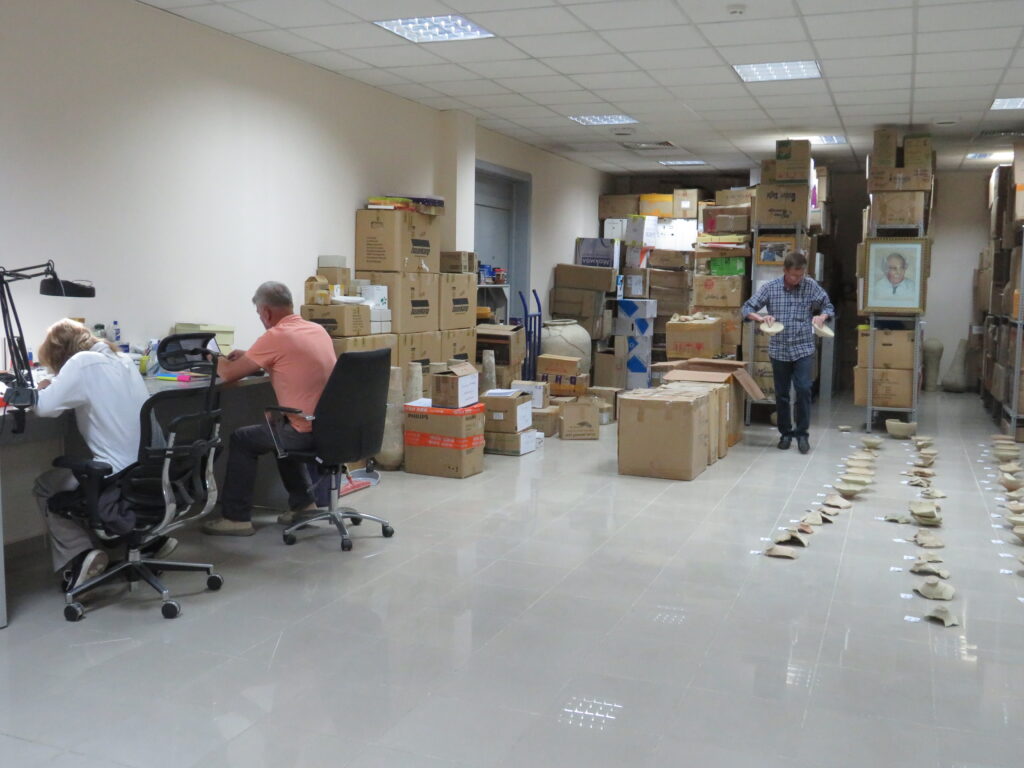
The shape of a vessel, the composition of its clay, the firing technique and its decoration can reveal much about production methods, domestic practices, food traditions and cultural contacts.
The museums in Mary and Ashgabat hold tens of thousands of archaeologically intact ceramic objects. Each item must be documented according to a specific scholarly framework, photographed and drawn.
Looking ahead, the expedition plans to create digital 3D models of unique artefacts and subsequently produce plastic replicas of them.
Another important area of research has been the study of unique mosaics from Gonur-Depe, which continued at the Museum of Fine Arts of Turkmenistan in Ashgabat.
The mosaic compositions have survived only partially, with their elements scattered across thousands of individual fragments. Specialists are gradually investigating the techniques and artistic methods employed by ancient craftsmen.
One particularly remarkable find is a miniature stone hare’s head measuring just two by two centimetres. Despite its tiny size, the artisan managed to capture exceptionally fine details: delicate engraving depicts the animal’s eyelashes, fur on its muzzle and other distinctive features.
According to researchers, this is the first known depiction of a hare discovered in Margiana.
The autumn season also yielded results at the Gonur oasis itself, where research has begun at a new settlement.
The findings have confirmed the diversity of economic activities. Among the materials examined was a partially preserved skull belonging to an equid, probably a kulan (Asiatic wild ass). This is the first find of its kind at Gonur-Depe.
The expedition brings together specialists from the Institute of Ethnology and Anthropology of the Russian Academy of Sciences, the Institute for the History of Material Culture of the Russian Academy of Sciences, and the State Research Institute for Restoration. The research is being conducted in close cooperation with staff from Turkmenistan’s museums, the Ancient Merv State Historical and Cultural Reserve in Bayramaly, and the Department for the Protection, Study and Restoration of Historical and Cultural Monuments of Turkmenistan.
The successful completion of the autumn 2026 season marks another milestone in the long-term study of ancient Margiana. During the expedition’s work in the museums, several hundred artefacts, discovered both during the current research and in previous excavations, were documented and entered into the electronic database.
Archaeological excavations and museum research are scheduled to resume in spring 2027.

Every new discovery — whether a fragment of a ceramic vessel, a piece of mosaic or an animal bone — adds another element to the broader historical picture. Step by step, these individual pieces are helping researchers build a more complete understanding of the people who created a distinctive civilisation along the banks of the ancient Murghab River thousands of years ago. The more closely scholars examine Margiana’s surviving heritage, the more opportunities emerge to understand its place in the history of Central Asia. ///nCa, 12 November 2026 (based on materials from the Institute of Ethnology and Anthropology of the Russian Academy of Sciences)