


Liliya Zhirnova
Standing tall against the arid backdrop of the Kopetdag mountains, the Eldar Pine is one of the most recognizable evergreen features of Ashgabat’s urban landscape.
From wide avenues and public parks to residential courtyards and peripheral green belts, this drought-hardy coniferous tree serves as a vital pillar of Turkmenistan’s urban forestry initiatives.
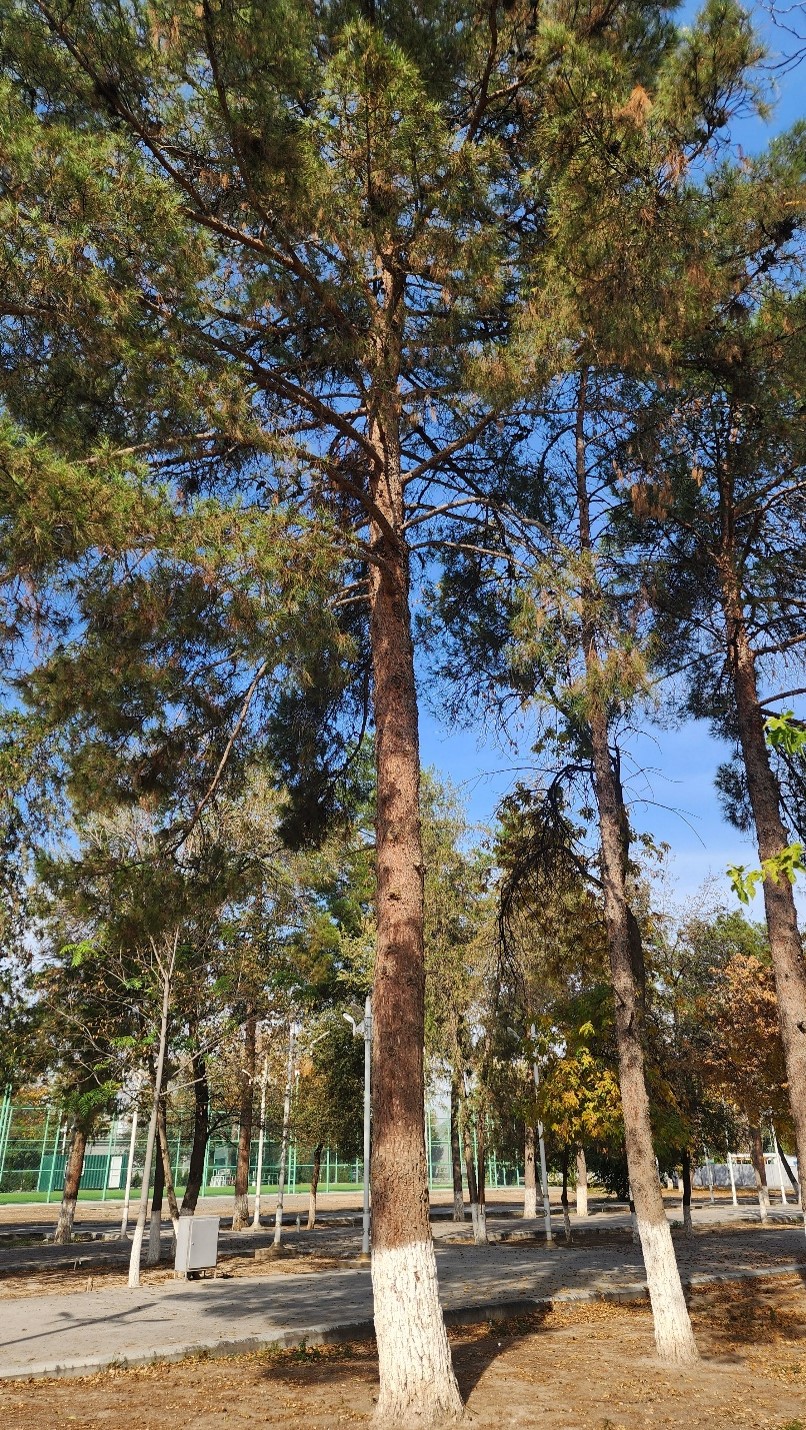
Names & Botanical Classification
- Botanical Name: Pinus eldarica (also classified as Pinus brutia var. eldarica or Pinus brutia subsp. eldarica).
- English Common Names: Eldar Pine, Afghan Pine, Central Asian Pine.
- Russian Name: Сосна эльдарская (Sosna eldarkaya).
- Turkmen Names: Eldar sosnasy (used in botanical and educational contexts) or classically Şenuber / Arça (broadly used in literature and vernacular speech for pine and juniper conifers).
Botanical Identification & Physical Characteristics
The Eldar Pine is an evergreen conifer capable of reaching heights of 15 to 20 meters.
- Trunk & Bark: It forms a straight central trunk clad in thick, reddish-brown to dark gray bark that becomes deeply furrowed with age.
- Needles & Cones: The needles (pür) grow in pairs, measuring roughly 10–12 cm long with a dark green hue. Its oval cones (goza) mature in their second year, housing small winged seeds.
- Trunk Whitewashing: The distinct white coating seen on the lower trunk in urban settings is a traditional horticultural application of lime wash. This practice shields the bark from winter frost cracking, sunscald caused by intense sunlight reflecting off surrounding pavement, and burrowing insect pests.
Ecological & Urban Benefits
The widespread introduction of the Eldar Pine across Ashgabat offers critical environmental services tailor-made for semi-arid continental climates:
- Extreme Drought & Heat Tolerance: Naturally adapted to xerothermic conditions, the Eldar Pine thrives in intense summer heat and requires minimal irrigation once established.
- Soil Versatility & Alkalinity Resistance: It adapts well to poor, dry, saline, or highly alkaline clay soils that would stress most other tree species.
- Dust Trapping & Air Purification: With dense foliage that remains green year-round, it acts as a mechanical filter, trapping airborne dust and micro-particles carried by desert winds.
- Windbreak & Soil Stabilization: Planted extensively along urban margins and hill slopes, its strong root system anchors fragile soils, reduces dust storm impacts, and combats land degradation.
- Urban Microclimate Moderation: Large canopy stands lower ground surface temperatures, offer dense shade, and release natural resins (terpenes) that enrich the surrounding urban air.
Cultural & Historical Significance in Ashgabat
Originally endemic to a tiny naturally occurring habitat on the Eldar-Oyughu ridge in the Caucasus, the Eldar Pine was recognized by 19th- and 20th-century botanists as an ideal species for greening arid landscapes across Central Asia.
In Ashgabat, greening efforts incorporating conifers date back to the late 19th century. Today, specimen Eldar Pines stand throughout the capital—including historical specimens in older neighborhoods such as Keoshi—serving as living monuments to the region’s enduring landscape architecture. /// nCa, 11 November 2026