


nCa Report
Part I: Understanding the Sponge City Concept
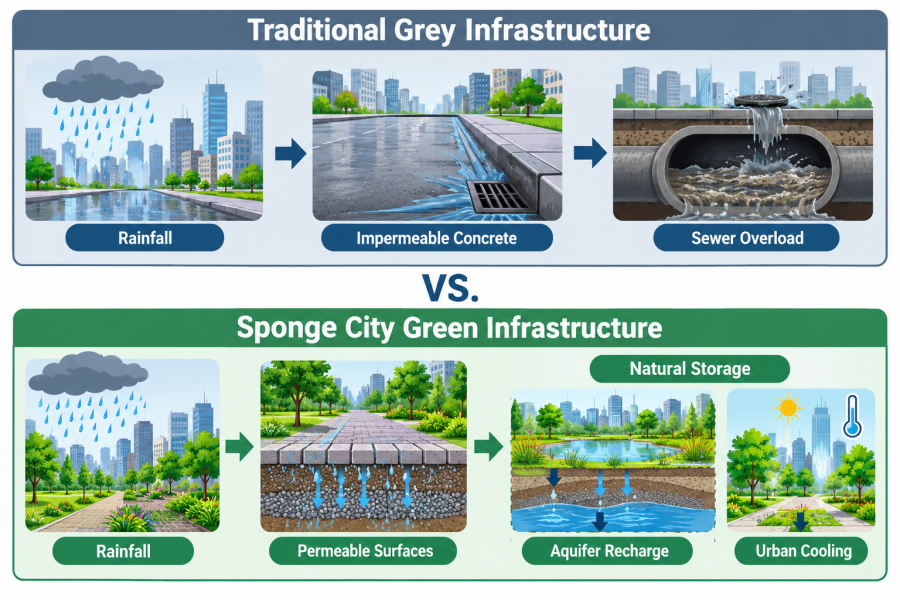
As climate change accelerates the frequency of extreme weather events, traditional urban infrastructure—often termed “grey infrastructure”—is failing. Densely paved cities act as giant funnels, forcing heavy rainwater into concrete channels and storm sewers that quickly become overwhelmed, leading to catastrophic urban flooding.
The sponge city model represents a paradigm shift from fighting water to working with it. Coined by landscape architect Kongjian Yu in 2003 and adopted as a national framework in China by 2013, this nature-based urban planning strategy replaces impermeable concrete with ecologically managed, absorbent landscapes.
A sponge city mimics the natural hydrological cycle by capturing, slowing down, filtering, and storing rainwater where it falls. Rather than rushing stormwater away, the city retains it to recharge groundwater tables, alleviate the urban heat island effect, and provide local water security during droughts.
Core Mechanisms of a Sponge City
- Permeable Pavements: Replacing standard asphalt with porous surfaces allows rainwater to directly infiltrate the soil.
- Bio-Retention Cells and Bioswales: Vegetated ditches and rain gardens channel runoff, naturally filtering out urban pollutants before the water sinks into the ground.
- Green Roofs and Walls: Living vegetation on buildings captures initial rainfall, reducing the volume of water hitting street level.
- Urban Wetlands and Floodplains: Restored natural areas act as massive temporary reservoirs during heavy storms, doubling as biodiverse public parks in dry seasons.
Global Success Stories
Several cities worldwide serve as benchmarks for this model:
Wuhan, China: Once dubbed the “city of a hundred lakes,” rapid paving left Wuhan highly vulnerable to flooding. As part of China’s multibillion-dollar Sponge City initiative, Wuhan converted concrete riverfronts into massive ecological corridors, such as the Yangtze River Beach Park, which absorbs seasonal floodwaters while creating vibrant public green spaces.
Rotterdam, Netherlands: Facing severe sea-level rise, Rotterdam integrated urban water squares (like the Benthemplein Water Square). These function as skateparks and sports arenas during dry spells but transform into temporary retention basins during torrential rains.
Shenzhen, China: Paved heavily during its rapid rise, Shenzhen aggressively integrated low-impact development. It has mandated thousands of small-scale eco-features, transforming the city’s green grid to filter and retain over 70% of local stormwater.
Part II: Potential and Movement in Central Asia
Central Asia—comprising Kazakhstan, Uzbekistan, Kyrgyzstan, Tajikistan, and Turkmenistan—faces a dual climate crisis. The region is highly vulnerable to rapid glacial melt, altering river flows and triggering flash floods in mountainous regions, while simultaneously suffering from extreme summer heat waves and severe desertification. The sponge city concept holds immense potential here, offering a holistic method to capture volatile seasonal downpours and safeguard scarce water resources.
The Imperative for Central Asian Implementation
Historically, Soviet urban design in Central Asian hubs relied on uniform, hard-engineered drainage and canals. Over the last few decades, rapid, unregulated development has systematically eliminated urban green spaces.
For example, Bishkek, Kyrgyzstan, has seen a colossal loss of its historic park systems and micro-canals (aryks) since the Soviet era. When intense, short-duration cloudbursts strike these degraded urban grids, flash flooding paralyses the streets. Conversely, in the dry summer months, the lack of vegetation exacerbates dangerous urban heat island effects. Implementing sponge city techniques would allow Central Asian capitals to catch unpredictable mountain runoff, store it safely in urban aquifers, and reuse it during arid summer stretches.
Initial Movements and Progress
While comprehensive state-mandated sponge city programs are not yet fully institutionalised like those in East Asia, notable shifts toward climate-resilient urban design are emerging across Central Asia:
| Location | Current Initiatives & Strategic Movement |
| Bishkek, Kyrgyzstan | The municipality has introduced the Bishkek Green Cities Action Plan with backing from international lenders. The framework explicitly acknowledges the need to revive public green spaces and build out climate resilience. Ground-level civil groups, such as the El-Too Foundation, are actively advocating for community-led permaculture and urban water conservation practices. |
| Almaty, Kazakhstan | Due to its location at the foot of the Trans-Ili Alatau mountains, Almaty is highly exposed to mudslides and flash floods. The city is progressively investing in riverbank restoration, urban reforestation, and upgrading its old aryk canal network to act as a natural drainage system. |
| Tashkent, Uzbekistan | Following major infrastructure stress from seasonal downpours, Uzbek planners are shifting toward integrating nature-based solutions into the “New Tashkent” expansion plan. This includes creating extensive artificial lakes, green corridors, and parklands designed to mitigate intense heat and handle sudden stormwater surges. |
Challenges to Overcome
Transitioning to sponge city layouts in Central Asia involves several structural hurdles:
- Funding Gaps: Ecological infrastructure requires significant upfront investment, competing directly with immediate priorities like repairing aging roads, heating grids, and electric lines.
- Exogenous Knowledge vs. Local Climate: Central Asia’s arid and semi-arid climate differs significantly from the monsoon-heavy regions of Southeast China where the model was modernised. Planners must adapt sponge city principles to focus heavily on water preservation, winter freeze cycles, and drought-tolerant landscaping (xeriscaping) rather than just flood drainage.
- Regulatory Inertia: Bureaucracy and a historical preference for hard concrete engineering continue to slow down the adoption of flexible, nature-based architectural codes.
Central Asian states are beginning to recognise that grey infrastructure alone cannot withstand intensifying climate shocks. Developing an interconnected grid of miniature green spaces, permeable walkways, and restored natural waterways may prove essential to keeping these expanding urban centres livable in the decades ahead. /// nCa, 29 September 2026