


nCa Report
A single truck journey completed this month has quietly signalled one of the more consequential shifts in global freight logistics.
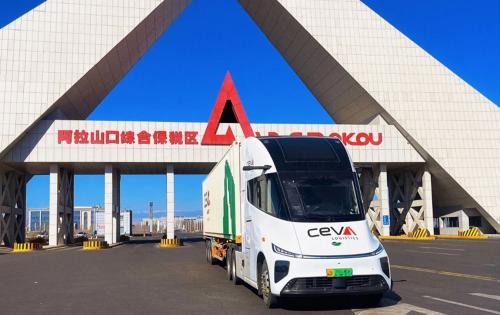
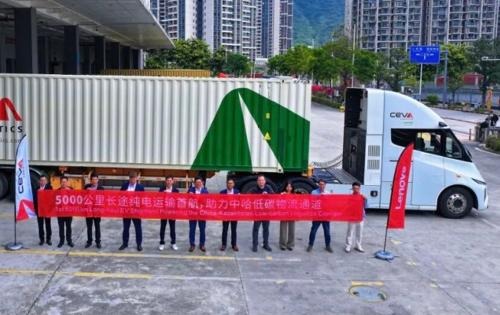
CEVA Logistics, in partnership with tech giant Lenovo and electric truck maker Windrose, drove a heavy-duty electric vehicle from Shenzhen — on China’s southern coast — all the way to Alashankou on the Kazakhstan border: a journey of 5,000 kilometres across the full breadth of the world’s most populous country.
At the border, the cargo was transferred to a diesel vehicle for the remaining stretch to Almaty. Total distance: nearly 6,000 kilometres. Total CO₂ reduction versus a conventional all-diesel run: 46 per cent. Total time, door to door: six days.
The headline numbers are striking on their own. But the real significance lies in what they point toward: a nascent low-carbon freight corridor between China and Central Asia that, if scaled, could transform one of the world’s most strategically important trade routes.
What Is the Low-Carbon China–Central Asia Corridor?
The concept is straightforward in principle and deceptively complex in execution. The idea is to run freight between Chinese manufacturing centres and Central Asian markets — primarily Kazakhstan, but with ambitions reaching into Uzbekistan, Kyrgyzstan, and beyond — using the cleanest available technology for each segment of the journey.
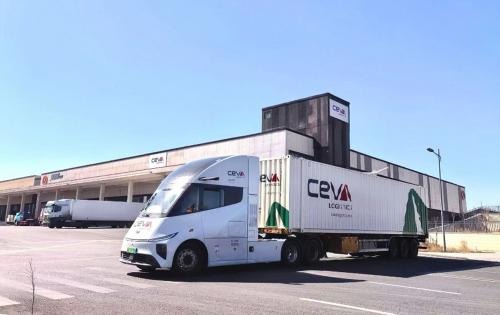
At present, this is a ‘hybrid’ model. The Chinese domestic leg, which accounts for the bulk of the distance, uses electric heavy-duty trucks. These vehicles run on Windrose’s purpose-built long-haul EV platform, which achieves roughly 700 kilometres on a single charge and is capable of sustaining over 1,000 kilometres of progress per day when combined with fast-charging stops.
The cross-border and Central Asian segments, where charging infrastructure does not yet exist at the required density, currently use conventional diesel.
This half-and-half structure — electric on the China side, diesel on the international leg — is not a compromise born of ambition falling short of reality. It is a deliberate, phased architecture that uses the infrastructure that exists today while building toward something more comprehensive tomorrow.
CEVA calls it a ‘synchronised’ solution: domestic electric trucking, rapid customs clearance at the border, and a seamless hand-off to international diesel fleets. The combination is what allows a door-to-door journey of nearly 6,000 kilometres to be completed in six days with a 46 per cent reduction in carbon emissions.
The Physical Infrastructure Behind It
The China leg of this corridor runs along the G30 highway — one of the country’s great east-west arteries — from Shenzhen in Guangdong province to Alashankou in Xinjiang, tracing a route that cuts across more than a dozen provinces. The 5,000-kilometre journey was completed in just 4.5 days, supported by nine strategic charging stops. These stops were not improvised: China has spent years building out a dense fast-charging and battery-swapping network for heavy commercial vehicles, and that infrastructure is now mature enough to sustain long-haul runs of this magnitude.
At the border, CEVA’s Alashankou International Road Transport (TIR) Centre plays a critical role. The TIR — Transports Internationaux Routiers — is a UN customs transit system that allows sealed cargo to cross multiple borders under a single customs document, eliminating the need for repeated inspections and dramatically cutting dwell times. Efficient border procedures were specifically cited as a key factor in the pilot’s success: without streamlined customs, the six-day total transit time would have been impossible.
Beyond the border, the broader corridor into which this pilot feeds is the Trans-Caspian International Transport Route — commonly called the Middle Corridor — a multimodal freight network stretching from Chinese ports through Kazakhstan and/or Turkmenistan, across the Caspian Sea, and onward through Azerbaijan, Georgia, and Turkey into Europe.
This corridor has seen explosive growth since the Ukraine war in 2022 redirected much of Eurasian freight traffic away from Russian territory. Transit times from China to Europe via this route have dropped from 38–53 days to around 18–23 days. Cargo volumes on the China–Kazakhstan leg alone have grown dramatically: more than 27,000 twenty-foot equivalent container units moved through the route in 2024, a twenty-five-fold increase over 2023.
Can It Scale Quickly, or Is This Just an Experiment?
The honest answer is: it is genuinely both, and the distinction matters less than it might seem.
Every major logistics revolution begins with pilots. What separates a pilot that leads somewhere from one that does not is whether the underlying conditions for scaling already exist — or can be created within a realistic timeframe.
On the Chinese side, the conditions are already substantially in place. New-energy vehicles accounted for 29 per cent of all domestic truck sales in China in 2025, up from 14 per cent the year before, according to market intelligence provider Commercial Vehicle World.
China’s fast-charging and battery-swapping infrastructure for heavy trucks has reached the point where, as one expert put it, ‘if the infrastructure is there, the economics are there for an increasing number of logistics routes.’ The economics of electric trucking in China are now clearly superior to diesel on an increasing number of routes. Windrose, whose trucks powered this pilot, has plans to scale from 1,000 units produced this year to 10,000 next year and 100,000 by 2030.
CEVA itself is not treating this as a one-off. The company has already conducted multiple electric truck pilots: a round-trip from Guangdong to the Chinese-Vietnamese border at Pingxiang; a test run in Spain between Algeciras and Madrid; and trials across 16 of the world’s top 40 highway corridors via the Windrose fleet.
The strategic roadmap is explicit — CEVA aims to use the TIR network to establish electric freight connectivity across Southeast Asia, Central Asia, and potentially Europe. The company plans to deploy 1,450 low-carbon vehicles in its ground operations, including over 650 battery-electric trucks globally.
The Central Asian and cross-border sections are more constrained. Charging infrastructure in Kazakhstan and neighbouring states does not yet support fully electric long-haul operations, and the regulatory and technical standards for electric heavy-vehicles differ across jurisdictions. But this is a known gap, not an insurmountable one — and it is being actively addressed by multiple stakeholders with significant resources.
The Latent Potential
The scale of what this corridor could eventually carry is substantial. China’s trade with Kazakhstan alone reached $39.8 billion in 2025, up from $36.5 billion the year before. Trade with Kyrgyzstan grew from $17.4 billion to $23.6 billion over the same period.
The broader China–Central Asia corridor is a critical link in a trade system that, by 2025, involves cumulative Chinese investment in the region of $35.9 billion — a 1.5-fold increase since 2020.
The Middle Corridor as a whole is on a trajectory toward handling 11 million tonnes of freight annually by 2030, according to World Bank projections. The China–Europe Railway Express, which shares much of this corridor’s infrastructure, saw container volumes grow by 15 per cent in the first half of 2025 alone. China and Kazakhstan are the anchor economies of this system, but the corridor increasingly serves as a conduit for the entire landlocked interior of Eurasia.
What the electric-truck pilot adds to this picture is not merely a greener version of existing logistics. It potentially changes the economics of the corridor in ways that could accelerate adoption. Electric operation on the China leg reduces fuel costs significantly — diesel is expensive and price-volatile, while electricity in China is cheap and stable. Lower per-kilometre operating costs make the corridor more competitive against maritime alternatives and against air freight for time-sensitive high-value goods like the electronics Lenovo was shipping.
And for multinational companies with Science-Based Targets and net-zero commitments, the ability to document a 46 per cent reduction in supply-chain emissions for a key freight corridor is not a marketing footnote — it is a material business advantage.
Investment, Technology, and New Methods Required
Scaling this corridor to its full potential will require meaningful investment and the introduction of new operational approaches — though the picture is less daunting than it might appear from first principles.
On the vehicle side, the technology already exists and is being rapidly commercialized.
Windrose’s current trucks achieve roughly 700 kilometres on a single charge, with a third-generation platform targeting 800 kilometres by 2027. Peak charging capability of 870 kW already allows 360 kilometres of additional range to be added in 36 minutes. These are not laboratory specifications — they have been demonstrated in real-world long-haul operations across multiple continents. The capital cost of electric heavy-trucks remains higher than diesel equivalents, but this premium is narrowing as production volumes increase, and lifetime total cost of ownership already favours electric on many Chinese routes.
The more significant investment requirement is infrastructure — specifically charging stations and battery-swap points along the Central Asian legs of the corridor. Kazakhstan and its neighbours have limited existing fast-charging infrastructure for heavy vehicles, and extending the fully-electric segment beyond the Chinese border will require coordinated deployment across multiple jurisdictions. This is not purely a private sector decision: it requires government policy, cross-border standards harmonisation, and potentially multilateral financing.
There is appetite for this investment. China’s BRI has already channelled $35.9 billion in cumulative investment into Central Asia, with over 65 per cent of new BRI projects now in renewable energy and guided by Green Investment Principles. Kazakhstan itself announced $26.7 billion in new industrial investment across 17 projects in 2025.
The Middle Corridor’s expansion has attracted investment from Azerbaijan, Georgia, the EU, and UK sovereign bond markets. The electrification of the corridor’s road freight component is a natural next step in this investment thesis — one that aligns decarbonization goals with economic development objectives.
Operationally, new methods are already being validated through the pilot programme. The key innovation is not any single technology but the system design: the synchronisation of domestic electric trucking, TIR customs facilitation, GPS-based real-time monitoring, and a structured hand-off protocol at the border. This is logistics engineering as much as it is green technology, and it is demonstrably replicable.
Do the Benefits Outweigh the Costs?
The case for building out this corridor is compelling across multiple dimensions, and the balance of costs and benefits tilts strongly positive — with the important caveat that the magnitude of benefit depends heavily on how quickly the Central Asian charging infrastructure is deployed.
On the climate side, the numbers speak clearly. A 46 per cent reduction in CO₂ emissions, achieved without any change in transit time or cargo capacity, is a material improvement. Earlier pilot data using the well-to-wheels methodology put average emission reductions at 55 per cent. If these figures are replicated across the volume of freight the corridor is projected to handle — tens of millions of tonnes per year by 2030 — the cumulative impact is significant at a regional and global scale.
Road freight is a major source of greenhouse gas emissions globally, and the China–Central Asia corridor is one of the fastest-growing freight routes in the world. Decarbonizing it early, while volumes are still expanding, locks in lower emissions trajectories before high-carbon habits become entrenched.
On the economic side, the pilot demonstrated that door-to-door delivery across nearly 6,000 kilometres can be completed in six days — competitive with, and in some cases faster than, existing diesel-based operations, thanks to streamlined border procedures. Lower fuel costs on the electric segment improve margins for logistics providers, potentially making the corridor more attractive for a wider range of cargo types. For Central Asian economies, a more reliable, lower-cost, and cleaner freight corridor supports export competitiveness and supply chain integration with both Chinese and European markets.
The costs are real but not prohibitive. The upfront capital requirement for extending charging infrastructure into Central Asia is the largest variable, and it will require public-private coordination rather than purely commercial investment. The transition period — during which the hybrid electric-diesel model is the only viable option — involves some operational complexity. And there are competitive and geopolitical dimensions: the corridor’s growth comes partly at the expense of Russian transit routes, which creates friction with Moscow and some of the regional bodies it dominates.
But the trend lines are clear. The underlying economics of electric trucking are already superior and improving. The freight volumes flowing through the corridor are growing rapidly. The political and commercial constituencies in favour of developing the Middle Corridor — governments, multilateral institutions, major logistics companies, and multinational shippers — are broad and increasingly well-resourced. And the technology risks have been substantially de-risked by pilots like the CEVA–Lenovo operation.
A Corridor Whose Time Is Coming
The low-carbon China–Central Asia freight corridor is not yet a finished product. It is a proof of concept that has been demonstrated convincingly at scale, supported by a rapidly maturing technology ecosystem, embedded in a broader trade infrastructure that is growing faster than almost any comparable corridor in the world, and backed by an investment community that sees economic and strategic value in its development.
The half-electric, half-diesel structure of today’s operations reflects practical constraints, not a ceiling on ambition. As charging infrastructure extends beyond the Chinese border and as the next generation of electric heavy trucks extends their range further, the proportion of the journey covered by zero-emission vehicles will grow. The goal — a fully low-carbon corridor connecting China’s manufacturing heartland to the markets of Central Asia and, ultimately, Europe — is achievable within this decade if the investment and policy conditions are aligned.
What the CEVA–Lenovo pilot has done is demonstrate that the journey has already begun — and that it can be completed six days at a time. /// nCa, 30 April 2026