


Tariq Saeedi
Water has a habit of slipping off the global agenda. It lacks the drama of energy geopolitics or the headline pull of climate summits, and it rarely commands the kind of sustained political attention that its importance warrants.
That is precisely what makes the conference series hosted by Tajikistan in Dushanbe worth examining — not because it has solved the world’s water problems, but because it has quietly refused to let the world forget them.
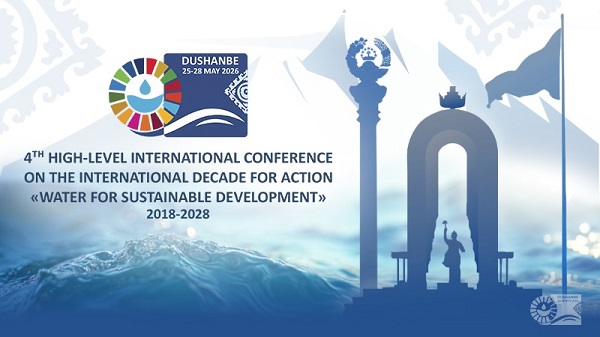
The fourth gathering in this series takes place in May 2026, under the auspices of the International Decade for Action “Water for Sustainable Development.”
Looking back at nearly a decade of these meetings, there is a real story to tell about how a diplomatic initiative can mature into something structurally meaningful — if you know what to look for.
When the first conference convened in 2018, the most important outcome was not a project list or a funding pledge. It was the establishment of a recurring forum with genuine institutional anchoring — one that fed directly into UN-Water processes and the High-Level Political Forum on Sustainable Development. That may sound procedural, but it mattered. It gave water a seat at the table in global policy cycles where it had often been crowded out by louder agenda items.
By 2022, the second conference had shifted gears. The Dushanbe Declaration and its accompanying thematic tracks began moving from aspiration to structure — national water roadmaps, global data systems, the integration of climate risk into water planning. These deliberations fed directly into the 2023 UN Water Conference in New York, which produced the Water Action Agenda: a repository of over 800 voluntary commitments from governments, development banks, and private actors. That is a tangible output, even if voluntary commitments are only as good as the will to honour them.
The 2024 conference reflected a further evolution. There were fewer grand declarations and more hard questions: what has actually been implemented, where are the gaps, and who is accountable? This shift from rhetoric to review is a sign of a process growing up.
None of this should be overstated. Progress toward Sustainable Development Goal 6 — universal access to clean water and sanitation — remains badly off track in many parts of the world. The commitments gathered under the Water Action Agenda vary enormously in ambition and execution. Accountability mechanisms are still underdeveloped. And the broader context — economic pressure, climate shocks, shifting political priorities — can disrupt even the best-laid plans.
But the direction of travel is, on balance, encouraging. And that is the frame through which the upcoming Dushanbe conference should be understood.
This is not a moment for a new big idea. It is a consolidation point — a chance to channel conclusions into the next UN Water Conference, to layer new commitments onto existing ones, and above all, to press harder on implementation. The question the 2026 gathering should be asking is deceptively simple: what is actually getting built, and where is the money coming from?
On this front, there is both unfinished business and genuine opportunity. The link between water security and climate resilience has never been more evident, particularly in regions grappling with droughts, floods, and retreating glaciers. The connections to food systems, energy production, and urban growth are equally compelling, and still too rarely addressed in an integrated way. The Dushanbe platform, with its broad mix of stakeholders, is well placed to push for more joined-up thinking across these domains.
At the national level, the priority should be converting high-level pledges into funded, time-bound programmes with transparent monitoring.
At the international level, development banks and bilateral partners could do more to scale blended finance models and close the persistent gap in water infrastructure investment. The private sector, increasingly present in these conversations, has real contributions to make — particularly in water reuse technology and digital monitoring — provided the incentive structures are right.
Regional cooperation in shared river basins remains one of the more difficult but consequential frontiers. Transboundary water management is inherently political, but collaborative frameworks can reduce tensions while improving the resilience of the resource itself. And local communities — the people actually living downstream of these decisions — need to be closer to the centre of accountability, not treated as passive beneficiaries.
The Dushanbe process will not, on its own, deliver clean water to the 700 million people who still lack it. That depends on national governments, financing institutions, and a global community willing to match ambition with resources. What the process can do — and has done — is maintain the pressure, sustain the connections, and ensure that when water does reach the top of the agenda, there is a coherent framework ready to absorb the momentum.
That is, in the end, no small thing. Keeping a technically complex, politically awkward issue on the global radar across nearly a decade of competing crises is itself an achievement.
The test of May 2026 will be whether it can take the next step: from a platform that convenes, to one that genuinely drives delivery. /// nCa, 30 April 2026