


Shirin Karryeva, Technical Advisor to the CXLs project
On 16 July 2025, a hybrid meeting was held at the Ministry of Environmental Protection of Turkmenistan in collaboration with representatives of the Michael Succow Foundation for Nature Protection (Germany), Conservation X Labs (USA), the Slovak Speleological Society, the Ministry of Ecology, Environmental Protection and Climate Change of the Republic of Uzbekistan, the Surkhan State Nature Reserve of Uzbekistan, the Secretariat of the National Commission of Turkmenistan for UNESCO, the National Institute of Deserts, Flora and Fauna, and national experts serving as implementers of the Conservation X Labs project.
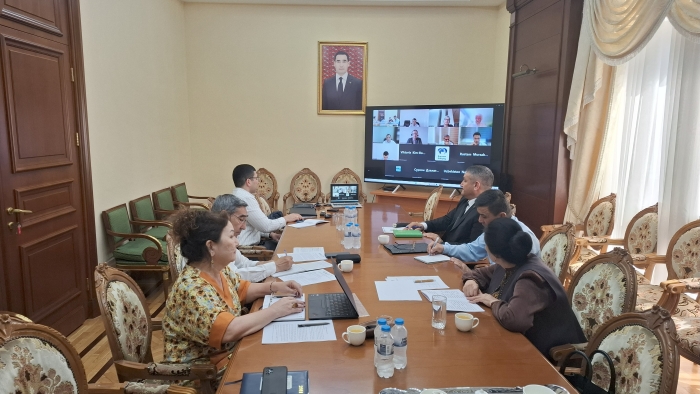
The meeting focused on advancing the nomination of the Koytendag and Surkhan State Nature Reserves as a single transboundary UNESCO World Natural Heritage Site. Turkmenistan considers the inclusion of the Koytendag Nature Reserve on the UNESCO World Natural Heritage List a national priority, with dedicated efforts underway over several years. The Koytendag Mountain Ecosystem dossier was first developed and submitted to the UNESCO World Heritage Centre in 2015. Following a technical review by experts from the International Union for Conservation of Nature, it was recommended that a joint nomination be prepared in collaboration with the Surkhan Nature Reserve of Uzbekistan, in order to ensure the integrity of the entire Kugitang mountain ecosystem.

The meeting discussed a Declaration of Intent for joint cooperation, a Roadmap, and agreed upon criteria for the vii, viii, and x of the Convention of the World Heritage Site, according to which the site will be described.
They also discussed the text of the Tentative List under the new name “Karsts, Caves and Canyons of the Kugitang Range” and agreed on the next steps to submit it to the UNESCO World Heritage Center. Despite the fact that the Kugitang mountain range is divided by an international border along a mountain range and watershed, the landscape is geographically and ecologically integral and represents a variety of karst phenomena, including labyrinths of caves and countless canyons of exceptional geological, geomorphological, aesthetic and ecological value. Thanks to the cross-border approach, the diversity of the most pristine caves, canyons and mountain ecosystems with their unique flora and fauna will be represented by the best examples in the two countries.


The proposed site is distinguished by towering mountain ranges segmented by deep canyons—many exceeding 100 meters in depth—and a complex karst landscape featuring over 300 caves, mines, and sinkholes formed through the erosion of Jurassic limestone.
This extensive cave system showcases an extraordinary variety of geological formations of striking beauty, regarded as among the most significant in Eurasia. Moreover, the mountain range illustrates key periods of Earth’s geological history—from the Precambrian to the Cenozoic era—and contains fossil remains, including globally important dinosaur footprints.

In recent years, through projects supported by various foundations and international organizations, a series of joint scientific expeditions have yielded new data on the biodiversity of the Koytendag Nature Reserve. Although research remains incomplete, the Reserve’s flora and fauna are notable for their exceptional diversity, encompassing a wide range of species—including threatened taxa listed in national and international “Red Books,” as well as regionally endemic species of high conservation value. Koytendag is a home for the westernmost and most isolated population of the markhur, or screw-horned goat, whose global distribution is extremely limited. The presence of a stable population in this area is therefore crucial for its worldwide conservation. Additionally, the mountainous terrain supports a transboundary population of Bukhara urial (mountain sheep).

The region is home to such endangered bird species as the Saker falcon, vulture, steppe eagle, black vulture, bearded eagle and others included in the Red List of the International Union for Conservation of Nature under various categories.

The ichthyofauna is represented by a unique endemic cave fish, the Koytendag blind char.


The region is characterized by Central Asian fauna and flora with a significant proportion of wide and narrow endemics and red Book elements concentrated in a relatively small area, which forms an exceptional biodiversity of the mountain range and state nature reserves, exceeding the diversity of the surrounding semi-desert and mountainous regions.
National experts will continue to work on the preparation of a transboundary nomination together with international consultants from the M. Succow Foundation and Uzbekistan’s specialists, taking into account the new requirements of the UNESCO World Heritage Convention. ///nCa, 18 July 2025 (photo credit – Shaniyaz Mengliyev and Islam Annamamedov)