


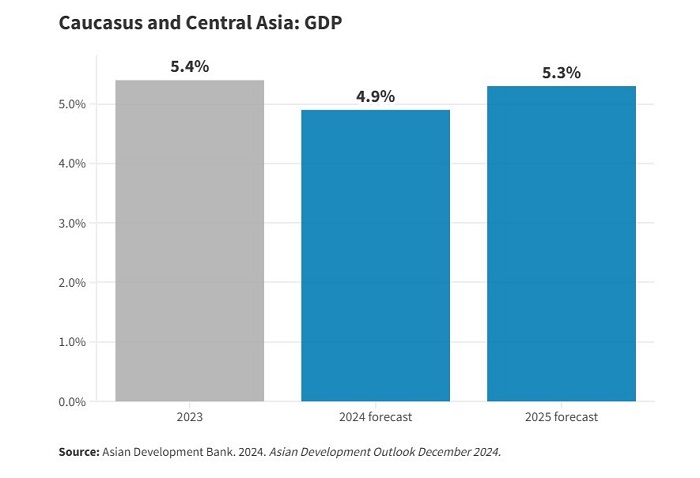
The growth projection for the Caucasus and Central Asia is revised by the Asian Development Bank (ADB) upward to 4.9% from 4.7% for 2024 and to 5.3% from 5.2% for 2025, according the latest edition of the Bank’s Asian Development Outlook (ADO), released on 11 December.
The adjustment reflects robust growth in Azerbaijan, Georgia, Tajikistan, and Uzbekistan to date, higher than expected in ADO September 2024.
Driven by the nonhydrocarbon sectors supported by public investment, Azerbaijan’s economy expanded 4.7% in the first 3 quarters of 2024. In the same period, GDP growth in Georgia reached 9.8%, due to strong consumption supported by credit and salary growth, as well as public spending on infrastructure.
With strong remittances and gold exports, Tajikistan’s economy grew 8.4%. With a surge of fixed investment, Uzbekistan’s grew 6.6% in the first 9 months of 2024.
The growth outlook remains unchanged for Armenia, Kazakhstan, the Kyrgyz Republic, and Turkmenistan.
GDP growth in Kazakhstan, the subregion’s largest economy, was 4.0% in January-September 2024. Among major sectors of the economy, agriculture recovered to grow 11.4%, thanks to favorable weather, after contracting 9.9% in the same period a year earlier.
In the first 9 months of 2024, Kazakhstan’s oil production declined marginally over the same period in 2023.
The Caucasus and Central Asia subregional inflation projection for 2024 has been adjusted downward to 6.8%, from 6.9% in ADO September 2024, and the 2025 forecast held at 6.2%.
The downward revision reflects low inflation in Armenia, Georgia, the Kyrgyz Republic, and Tajikistan.
With decelerating price increases in most product categories, the average inflation rate for the first 9 months of 2024 remained 4.8% in the Kyrgyz Republic. Low global commodity prices benefited Tajikistan, where inflation for the first 3 quarters was 3.5%, well below the central bank’s target. There is no change in inflation projections for Azerbaijan, Kazakhstan, Turkmenistan, and Uzbekistan.
The December edition of the Asian Development Outlook is available here: https://www.adb.org/sites/default/files/publication/1017791/ado-december-2024.pdf
***
Asia and the Pacific’s economic growth will remain steady this year and next, but expected US policy changes under the incoming administration of President-elect Donald Trump are likely to affect the region’s longer-term outlook, according to a new report by the Asian Development Bank (ADB).
Changes to US trade, fiscal, and immigration policies could dent growth and add to inflation in developing Asia and the Pacific. Because these significant policy changes are expected to take time and be rolled out gradually, the effects on the region would most likely materialize from 2026. Impacts could be seen sooner if the policies are implemented earlier and more rapidly than expected, or if US-based companies front-load imports to avoid potential tariffs.
Developing Asia and the Pacific’s economies are projected to grow by 4.9% in 2024, slightly below ADB’s September forecast of 5.0%, according to the report. Next year’s growth projection is lowered to 4.8% from 4.9%, mainly due to weaker prospects for domestic demand in South Asia. The region’s inflation outlook has been trimmed to 2.7% from 2.8% for this year, and cut to 2.6% from 2.9% next year, partly due to an expected moderation in oil prices.///nCa, 12 December 2024