



Central Asia is rapidly turning into one of the world’s fastest-growing air transport hubs. Driven by dynamic demographic trends, strong economic expansion, and strategic geopolitical shifts in global trade, the aviation sector across the five Central Asian states—Kazakhstan, Uzbekistan, Kyrgyzstan, Tajikistan, and Turkmenistan—has outpaced global recovery rates following the pandemic.
1. Flying Past Pre-Pandemic Levels
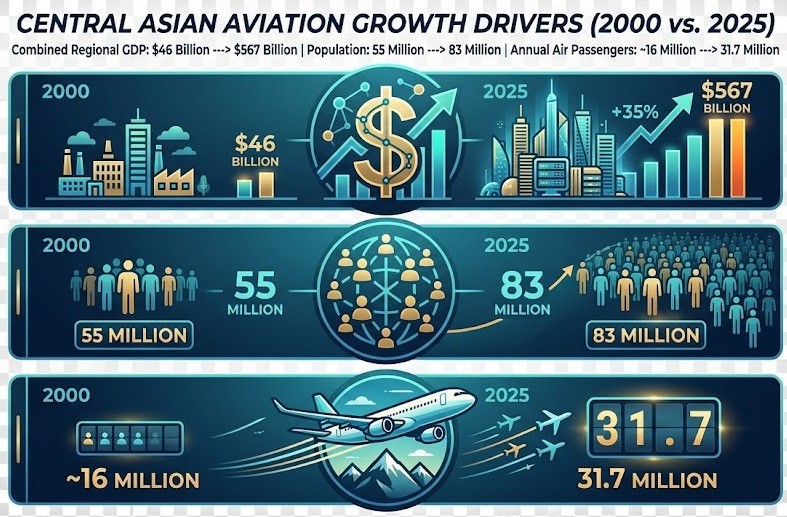
According to data published by the Eurasian Development Bank (EDB) and supported by reports from the International Air Transport Association (IATA), passenger travel in Central Asia reached 31.7 million passengers in 2025—nearly double its 2019 pre-pandemic benchmark.
Between 2015 and 2025, the region’s aircraft fleet capacity expanded at an average annual rate of 7.7%, expanding roughly three times faster than the global average.
Central Asian Aviation Growth Drivers (2000 vs. 2025)
Market Share Breakdown by Country
- Kazakhstan (48.7%): Continues to hold the dominant market position, handling over 18 million passengers annually, spearheaded by carrier expansion (such as Air Astana and FlyArystan) and major hub modernization.
- Uzbekistan (35.0%): Represents the region’s fastest-growing aviation market. Uzbekistan’s air passenger volume tripled compared to 2019 levels, hitting over 11 million passengers, driven by aggressive tourism development and market liberalization.
- Turkmenistan (7.0%): Sustains stable domestic and selective international corridors.
- Kyrgyzstan (5.6%): Serves as a vital domestic and regional connector, generating over $100 million annually in airport revenues.
- Tajikistan (3.7%): Continues gradual expansion focused on labor migration routes and intra-regional connections.
2. The Cargo Skybridge: Bridging Europe and Asia
While passenger numbers have surged, air cargo and freight operations have experienced an even more striking boom.
- Between 2023 and 2025 alone, regional air freight volumes more than quadrupled to 335,700 tonnes.
- Direct transit cargo increased to 65% of all regional air cargo volume, shifting Central Asia’s role from a simple refueling stopover into a major intercontinental logistics and consolidation node between China, Europe, and the Middle East.
- Inbound, outbound, and transit freight jumped 149% in Kazakhstan and 182% in Uzbekistan relative to 2019.
3. Infrastructure & Investment: A $5.1 Billion Push
To accommodate this rapid traffic expansion, massive investments are flowing into airport modernizations, logistics parks, and fleet acquisitions. Cumulative foreign direct investment (FDI) in Central Asia’s air transport sector stands at $1.4 billion, with a broader developmental pipeline under way:
| Metric / Focus Area | Investment & Scope |
| Major Airport Projects | 12 mega-projects planned or underway by 2035 across the 5 states |
| Total Pipeline Capital | $5.1 Billion allocated for terminal expansions, runways, and airside logistics |
| Key Investment Sectors | Cargo warehousing, modern MRO (Maintenance, Repair, and Overhaul) facilities, automated refueling hubs, and fleet upgrades |
4. Key Priorities for Sustainable Growth
To ensure this momentum remains sustainable, regional governments and international aviation bodies (such as IATA and the EDB) recommend several policy and operational shifts:
- Expanding ‘Open Skies’ Regulations: Broader adoption of liberalized air rights, particularly for cargo transit, to lower operating costs and invite international carriers.
- Promoting Low-Cost Carriers (LCCs): Scaling budget airlines to make intra-regional travel affordable for the growing population.
- Digitalization & Standards: Streamlining customs processing, adopting e-freight documentation, and harmonizing air safety security standards across borders.
- Regional Alliances: Building stronger coordination between national carriers to improve route schedules and feeder networks. /// nCa, 12 October 2026