


Overview
The third edition of the Turkmenistan Investment Forum (TIF 2026) opened in Ashgabat on 1 October at the Ýyldyz Hotel, beginning a two-day programme intended to connect Turkmen government institutions and businesses with international investors, financial institutions, development banks and technology companies.
The forum is organised by the Ministry of Finance and Economy and the Ministry of Foreign Affairs of Turkmenistan, in partnership with Turkmen Congress. The official programme describes the event as a platform designed to move from business contacts and investment interest towards practical projects.
The event is particularly significant because it takes place in the year of Turkmenistan’s 35th anniversary of independence and follows the country’s September Halk Maslakhaty, where a number of long-term economic and industrial-development priorities were formally established.
The official TIF programme lists participants from more than 40 countries. Turkmen government sources and organisers put the attendance at more than 800 delegates, while the opening-day address by Minister of Finance and Economy Mammetguly Astanagulov referred to more than 850 participants, including nearly 370 foreign guests representing approximately 50 countries. The different figures appear to reflect different stages of registration and reporting rather than necessarily a contradiction.
More than 200 foreign companies were represented, including major Japanese, Korean, European, Middle Eastern and international energy, construction, agricultural, financial and technology companies.
The International Character of TIF 2026
The composition of the forum was one of its most notable features.
Among the international corporate participants were:
- Mitsubishi Corporation
- Mitsubishi Heavy Industries
- ITOCHU
- Sumitomo Corporation
- Kawasaki Heavy Industries
- Mizuho
- Samsung C&T
- Daewoo Engineering & Construction
- John Deere
- CLAAS
- WIRTGEN Group
- Siemens Energy
- TotalEnergies
- Dragon Oil
- ADNOC
- Toyota Central Asia
- Damen Shipyards
- Oppenheimer & Co.
- Moody’s
- Fieldfisher
- Canaan
- Bitdeer
The development-finance side included the World Bank, IFC, Asian Development Bank, EBRD, Islamic Development Bank and Export-Import Bank of China.
The official speaker list also included senior representatives from Uzbekistan, Armenia, Türkiye, Iran, Qatar, Saudi Arabia, Kyrgyzstan, the EU, UK, OSCE, UN, Switzerland, Kazakhstan, Malaysia and several international companies and financial institutions.
This gave TIF 2026 a considerably broader institutional profile than a conventional sector-specific investment conference.
Opening of the Forum and Presidential Message
The opening ceremony began with a message from President Serdar Berdimuhamedov, delivered by Deputy Chairman of the Cabinet of Ministers Hojamyrat Geldimyradov.
The President presented TIF as a platform for constructive dialogue between foreign investors, international financial and banking institutions, government agencies and Turkmenistan’s private sector.
His message placed investment policy within a broader programme of:
- industrialisation;
- economic diversification;
- technological modernisation;
- digital transformation;
- environmentally friendly technologies;
- development of competitive industries;
- expansion of the financial market; and
- stronger international economic cooperation.
The President also emphasised Turkmenistan’s geographical position and resource base as important factors in its investment proposition.
Particularly noteworthy was the reference to digital financial instruments and advanced sustainable-development technologies. This suggests that the government’s investment narrative is no longer limited to conventional resource and infrastructure projects, but is increasingly incorporating digitalisation, technology and new financial mechanisms.
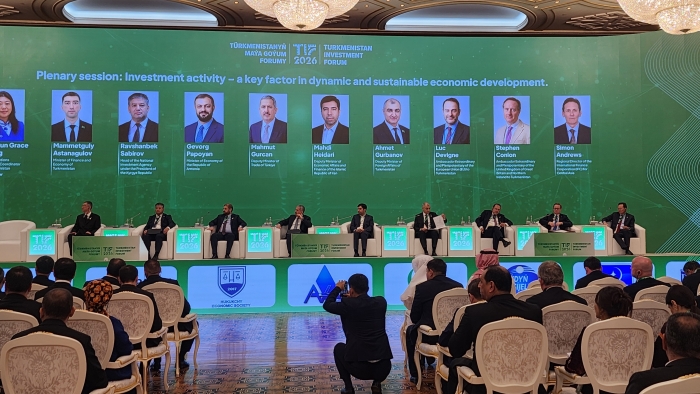
The Plenary Session: Investment Activity as a Driver of Sustainable Development
The principal morning session was titled:
“Investment activity – a key factor in dynamic and sustainable economic development.”
The session was moderated by Xiaojun Grace Wang, UN Resident Coordinator in Turkmenistan.
The session brought together an unusually broad group of government and international speakers:
- Hojamyrat Geldimyradov, Deputy Chairman of the Cabinet of Ministers of Turkmenistan;
- Mammetguly Astanagulov, Minister of Finance and Economy;
- Ahmet Gurbanov, Deputy Minister of Foreign Affairs;
- Djamshid Kuchkarov, Deputy Prime Minister and Minister of Economy and Finance of Uzbekistan;
- Gevorg Papoyan, Minister of Economy of Armenia;
- Mahmut Gürcan, Deputy Minister of Trade of Türkiye;
- Mahdi Heidari, Deputy Minister of Economy and Finance of Iran;
- Prince Mansour bin Mohammed Al Saud, Chairman of Najd Gate Holding, Saudi Arabia;
- Ravshanbek Sabirov, Head of Kyrgyzstan’s National Investment Agency;
- Luc Devigne, EU Ambassador to Turkmenistan;
- Stephen Conlon, UK Ambassador to Turkmenistan; and
- Simon Andrews of the IFC.
The composition itself was significant: investment was discussed not simply as a bilateral issue between Turkmenistan and individual companies, but as part of a wider regional economic and connectivity environment.
Ahmet Gurbanov: Investment and the Changing Global Economy
Deputy Foreign Minister Ahmet Gurbanov emphasised the changing global economic environment and the need for sustainable investment flows.
The underlying argument was that investment is increasingly connected with:
- modernisation of national economies;
- creation of employment;
- technological upgrading;
- economic resilience; and
- improved living standards.
This framing was important because it placed TIF within Turkmenistan’s wider diplomatic and economic narrative rather than presenting it simply as a search for foreign capital.
Turkmenistan’s Macroeconomic Presentation
Minister of Finance and Economy Mammetguly Astanagulov presented the government’s assessment of the country’s economic position and investment opportunities.
According to the figures presented:
- GDP increased by approximately 1.5 times over the preceding five years;
- GDP exceeded $77.4 billion at the end of 2025;
- economic growth remained at approximately 6.3%;
- inflation was 3.2% at the end of 2025;
- inflation was 3.6% during the first half of 2026;
- total investment exceeded $13.8 billion in 2025;
- exports exceeded $11.2 billion.
The presentation identified investment in industry as particularly important, with industrial investment described as accounting for more than 30% of GDP.
The minister’s presentation therefore placed investment within a broader transformation agenda: industrialisation, creation of value chains, joint ventures and greater use of Turkmenistan’s scientific and technological potential.
His speech has been covered in full in a separate news story by nCa.
Industrialisation and Value Chains
One of the important messages emerging from the opening session was that Turkmenistan is seeking to move beyond simply attracting investment into individual production facilities.
The emphasis was on:
new value chains → joint ventures → technological upgrading → greater domestic processing → export-oriented production.
The government presentation argued that greater use of domestic scientific and technological capabilities would be necessary to strengthen the economy’s competitiveness.
This is particularly relevant to the country’s traditional hydrocarbons sector, where the policy emphasis is increasingly on processing, petrochemicals and higher-value products rather than simply extracting and exporting raw resources.
Oil and Gas as a Continuing Investment Priority
Despite the diversification agenda, hydrocarbons remained firmly at the centre of TIF 2026.
The opening presentation identified:
- oil and gas;
- petrochemicals;
- energy;
- construction;
- transport; and
- agriculture
as major investment priorities.
The President’s message similarly emphasised industrialisation and development of the country’s resource base.
The first thematic session then moved directly into the oil, gas and chemical sectors.
TAPI and Regional Energy Connectivity
The Turkmenistan–Afghanistan–Pakistan–India (TAPI) gas pipeline was specifically highlighted in the investment narrative.
The Serhetabat–Herat section of TAPI was described as progressing, alongside construction of new gas-processing facilities and continued modernisation of Turkmenistan’s oil-refining infrastructure.
The significance of TAPI at TIF 2026 goes beyond a single pipeline project. It fits into Turkmenistan’s larger attempt to present itself as a regional energy-connectivity state, linking its gas resources with South Asian markets.
This also corresponds with the forum’s broader emphasis on energy connectivity and security.
Session 1 — Oil, Gas and Chemical Industries
The first thematic session was titled:
“Stable and reliable energy sustainability. Development of priority sectors of oil and gas and chemical industries of Turkmenistan.”
It was held in the Grand Hall at 11:30.
The session was moderated by Myrat Archayev, Deputy Chairman of the State Concern Turkmengas.
Presentations were delivered by:
- Batyr Jumayev, Deputy Chairman of Turkmennebit;
- Resul Myradov, Chairman of Turkmenhimiya;
- Dmitry Kabrelyan, Asian Development Bank;
- Robert van der Geest, World Bank;
- Min Man-Jun, Daewoo E&C;
- Mykhailo Partikevych, VEMA S.A.;
- Nicolas Ramseier, Swiss Foreign Business Council/Geneva Center for Neutrality;
- Rustem Rastumkhanov, CIS Economic Development Business Center; and
- Ismadi bin Ismail, CEO of PETRONAS Carigali (Turkmenistan).
The composition of the panel is significant: government representatives were joined by development banks, an international energy company, engineering firms, an industrial technology company and private-sector specialists.
The discussion therefore addressed not merely production but technology, investment structures, industrial upgrading and international partnerships.
PETRONAS and International Energy Participation
PETRONAS Carigali’s presence was particularly notable.
CEO Ismadi bin Ismail was among the speakers in the energy session. His participation reflects the long-running Malaysian company’s involvement in Turkmenistan’s energy sector and provides continuity between existing foreign investment and the government’s current effort to attract additional international capital and technology.
The participation of Dragon Oil, TotalEnergies and ADNOC elsewhere in the forum’s corporate programme similarly demonstrates the continuing role of international energy companies.
Energy Security and Industrial Development
At 14:30, a second major thematic stream addressed:
“Energy connectivity and energy security as guarantees of stable economic development. Development of the industrial and construction sectors of the economy.”
The session was held in Hall No. 1.
The official speaker list indicates participation by:
- Annageldi Saparov, Minister of Energy;
- Toyguly Nurov, Minister of Industry and Construction Production;
- Abdulla Geldiev, Minister of Construction and Architecture;
- Vladimir Petruk of CAI Interbudmontazh;
- BVS Construction;
- Daewoo E&C and other industrial and construction specialists.
The session connected energy availability with the expansion of industrial and construction capacity.
This is an important structural point: Turkmenistan’s industrialisation programme requires not only raw materials but reliable electricity, construction capacity, engineering services and infrastructure.
Transport, Logistics and Communications
The parallel 14:30 session in Hall No. 2 addressed:
“Development of sustainable transport systems, logistics connectivity and communications infrastructure of Turkmenistan.”
This session brought together government transport officials and international logistics specialists.
Among the listed participants were:
- Begench Annadurdyev, Minister of Automobile Transport;
- Hangeldi Kerimov, Minister of Highways;
- Mammet Akmammedov, Minister of Railway Transport;
- Dovran Saburov, Chairman of Turkmenhowayollary;
- Azat Shanazarov, State Maritime and River Transport Service;
- Berdimyrat Berdiyev, Deputy Minister of Communications;
- Claude Béglé, Swiss NeWater;
- Jean-François Morin, Air Belgium;
- Vadim Ganin, CIS Economic Development Business Centre;
- Kanan Samadov, WIRTGEN;
- and other international transport and infrastructure specialists.
The agenda indicates that the discussion focused on sustainable transport, logistics connectivity and communications infrastructure.
Turkmenistan invited international investors and financial institutions to cooperate in modernizing locomotive and railcar fleets, building dry ports and container terminals, said Minister of Railway Transport Mammet Akmammedov.
According to him, cooperation is proposed in three key areas. The first is investment in infrastructure, including the renewal of the locomotive and railcar fleet. The second is the implementation of resource-saving solutions, railway electrification, and the transition to environmentally friendly transportation standards in line with the global climate agenda. The third is the development of multimodal supply chains.
He explained that the idea is to create unified logistics operators and door-to-door services that will ensure maximum speed and reliability of deliveries.
Akmammedov explained that special attention is being paid to the development of the Trans-Caspian route. The integration of rail transport with the Turkmenbashi International Seaport, he said, enables the creation of seamless logistics chains. Work is underway to implement electronic document management, digital consignment notes, and unified digital platforms for real-time cargo tracking. Digitalization, the minister noted, expedites customs and border formalities and makes the corridor more attractive to international operators.
North–South and East–West Corridors
Transport connectivity was one of the most prominent recurring themes of the first day.
The government presentation emphasised the importance of both:
- North–South
- East–West
corridors, together with Caspian connections.
Turkmenistan’s investment proposition is increasingly based on the idea that its geographic position can support multimodal connectivity linking Europe, Asia, the Middle East and the Caspian region.
The emphasis was not simply on constructing roads and railways. It included:
- integration of rail, road and maritime systems;
- multimodal transport;
- border infrastructure;
- shorter transit times;
- digital transport systems; and
- more efficient logistics.
This represents a broader connectivity infrastructure proposition rather than a conventional transport-building programme.
Recent Transport Infrastructure Highlighted
Several current infrastructure projects were cited in the government’s presentation.
These included:
Mary–Turkmenabat highway
A new 600-kilometre Mary–Turkmenabat section of the Ashgabat–Turkmenabat highway was commissioned during 2026.
Turkmenbashi–Kazakhstan direction
Road construction along the route toward the Kazakhstan border is progressing.
Ashgabat–Dashoguz highway
The government stated that reconstruction of the strategically important Ashgabat–Dashoguz highway is scheduled to begin during 2026.
These projects reinforce the investment narrative around Turkmenistan as a country simultaneously upgrading its domestic infrastructure and international transit capacity.
European Union Priorities
EU Ambassador Luc Devigne outlined several areas of European interest.
He noted that EU–Turkmenistan trade turnover is approximately €1.4 billion, with the EU described as Turkmenistan’s fourth-largest foreign trade partner.
The EU identified several future cooperation priorities:
Trans-Caspian transport
The EU expressed interest in development of the Trans-Caspian Transport Corridor, reflecting the growing importance of Turkmenistan’s geographic position.
Railways
The EU indicated readiness to support modernisation of Turkmenistan’s railway infrastructure.
Energy
Turkmenistan’s large energy-resource base remains an important area of cooperation.
Renewable energy
The EU highlighted solar and wind power as areas with considerable future potential.
Green technologies
The EU’s overall message was that infrastructure and energy cooperation should increasingly incorporate the green transition.
International Financial Institutions
The presence of the World Bank, IFC, ADB, EBRD, Islamic Development Bank and Export-Import Bank of China was one of the most important institutional features of the forum.
The forum’s structure therefore extended beyond conventional foreign direct investment.
The presence of development-finance institutions opens discussion around:
- project financing;
- private-sector development;
- infrastructure financing;
- investment-risk assessment;
- institutional capacity;
- green investment;
- agriculture;
- energy;
- transport; and
- digitalisation.
The official speaker list included senior World Bank, IFC, ADB and EBRD representatives.
Agriculture and Climate-Resilient Investment
The fifth session on the first day was scheduled for 16:30 in Hall No. 2:
“Agribusiness, climate-resilient agriculture and investment in the development of processing industries. Climate change and resilient infrastructure for a sustainable future.”
The panel brought together:
- Charyyar Chetiev, Minister of Agriculture;
- Pierre Gerber, World Bank;
- Irakli Chikava, TelAgri;
- Nurbek Dairbekov, Rubicon;
- Peeter Pelisaar, Rubicon;
- Min Man-Jun, Daewoo E&C;
- Vadim Akimov, Damen Shipyards;
- and other specialists.
The inclusion of climate resilience alongside agribusiness and processing is important. It indicates that agricultural investment is being presented not simply as increasing production but as a combination of:
agriculture + processing + water management + technology + climate resilience + infrastructure.
Water and Agricultural Technology
The presence of Rubicon specialists in water-resource management and agricultural technology further underlines the importance of water efficiency.
The official TIF programme identifies water resources as one of the broader investment areas covered by the forum.
This is strategically important for Turkmenistan because agriculture, climate adaptation and water management are closely interconnected.
The forum therefore presents potential investment opportunities in agricultural technology not merely through machinery, but through irrigation, resource efficiency and climate-resilient production.
Modernization of Karakum Canal
Daewoo E&C plans to build a new modernized canal to provide a stable water supply to the Akhal and Balkan regions of Turkmenistan as part of the reconstruction of the Karakum Canal, said Min Man Zhong, General Director of the company’s branch in the country, at the Turkmenistan Investment Forum (TIF-2026).
Min Man-joon recalled that during President Serdar Berdimuhamedov’s visit to Seoul in September, his company and the State Committee for Water Resources of Turkmenistan signed a memorandum of cooperation.
According to Zhong, the project section, currently in the preparatory phase, extends approximately 250 kilometers within the Ahal and Balkan velayats. It begins at the Kopetdag Reservoir and extends to the Bereket Reservoir. The goal is to modernize the canal’s outdated structures and create a stable water supply system.
Digital Economy, AI and Virtual Assets
Although the detailed AI and virtual-assets discussions are distributed across the two-day programme, digital transformation was already a major theme of the opening day.
The government identified:
- digital technologies;
- digital financial instruments;
- innovation;
- artificial intelligence;
- and modern technologies
as part of the investment agenda.
The forum’s announced eight-session structure includes a dedicated thematic stream dealing with virtual assets, as well as innovation and green transformation.
The participation of technology companies including Canaan and Bitdeer gives this element a practical corporate dimension rather than leaving it purely at policy level.
Direct B2B and B2G Meetings
An important practical component of TIF 2026 was the pre-arranged meeting system.
Registered participants could use the TIF Attendee Hub and mobile application to identify companies and representatives and request meetings before arriving at the forum.
The system was specifically promoted as a mechanism allowing Turkmen businesses to arrange meetings with international companies such as Mitsubishi, John Deere, Samsung, Siemens Energy, TotalEnergies and others.
This is significant because the forum is designed not merely as a conference but as a transaction-oriented business platform.
The organisers explicitly framed the event around moving:
connections → negotiations → projects.
Saudi Arabian Business Delegation
Saudi Arabia had an especially visible presence.
A high-level Saudi delegation was led by Prince Mansour bin Mohammed Al Saud, Chairman of Najd Gate Holding.
The delegation included representatives of:
- Al Ufuq Holding;
- Al Majdiah Holding;
- Arabian Drilling Company;
- Al Taleb Agricultural Company;
- the Saudi Business Council for Central Asia; and
- the Federation of Saudi Chambers.
The delegation was described as examining opportunities across several sectors simultaneously, including energy, industry, agriculture, real estate and drilling.
This suggests that Saudi interest is not restricted to hydrocarbons but extends across multiple components of Turkmenistan’s diversification agenda.
Japan and South Korea
Japan was one of the most strongly represented corporate groups.
Companies included:
- Mitsubishi Corporation;
- Mitsubishi Heavy Industries;
- ITOCHU;
- Sumitomo;
- Kawasaki Heavy Industries; and
- Mizuho.
South Korean participation included:
- Samsung C&T; and
- Daewoo Engineering & Construction.
This provides a substantial East Asian technology and engineering component to the forum.
European and Western Corporate Participation
The European and Western presence was also broad.
Companies and organisations included:
- John Deere;
- CLAAS;
- WIRTGEN;
- Siemens Energy;
- Damen Shipyards;
- TotalEnergies;
- Oppenheimer & Co.;
- Moody’s;
- Fieldfisher;
- the European Union;
- EBRD;
- World Bank;
- IFC;
- and others.
The resulting structure is unusually diverse: TIF 2026 is simultaneously an energy, infrastructure, transport, agriculture, finance and technology forum.
The Forum’s Geographic Dimension
The first day demonstrated that Turkmenistan is attempting to cultivate investment relationships across several geographic directions simultaneously.
Europe
EU institutions and European companies.
East Asia
Japan, South Korea and China.
Gulf
Saudi Arabia, Qatar and the UAE.
South and Central Asia
Uzbekistan, Kyrgyzstan, Iran and other Central Asian and neighbouring countries.
North America
The forum’s participant list included American interests, including DFC representation in the official programme.
The overall pattern is consistent with Turkmenistan’s longstanding preference for maintaining multiple external economic relationships rather than depending on a single investment source.
Cultural Programme for International Delegates
The forum began even before the business programme with a cultural introduction to Turkmenistan.
Foreign participants visited:
- Old Nisa, the ancient Parthian archaeological site;
- the National Museum of Turkmen Carpet; and
- the State Museum of the State Cultural Centre of Turkmenistan.
This was presented as an opportunity for foreign participants to become acquainted with Turkmenistan’s historical and cultural heritage before beginning the investment programme.
What the First Day Says About Turkmenistan’s Investment Strategy
Taken together, the first day’s proceedings reveal several interconnected priorities.
Resource base
Oil and gas remain fundamental.
Industrialisation
The emphasis is increasingly on processing and higher-value industrial activity.
Connectivity
Transport corridors are presented as an economic asset in their own right.
Digitalisation
AI, digital finance and virtual assets are entering the investment narrative.
Green transition
Renewable energy, climate resilience and environmental technologies are increasingly integrated into the agenda.
Agriculture
The emphasis is moving towards technology, processing, water efficiency and climate resilience.
Financial architecture
Development banks and international financial institutions are being brought into the investment conversation.
Private sector
B2B and B2G negotiations are being placed at the centre of practical implementation.
Preliminary Assessment of the First Day
The first day of TIF 2026 is notable less for a single headline transaction than for the breadth of the investment architecture being presented.
Turkmenistan’s message to investors can be summarised as a combination of five propositions:
1. Energy:
The country remains a major gas and energy producer and is seeking technology and capital for further development.
2. Industrialisation:
The government wants greater domestic processing, new value chains and joint ventures.
3. Connectivity:
Turkmenistan is presenting its geographic position between major markets as an investment asset, supported by rail, road, maritime and communications infrastructure.
4. Diversification:
Agriculture, construction, tourism, digital technologies, finance, green projects and water management are increasingly part of the investment proposition.
5. Institutional engagement:
The participation of the World Bank, IFC, ADB, EBRD, IsDB and other institutions indicates an effort to embed investment projects in a broader international financing ecosystem.
The Emerging Strategic Message
Perhaps the most important feature of the first day is the way the traditional Turkmenistan investment narrative is being broadened.
The proposition is no longer simply:
“Turkmenistan has enormous gas reserves.”
It is increasingly:
“Turkmenistan has energy resources, industrial capacity, geographic connectivity, infrastructure, a developing private sector and emerging opportunities in digital, green, agricultural and financial sectors.”
That is a materially broader investment proposition.
The forum also links these elements together. Gas connects with petrochemicals; petrochemicals connect with industrialisation; industrialisation connects with electricity and construction; transport connects with exports; agriculture connects with water and climate resilience; digitalisation connects with finance and logistics.
In other words, TIF 2026 is presenting Turkmenistan’s investment opportunity increasingly as an interconnected economic system rather than a collection of individual projects. /// nCa, 2 October 2026