


Elvira Kadyrova
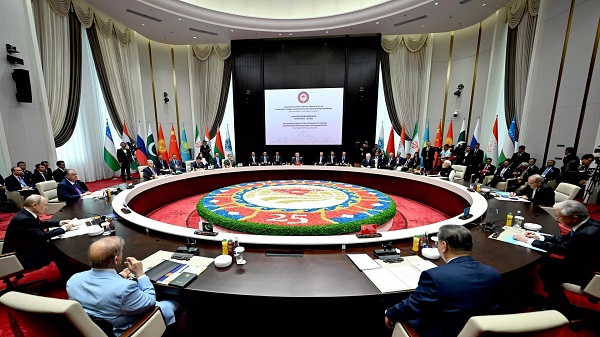
In the Bishkek Declaration adopted at the SCO summit on 1 September 2026 in Kyrgyzstan, the member states emphasized that the organization is not a military-political bloc and rejected bloc-based confrontation in international relations. The document also sets out the SCO’s positions on Iran, Afghanistan, terrorism and technological threats, while outlining areas for practical cooperation in trade, transport, energy and the digital economy.
Full text of the Declaration is available here: https://rus.sectsco.org/20260901/2495418.html
Here are the key points of the Bishkek Declaration:
The main political message — the SCO is not a military-political bloc
The member states emphasize that the SCO is not a military-political bloc and is not directed against other states or international organizations. The SCO operates on the principles of openness, non-interference, equality and mutual respect.
The member states reject bloc-based and confrontational approaches to addressing international and regional issues and advocate the peaceful settlement of differences and disputes between states.
The SCO reaffirms the relevance of initiatives aimed at building a new type of international relations based on mutual respect, justice, equality and mutually beneficial cooperation.
The document also highlights the continued relevance of initiatives to develop a shared vision of building a community with a shared future for humanity and to advance dialogue around the idea of “One Earth. One Family. One Future.”
Specific International Crises and Security Issues
In the section addressing international security, the member states reiterate that the unilateral and unrestricted expansion of global missile defense systems by individual countries or groups of states has a negative impact on international security and stability.
They consider attempts by states to ensure their own security at the expense of the security of other states unacceptable.
The member states reaffirm their firm commitment to combating terrorism, separatism and extremism and emphasize the unacceptability of attempts to use terrorist, separatist and extremist groups for vested interests.
At the same time, they consider “double standards” in the fight against terrorism unacceptable and stress that counter-terrorism efforts, including efforts to prevent the cross-border movement of terrorists, should be carried out with the central role of the United Nations.
The document also sets out the member states’ positions on pressing regional conflicts.
Regarding Iran, the SCO member states reaffirmed their position, condemning military strikes against Iranian territory and stating that such actions violate the principles and norms of international law and the UN Charter, while creating serious risks to international peace, security and stability.
The SCO calls for the conflict to be resolved exclusively through political and diplomatic means.
On Afghanistan, the SCO countries reaffirm their commitment to the emergence of Afghanistan as an independent, neutral and peaceful state free from terrorism, war and drugs. They stand ready to support the efforts of the international community to promote peace, stability and development in the country.
Technology Becomes Part of International Security
As reflected in the Declaration, the SCO countries view information and communication technologies (ICTs), the internet and artificial intelligence as integral elements of the broader security architecture.
The SCO countries categorically oppose the militarization of ICTs and the creation of threats to the security of critical information infrastructure.
The member states also stated that the provision of unauthorized satellite internet services in their territories without the relevant license and/or authorization from national authorities constitutes a violation of international law in the field of telecommunications.
The member states support the safe and responsible use of AI technologies and consider it unacceptable to use AI deliberately to cause harm to human life and health, as well as to the national security, territorial integrity and sovereignty of states.
As part of the broader technology agenda, the member states also emphasize their inherent right to develop research, production and the peaceful uses of nuclear energy.
Practical Economic Agenda
The Bishkek Declaration goes beyond geopolitics, setting out the SCO countries’ priorities and intentions for economic cooperation.
In particular, the member states call for further reform of the global economic governance system and support an open, transparent, fair, inclusive and non-discriminatory multilateral trading system based on universally recognized international principles and rules. They also advocate fair access to markets and special and differential treatment for developing countries.
The member states reject unilateral coercive measures that undermine international food, energy and humanitarian security and have a negative impact on the global economy.
The SCO countries intend to promote the development of cross-border e-commerce infrastructure and greater trust among businesses, including by expanding cooperation in the use of digital technologies to protect consumer rights and developing a common approach to the online settlement of cross-border commercial disputes.
The plans also include further deepening cooperation in transport, including the use of the transit potential of SCO member states, the creation of new and modernization of existing road and rail routes, multimodal transport corridors and logistics centers, as well as the introduction of digital, innovative and energy-efficient technologies.
In the energy sector, the member states stand ready to promote the sustainable, stable and balanced development of a non-discriminatory global energy market.
Eight SCO member states — Belarus, Iran, Kazakhstan, Kyrgyzstan, Pakistan, Russia, Tajikistan and Uzbekistan — reaffirmed their support for China’s Belt and Road Initiative (BRI) and noted efforts to align the development of the Eurasian Economic Union with the BRI.
Overall, the member states support reform of the international financial architecture aimed at strengthening the role of developing countries in the governance of international financial institutions, including the International Bank for Reconstruction and Development and the International Monetary Fund.
New Formats of Cooperation
Alongside international security and economic cooperation, the member states outlined new formats of engagement in the social, scientific and humanitarian spheres.
They supported proposals to establish SCO dialogue platforms for sharing expertise in healthcare management, as well as a platform bringing together heads of national academies of sciences and authorized leading fundamental research institutions.
Kyrgyzstan is set to host the Second Mountain Summit “Bishkek+25” in 2027.
The member states welcomed the designation of Lahore, Pakistan, as the SCO Tourism and Cultural Capital for 2026–2027.
Emphasizing the importance of developing intercivilizational and intercultural dialogue, the SCO countries welcomed the proposal to hold a Forum of Civilizations under the auspices of the SCO in India in autumn 2026.
The summit also resulted in the adoption of 27 additional documents, bringing the total number of final documents to 28. These decisions, programs, statements and declarations establish a legal framework for various areas of SCO activity, including institutional development, security and countering threats, biodiversity conservation, scientific and technological cooperation in the field of green technologies, the development of seaports and logistics centers, the establishment of regional data centers, the development of energy systems, energy efficiency, tourism and culture, support for the institution of the family, mutual assistance in emergencies, and cooperation with external organizations.
The Bishkek summit marked the end of Kyrgyzstan’s chairmanship of the SCO. The chairmanship now passes to Pakistan, which will host the next meeting of the Council of Heads of State of SCO Member States in 2027.///nCa, 3 September 2026 [photo credit – SCO]