


For the people of Turkmenistan, Victory Day is far more than a date on the calendar; it is a sacred holiday embodying the triumph of peace, humanism, and unbreakable solidarity. This year, the nation marks the 81st anniversary of the victory in the Great Patriotic War (World War II) —a milestone symbolizing the ultimate defeat of Nazi ideology. Society honors those who paid the price in blood to bring victory closer on the front lines, as well as those who forged and nurtured it in the fields and at the factories back home.
Living Legends: Stories of Courage
The celebrations, traditionally centered at the “Mekan” Palace in Ashgabat, underscore a profound respect for the veterans.
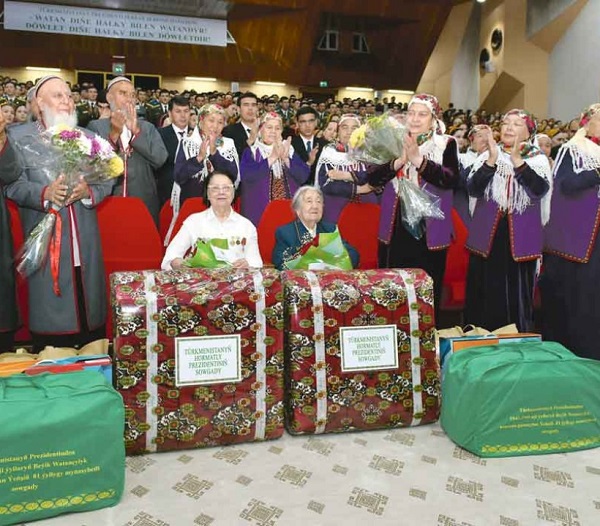
Among these heroes is Antonina Pryanichnikova, who recently celebrated her 98th birthday. At a very young age, she was thrust into the inferno of the Battle of Stalingrad. Under constant bombardment, Antonina Pavlovna restored railway tracks, tended to the wounded, and extinguished fires—heroic efforts for which she earned numerous decorations.
Equally remarkable is the story of Galina Mamedova, born in besieged Leningrad. Her life has become a symbol of the bond between two nations: it was in Leningrad that she met her future husband, the renowned artist Mamed Mamedov, eventually finding a second homeland in Turkmenistan.
The capital’s oldest resident today is 107-year-old Mikhail Khachaturov. A guards senior lieutenant and regimental engineer, he served on the 1st and 2nd Ukrainian Fronts, clearing mines and establishing crossings under enemy fire. His tunic is adorned with two Orders of the Red Star, two Orders of the Patriotic War (II degree), the Medal “For Courage,” and medals “For the Liberation of Prague” and “For the Victory over Germany in the Great Patriotic War 1941–1945.”
A special place in the constellation of heroes from the Dashoguz province belongs to Koshek Soltanmyradov, a resident of Gubadag who recently marked his 101st birthday. His life path is a vivid example of devotion to duty that began at the height of the war. In 1943, having just turned 18, young Koshek left for the front. He passed through the crucible of many battles, where his bravery and courage were recognized with multiple military orders and medals. Upon returning to civilian life, the veteran continued to serve society, dedicating many years to work in law enforcement.
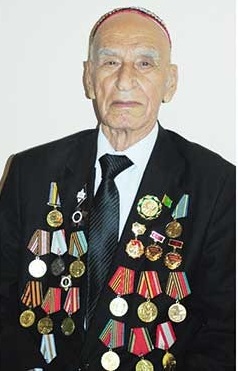
Ata Tutlykov
Ata Tutlykov stands today as the sole surviving war veteran in the Ahal province. At 101 years old, his life’s journey has become a true masterclass in resilience for younger generations.
The war broke out when he was a mere sixteen-year-old youth. Despite his age, he was determined to volunteer for the front, and by 1943, he was officially called up to the active army. Fighting on both the Belarusian and Ukrainian Fronts, Ata Aga endured some of the conflict’s most bitter and fierce engagements. Yet, upon returning from the front, Ata Tutlykov chose the most peaceful and noble of paths: he dedicated his life to teaching.
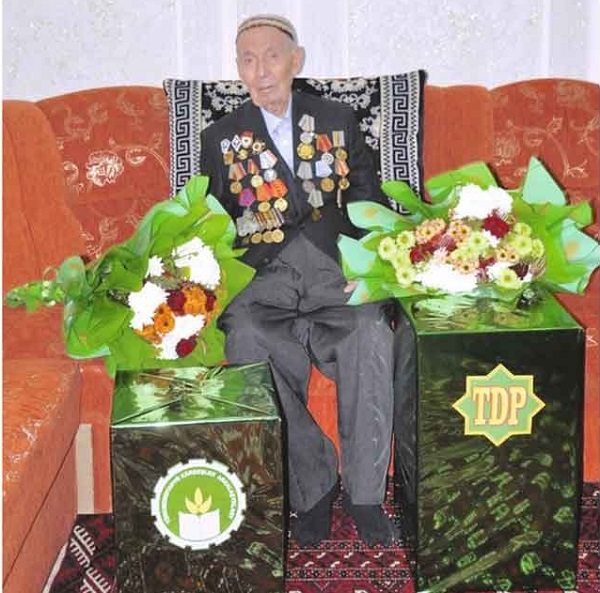
Koshek Soltanmyradov
In the Mary province, young soldiers paid their respects to the region’s two remaining veterans: 100-year-old Shamy Abdyev and 106-year-old Aidogdy Amadyev. Aidogdy Amadyev’s wartime path stretched from the defense of Moscow to the final storming of Berlin. Having served first as a submachine gunner and later in the cavalry, he was decorated with the Order of Glory (III degree), the Medal “For the Capture of Berlin,” and the Order of the Patriotic War (I degree).
The nation also honors those who forged the victory in the fields. Khojanepes Amanakov, a veteran of the home front, began working as a farmer at the age of ten, stepping in for the adults who had left for the front lines. In the peacetime that followed, he dedicated 49 years to the development of the country’s energy sector.
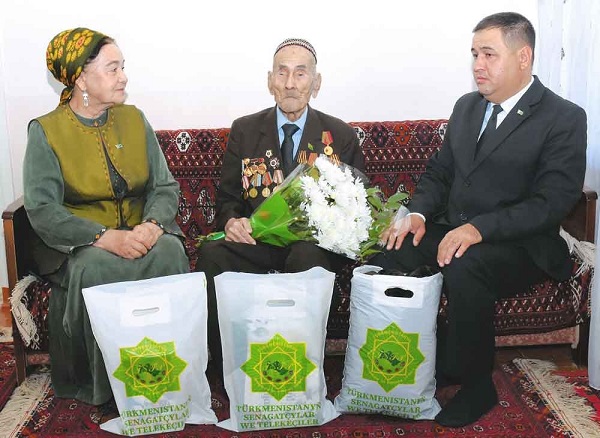
Mary province honors veterans
Inscribed in Eternity: Heroes of the Past
The memory of fallen soldiers serves as the bedrock for the upbringing of the younger generation. A profound chapter in this historical chronicle is the heroic legacy of Berdimuhamed Annayev, the great-grandfather of the President of Turkmenistan. While fighting on the 2nd Ukrainian Front, he displayed exceptional valor, for which he was posthumously awarded the Medal “For Courage.”
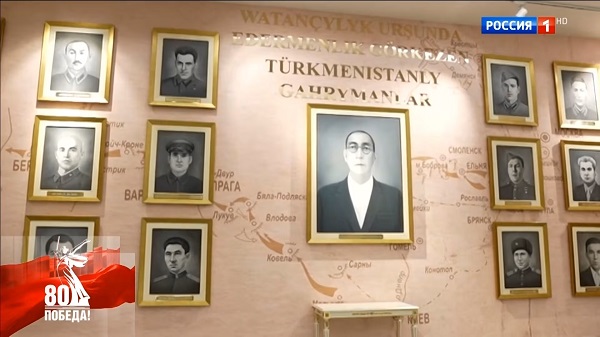
Berdimuhamed Annayev
The early heroes of the war also remain unforgettable. As early as June 1941, on the Romanian border, Kurban Durdy displayed unparalleled bravery. During a reconnaissance mission, he eliminated 11 enemy combatants and took several prisoners—an act of valor that made him one of the first in the USSR to be honored with the title of Hero of the Soviet Union.
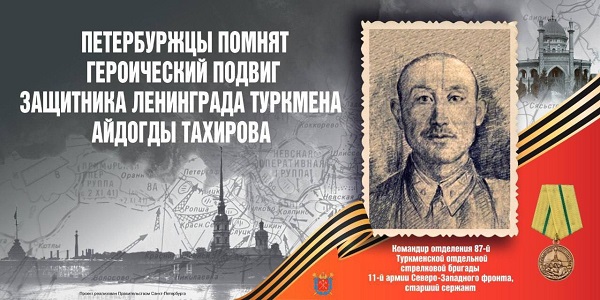
The sacrifice of Aidogdy Takhirov is as tragic as it is sublime. In January 1943, standing alone against an entire enemy company, he eliminated 47 soldiers. Despite being severely wounded and taken prisoner, he refused to betray his homeland. When the Nazis forced him to speak into a loudspeaker for propaganda, he instead shouted to his comrades: “Strike the fascists… long live the Motherland!” For this final act of defiance, he was executed.
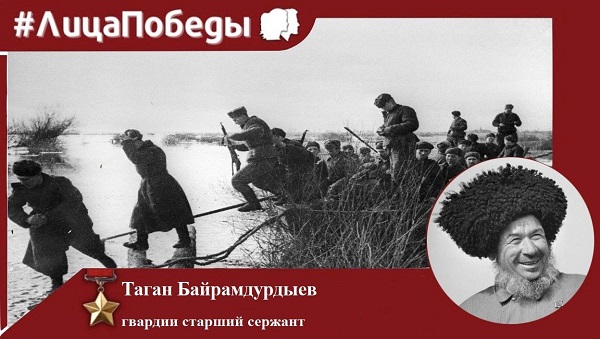
Tagan Bayramdurdyev, a native of Geok-Tepe, distinguished himself during the strategic crossing of the Oder River. On 2 February 1945, after crossing the river, he provided crucial cover for his squadron and regiment for two hours, repelling eight enemy counterattacks. During the engagement for the Altkessel station (now Stary Kisielin, Poland), his machine-gun fire destroyed six enemy vehicles. On 27 February 1945, for his exemplary fulfillment of command missions and the courage and heroism displayed in battle, Guards Senior Sergeant Tagan Bayramdurdyev was decorated with the title of Hero of the Soviet Union.
The memory of the war is, above all, a memory of people whose lives are woven into a single chronicle of heroism. In the Mary province, the names of those who spared no effort for the sake of peace are still remembered with deep reverence. Among them are the courageous tank commander and multi-decorated officer Cherkez Orazmuhammedov, who fought to liberate Ukraine, and the artilleryman Yakov Borisov, who stood in defense of Moscow during its darkest hours.
The name of Berdymurat Dovletjanov is inscribed in history in letters of gold. He was among the first to step onto the western bank of the Dnieper under a hail of enemy fire—an act for which he was rightfully awarded the nation’s highest honor, the title of Hero of the Soviet Union.
No less vital was the work of those who returned soldiers to the ranks. The renowned surgeon Margarita Moskovskaya served throughout the entire war in frontline hospitals. Upon returning to Mary, she continued to treat veterans at the hospital for war invalids until her final years, remaining steadfast in her noble calling.
For Nikolai Skotnikov, who was drafted in 1944, the war concluded in Königsberg. While his time at the front may seem brief, every day this signalman spent under fire was defined by genuine heroism.
A monumental contribution to preserving this history was made by Mered Bekov, a retired colonel and veteran. He authored five books that have become a definitive chronicle of the feats performed by Turkmenistan’s sons and daughters. In his works, he meticulously reconstructed the combat paths of the 87th Independent Turkmen Rifle Brigade and the 97th Turkmen Independent Cavalry Division, ensuring that future generations know and remember their heroes.
“Island of Salvation”: The Hospital Base in Lebap
During the war years, Turkmenistan emerged as a formidable hospital hub. Thanks to its mild climate and distance from the front lines, the republic became an “island of salvation” for thousands of wounded soldiers.
The city of Chardjou (now Turkmenabat) in the Lebap province played a pivotal role. A vast network of specialized hospitals operated there, where surgeons worked 15-hour shifts, often serving as blood donors themselves in the middle of operations. Local medics demonstrated remarkable ingenuity by utilizing the region’s natural resources: vitamin concentrates derived from licorice and rosehips, herbal antiseptics, and even snake venom for pain relief.
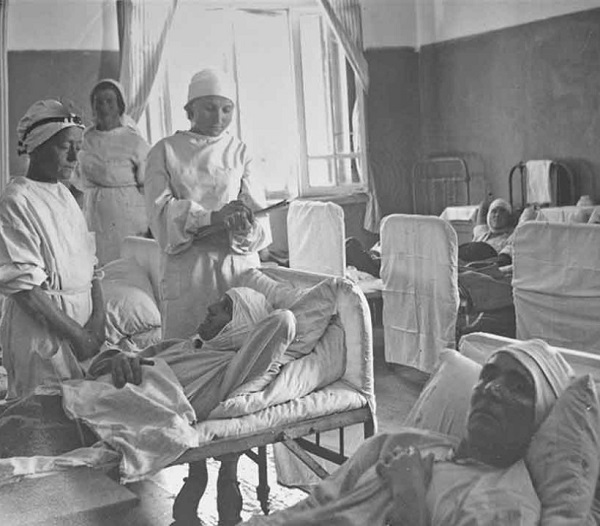
Hospital in the Lebap Province
Supporting the wounded was a collective effort: collective farmers brought melons and vegetables, schoolchildren took charge of hospital wards, and women laundered bandages and sewed clothing. After recovery, many front-line soldiers underwent vocational training here and chose to make Turkmenistan their permanent home.
The Victory in Figures
The scale of Turkmenistan’s contribution to the defeat of fascism is profound:
- 265,000 people were deployed to the front lines.
- 86,000 soldiers never returned home—all of whom have been declared National Heroes of Turkmenistan.
- 104 Turkmen citizens were honored with the title of Hero of the Soviet Union.
- 78,000 warriors were decorated with military orders and medals, while tens of thousands of workers, farmers, scientists, and cultural figures received the medal “For Valiant Labor in the Great Patriotic War 1941–1945.”
- Over 32,000 people evacuated from besieged Leningrad and other frontline or occupied territories found refuge in Turkmenistan.
- 7,392 kg of gold and silver were donated by Turkmen women to the Defense Fund, many parting with their most precious family heirlooms. Additionally, nearly 300 railcars filled with warm clothing, linens, and gifts were dispatched to the front, along with horses donated to the military effort.
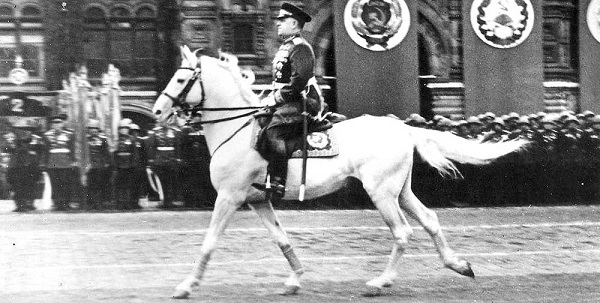
The 1945 Victory Parade on Red Square in Moscow remains an iconic moment: the legendary commander Marshal Georgy Zhukov reviewed the parade mounted on an Akhal-Teke stallion named Arab
Global Stance and Policy
Today, Turkmenistan remains steadfast against any attempts to distort history. At the OSCE, Turkmenistan’s delegation, alongside representatives from other states (Azerbaijan, Armenia, Belarus, Kazakhstan, Kyrgyzstan, Russia, Serbia, Tajikistan, and Uzbekistan), signed a joint statement marking the 81st anniversary of the Victory. The document emphasizes:
“Any attempts to falsify and to distort the outcomes of World War II, to diminish the decisive role of the peoples of the Soviet Union, as well as the contributions of the members of the anti-Hitler coalition and the liberation movements of European countries in the defeat of Nazism, are unacceptable. <…> It is our shared responsibility to prevent the recurrence of the tragedies of the past, to do everything possible to counter efforts aimed at the glorification and rehabilitation of Nazism and its accomplices, and to combat manifestations of neo-Nazism, aggressive nationalism, and all forms of discrimination. The memory of the Victory should serve to strengthen international security, cooperation, and mutual understanding”.
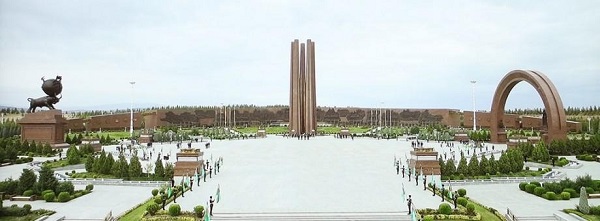
The Halk Hakydasy Memorial Complex in Ashgabat
Every year on 9 May, flowers are laid at the Eternal Flame of the “Halk Hakydasy” memorial complex—a poignant symbol that the memory of the people’s great feat lives on and will endure forever. // nCa, 8 May 2026 (based on reports from Turkmen media)