


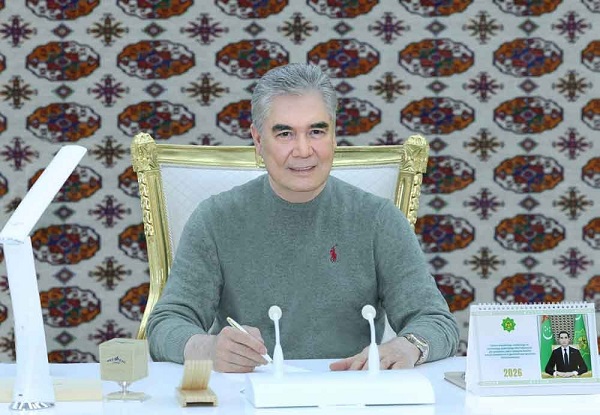
The National Leader of the Turkmen people and Chairman of the Halk Maslakhaty of Turkmenistan, Hero-Arkadag, paid a visit to the city of Arkadag to review ongoing construction and examine plans for upcoming projects. During the trip, he also convened a working meeting with senior officials overseeing the development of the new city.
The visit took place against the backdrop of a year marked by major national initiatives under the banner “Independent Neutral Turkmenistan – Homeland of Purposeful Winged Steeds.”
Within this broader context, Arkadag city continues to be presented as a flagship example of the country’s urban development strategy. Built at the initiative of Hero-Arkadag, the city is expanding rapidly, with construction efforts designed to harmonize with the natural landscape, particularly the scenic foothill surroundings.
In the morning, Hero-Arkadag inspected progress on the modernization of a specialized school focused on intensive foreign language education. The project is being implemented with support from the Gurbanguly Berdimuhamedov Charitable Foundation for Assistance to Children in Need of Care. Vice President for Medical Affairs of the Foundation, O. Atabaeva, briefed him on the status of the work.
Following the briefing, Hero-Arkadag stressed that the school’s facilities, especially its language laboratories and classrooms, must meet international standards and incorporate advanced technologies and best global practices. He also underlined the importance of establishing extracurricular clubs to help students develop their individual talents alongside language proficiency.
The National Leader highlighted the need to combine academic and physical development, calling for the creation of adequate sports infrastructure, including both indoor and outdoor stadiums. The inclusion of a 320-seat kindergarten within the school complex, he noted, would turn it into a comprehensive educational center, supporting the systematic development of well-educated and capable young people. He also pointed to the importance of ensuring comfortable conditions for parents and maintaining high standards in construction and organization.
Hero-Arkadag then reviewed a series of design proposals related to the second phase of the city’s development. Detailed presentations were delivered by D. Orazov, Chairman of the State Committee for the Construction of Arkadag city, and G. Mammedova, head of the city administration. The plans covered a range of industrial and social facilities, including interior design concepts, workspace layouts, and the Gün power plant.
After examining the proposals, Hero-Arkadag offered comments and adjustments, emphasizing that each project in the second phase should have a distinctive architectural identity.
He called for the adoption of innovative technologies, particularly in facilities powered by renewable energy, and highlighted the need for modern, functional, and aesthetically balanced interiors, especially in conference and meeting spaces.
Attention was also given to the design and lighting of the Arkadag Center, which, he said, should reflect contemporary standards while enhancing the city’s architectural appeal, especially at night. Administrative buildings, he added, must be equipped to support effective work, including facilities for meetings and for journalists.
At the same time, Hero-Arkadag underscored the importance of preserving national architectural traditions, noting that these historical elements should be integrated into the modern appearance of the city.
During the subsequent working meeting, discussions focused on the pace and quality of construction under the second phase, as well as the implementation of digital systems. D. Orazov reported on progress, including the construction of medical cluster facilities and Akhalteke Atlary Avenue.
Expressing dissatisfaction with delays and shortcomings in construction quality, Hero-Arkadag instructed officials to address the issues without delay. He specifically called for acceleration of work on Akhalteke Atlary Avenue and stressed the need for strict adherence to deadlines and quality standards. Improving landscaping and maintaining a healthy environmental environment in the city were also identified as key priorities.
All efforts, he said, should be aligned with the long-term development framework outlined in the national program for socioeconomic development through 2052.
G. Mammedova also briefed the meeting on preparations for National Turkmen Horse Day, including plans for festive events, an exhibition in Arkadag city, and the ceremonial handover of new apartments to residents.
Hero-Arkadag emphasized that celebrations in the homeland of the Akhal-Teke horses should be organized at a high level, reflecting their cultural significance.
He also proposed developing educational programs on the traditions of Akhal-Teke horse breeding, with active participation from the Aba Annaev International Academy of Horse Breeding. Referring to historical examples, he recalled the 1935 Ashgabat–Moscow horse race, during which Akhal-Teke horses covered 4,300 kilometers in 84 days, demonstrating their exceptional endurance.
Looking ahead, plans are also under consideration for the construction of a new complex for the Agricultural University in Arkadag, a project expected to contribute to the city’s social and cultural development.
Concluding the visit, Hero-Arkadag wished success to those involved in the ongoing projects and departed the site. /// nCa, 22 April 2026