


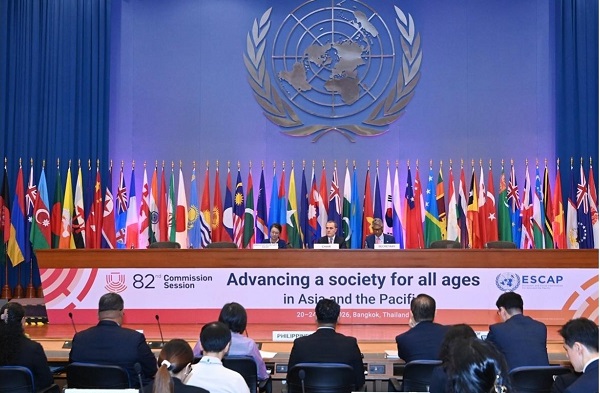
The 82nd session of the United Nations Economic and Social Commission for Asia and the Pacific (ESCAP) has opened in Bangkok, bringing together policymakers and development experts from across the Asia-Pacific to grapple with mounting economic, social and environmental challenges.
Turkmenistan is taking part in the high-level gathering with a delegation led by deputy minister of finance and economy Perhat Yagshiyev, reflecting Ashgabat’s continued engagement with regional development frameworks.
The session, running through April 24, is being held under the theme “Leave No One Behind: Advancing a Society for All Ages in Asia and the Pacific,” aligning closely with the broader goals of the United Nations’ 2030 Agenda.
Turkmenistan, a member of ESCAP since 1992, has steadily expanded its role within the commission, particularly in areas such as transport connectivity, energy cooperation, and environmental sustainability. Over the years, the country has also initiated resolutions within ESCAP aimed at strengthening regional transport corridors and ecological cooperation—priorities that remain highly relevant as global supply chains face increasing disruption.
The current session’s agenda spans a wide policy spectrum, including macroeconomic stability, trade and investment, digital transformation, disaster risk reduction, and climate resilience. For Turkmenistan, whose strategic location positions it as a key transit hub between Asia and Europe, discussions on transport and logistics connectivity carry particular weight.
A focal point for Central Asian participants is the ministerial meeting of the Special Programme for the Economies of Central Asia (SPECA), a joint initiative of ESCAP and the United Nations Economic Commission for Europe. The meeting is expected to emphasize coordinated action on sustainable and efficient transit systems, with an increasing focus on green and digital transformation of trade routes.
For Ashgabat, these discussions dovetail with its long-standing push to modernize regional transit corridors, integrate digital technologies into logistics, and expand the role of small and medium-sized enterprises in cross-border trade.
The emphasis on human capital development—particularly in transport, logistics, and digital trade—also aligns with Turkmenistan’s broader economic diversification efforts.
The ESCAP session comes at a moment of heightened global uncertainty, with geopolitical tensions and shifting economic patterns reshaping trade and connectivity across Eurasia. In this context, Central Asia’s role is evolving rapidly, and Turkmenistan’s active participation underscores its intent to remain engaged in shaping regional responses to these emerging challenges. /// nCa, 22 April 2026