


Tariq Saeedi
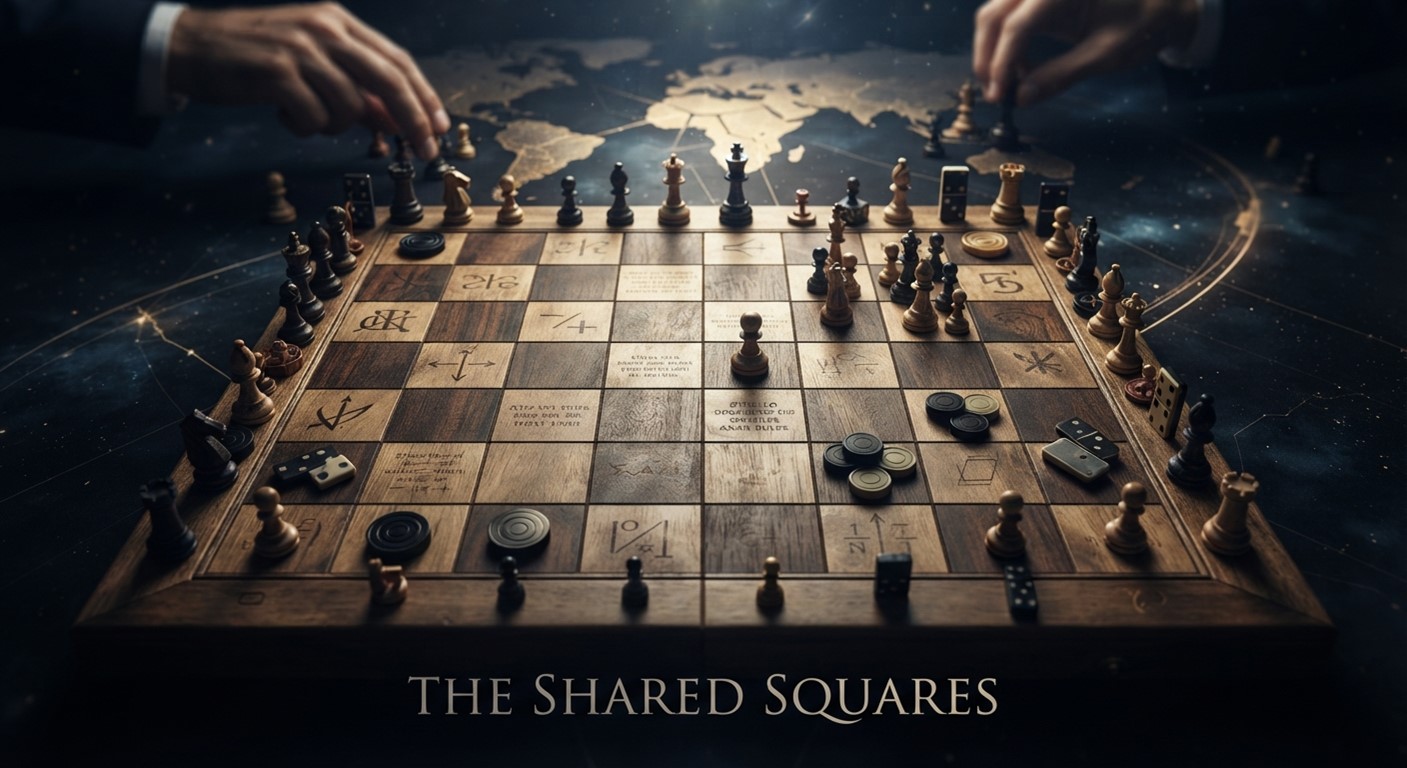
Imagine a single, finite wooden board of sixty-four squares. Around its perimeter sit nearly two hundred players.
To the casual observer, they appear to be engaged in one great, sprawling match. In reality, they are not even playing the same game. One corner is locked in the slow, attritional maneuvers of classical chess, trading pawns for positional advantage across decades. Another is playing Antichess, deliberately sacrificing assets to force a specific outcome. Elsewhere, someone is playing Checkers, jumping diagonally over complications while ignoring the deeper geometry of the ranks; another is playing Othello, flipping entire blocs of territory from one color to another overnight.
Even among the few who sit down to play the exact same game, the rulebooks do not match.
One side insists that a pawn may advance two squares on its first move; the other maintains that rule was abolished a century ago. And on the rare occasion when two powers finally agree on the name of the game and the text of the rulebook, they still diverge on interpretation: what constitutes a legitimate defense, where the boundaries of a square begin, or whether a subtle touch constitutes a binding move.
In a world where the games, the rules, and the readings of those rules are all contested, what remains? What is the lowest common denominator?
It is the board itself.
The lowest common denominator is the irreducible reality of the sixty-four squares—the shared geography, the finite resources, the atmospheric commons, and the inescapable fact of adjacency. A player may invent new movements for their pieces or declare ancient treaties void, but no player can conjure a sixty-fifth square out of thin air, nor can they lift their corner of the board off the table without spilling the entire structure into the floor.
Beyond the wood and the varnish, the board imposes three quiet, non-negotiable truths on every player, regardless of their game:
- Consequence is shared. When one player overturns a rook in frustration or floods the center with pieces, the resulting clutter obstructs everyone’s lines of sight. Turbulence on one side of the grid inevitably vibrates through the joinery to the other.
- Adjacency is permanent. You cannot choose your neighbors on the grid. A square borders what it borders. Trade, transit, waterways, and winds follow the geometry of the board, not the preferences of the players.
- The table holds everyone. The ultimate constraint is not victory, nor even a draw, but the preservation of the playing surface. If the board is broken in pursuit of a local win, every game—no matter how brilliantly conceived—ends simultaneously.
Philosophers and statesmen often exhaust themselves trying to persuade the entire room to adopt a single rulebook. History suggests that is a mirage; civilizations carry too much memory, temperament, and self-interest to ever play identically.
Stability does not require everyone to play the same game. It only requires a shared respect for the board: an agreement not to splinter the squares, not to tip the table, and to recognize that while the rules are ours to write, the space we occupy belongs to the whole. /// nCa, 25 November 2026