


Difficult water and marginal land need not mean limited food production, but only if the economics and ecology are tested first.
Tariq Saeedi and Elvira Kadyrova
On the edge of China’s Taklamakan Desert, in a county where sand covers about 90 percent of the land, a farm is harvesting 250–300 kilograms of Australian freshwater crayfish a day, according to the South China Morning Post. The report places the farm in Maigaiti County, Kashgar Prefecture. It links the project to a wider Chinese effort to develop aquaculture in saline-alkaline areas and use abandoned land.
For Turkmenistan, the useful question is not whether to copy Xinjiang. It is whether the broader lesson applies: can difficult water, marginal land and existing fisheries infrastructure become a more diverse source of food, rural income and, eventually, exports?
A base to build on
Turkmenistan is not starting from zero. Commercial aquaculture dates to the early 1970s, but output fell sharply for a while after 1991. The Food and Agriculture Organization (FAO) is now helping to rebuild the sector. Its project on the aquafeed value chain and aquatic animal health has included Ashgabat workshops on feed, biosecurity and farm design. FAO identifies access to affordable, good-quality feed as a major constraint.
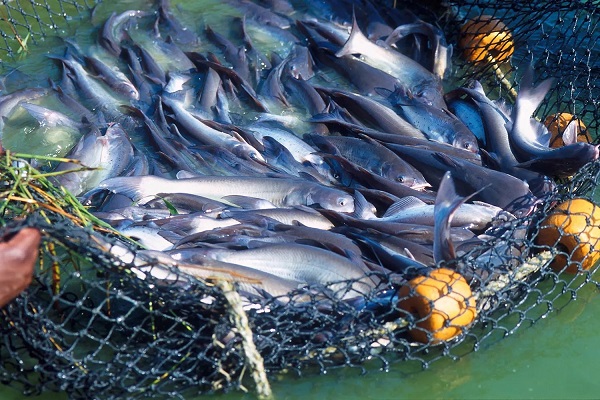
Some private producers are already moving beyond carp. Elin Balyk, a farm of about 130 hectares in Ahal Province, raises carp, silver carp, grass carp, African catfish, tilapia and sturgeon. It has also begun cultivating the giant freshwater prawn, Macrobrachium rosenbergii, from imported larvae.
By mid-2025 its nursery held roughly a million young prawns, and the first seven-month cycle was due to end that autumn. The farm uses water from the Karakum River and reports closed-system water losses of no more than 10 percent. It also plans to experiment with Vannamei shrimp, and its staff have trained in Iran and Thailand.
The question is therefore no longer whether exotic aquatic species can survive in Turkmenistan. It is whether scattered experiments can become a coherent national strategy.
A portfolio, not a single crop
Food security rests on diversification, and aquaculture can offer several tiers:
- Everyday protein. Carp remains the backbone. African catfish and tilapia suit intensive, controlled production and affordable supply.
- Higher-value products. Giant freshwater prawns could serve a premium domestic market and, if costs allow, exports.
- Saline-water trials. Vannamei is a marine and brackish-water species and remains an experiment, not a proven commercial model. Iranian researchers have reared it in brackish Caspian water, which suggests the idea merits controlled testing. Not every saline source is suitable. Salinity, alkalinity, temperature, oxygen, mineral composition and pollutants all determine whether a species survives and whether the product is safe to eat.
- Crayfish. Xinjiang shows what is possible, but Turkmenistan has options short of importing an Australian species. The narrow-clawed crayfish is native to the wider Ponto-Caspian region. Local species should be examined first. Any introduced species would need strict ecological review, because aquaculture must never become a route for invasive species into natural waterways.
- Sturgeon. This is a premium product rather than a protein staple. Commercial sturgeon fishing in the Caspian has been under a moratorium since 2013, which the Caspian states extended through 2026, with catches allowed only for research and reproduction. That strengthens the case for controlled farming as a source of high-value products.
The least conspicuous item may be the most strategic: Artemia, or brine shrimp. It will not reach the dinner table, but it is an important feed organism for hatcheries. Researchers in Xinjiang recently found it in highly saline desert water, and Turkmen enterprises have also produced it.
An industry that depends on imported feed, seed and equipment captures little of its own value. Domestic feed organisms, aquafeed, fingerlings and expertise turn fish ponds into a production system.
Culture matters as much as biology
A new species does not always require a new food culture. Fish already has a place in Turkmen cooking, so a locally farmed tilapia, catfish or prawn can enter through familiar techniques such as grilling, frying and stewing. These would be contemporary adaptations, not traditional dishes, and should be described that way. The principle is to change the ingredient before trying to change the cuisine.
Science-led, not enthusiasm-led
Promising experiments can harden into grand claims. Turkmenistan would be better served by pilot projects, measurements and honest economics. Every candidate species should answer the same questions:
- How much water, feed and energy does it need?
- What is the survival rate, and how vulnerable is it to disease?
- What share of feed can be produced domestically?
- What happens to wastewater?
- Can the product sell competitively at home, and eventually abroad?
- Does the return justify the use of scarce water and land?
Feed is usually the largest cost in fed aquaculture, often more than half of production cost, which is why an aquaculture industry cannot be separated from an aquafeed industry.
A staged approach
A sensible programme would proceed in stages:
- Consolidate what already works: carp farming, hatcheries, feed and disease control.
- Scale proven experiments, such as tilapia, catfish and prawns, on a commercial basis.
- Run controlled saline-water trials before larger investment.
- Build the biological supply chain: fingerlings, broodstock, Artemia and feed inputs.
- Work with chefs, processors and retailers to develop products suited to local tastes.
- Develop a premium export segment, such as sturgeon, caviar and prawns, where costs, quality and certification allow.
Throughout, exotic species should be contained and native ecosystems protected.
From difficult water to productive water
Food security does not mean producing every kilogram at home. It means a system diversified and adaptable enough to absorb shocks. Aquaculture can add a layer to that system without replacing agriculture. It uses less land than livestock, creates rural employment and may put to use water poorly suited to conventional crops.
Xinjiang does not prove that every desert can become a fish farm. It shows that technology can change the economic meaning of a natural constraint.
Turkmenistan has the ingredients to test that idea carefully: a fishing tradition, working aquaculture enterprises, a Caspian coastline, extensive water infrastructure, willing entrepreneurs and FAO support. The next step is not to declare success, but to ask better questions about which species suit which waters, and which production systems deliver the most food per unit of water. /// nCa, 6 October 2026