


nCa Report
A Legacy That Travels Well
There is a story, well-documented in history, that tells you everything you need to know about Turkmenistan’s melons. The Abbasid Caliphs of Baghdad — men who could command any luxury in the medieval world — maintained a relay courier system specifically to bring fresh melons from Merv (present-day Mary in Turkmenistan) to their tables. A lightweight buggy, a single horse, fresh horses waiting at every post, and a near-continuous run across the desert. Baghdad was four days away. The melons were worth it.
Zahiruddin Babur, founder of the Mughal dynasty and a man who conquered empires, wrote in his autobiography ‘Baburnama’ that when he thought of his Central Asian homeland, what he missed most — above all things — was the melons. Not the mountains. Not the people. The melons.
Dried Turkmen melons were traded as far as the markets of Paris in ancient times. This was not mere commerce. It was testimony. A fruit so extraordinary in taste and aroma that it crossed the world on camelback and still commanded a premium at the other end.
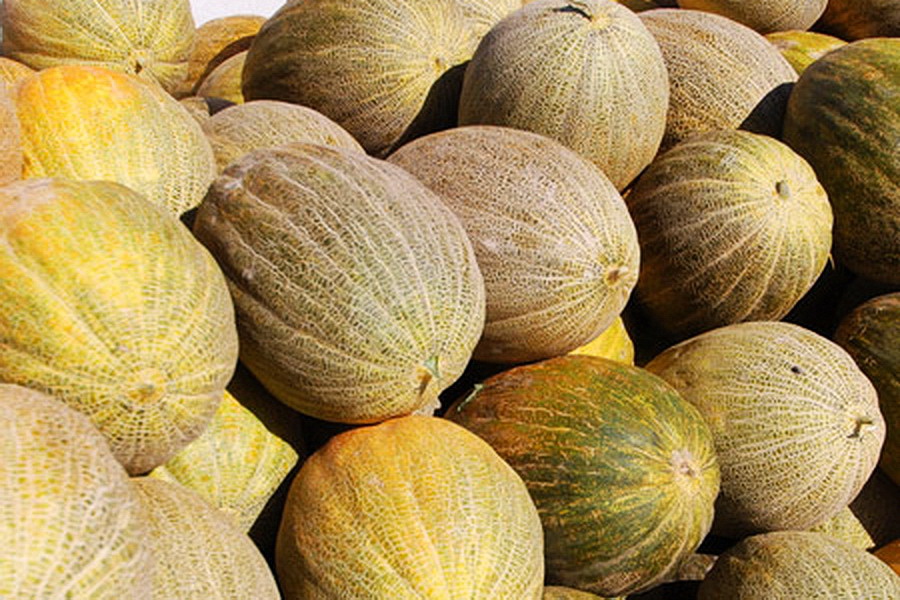
Today, Turkmenistan celebrates an annual Melon Day — a national holiday held on the second Sunday of August — where melons are displayed in great pyramids in the capital Ashgabat and citizens are invited to eat as many as they like. The country cultivates over 200 locally selected varieties, out of approximately 400 Turkmen varieties registered globally.
A scientific publication, Babadayhan Mirasy, catalogs 323 named varieties developed through centuries of folk breeding. Some of these melons, like the Dashoguz Gulyabi, can be stored for three to four months after harvest, their sugar content actually increasing with time. This is not a coincidence — it is the result of millennia of careful human selection in one of the world’s most demanding climates.
The numbers today are harder to pin down precisely but a single district — Gizilarbat in the Balkan region — reported a harvest of over 43,000 tons of melons and watermelons in a recent season, exceeding its own target. Scale that across a country where melon cultivation has been a cornerstone of agriculture since before recorded history, and you are looking at a very significant volume of some of the world’s most distinctive fruit.
The question for 2026 is not whether Turkmenistan has something special. That was settled centuries ago. The question is what the modern world can do with it.
What Makes Turkmen Melons Different — and Why It Matters
Before exploring the commercial opportunities, it is worth understanding what actually makes these fruits distinctive, because the answer shapes every downstream opportunity.
The soils of the Karakum and the extreme continental climate — blazing summers, cold nights, very low humidity — concentrate sugars and aromatic compounds in ways that more temperate growing regions simply cannot replicate. The diurnal temperature swing (the gap between daytime highs and nighttime lows) is one of the key drivers of high Brix — the measure of sweetness — in melons and watermelons. Turkmen farmers have been selecting for precisely these qualities across hundreds of generations, building a genetic library of varieties adapted to local conditions. The Vakharman, the Ak Gulyabi, the Gok Gulyabi, the Gurbek — each has its own flavor profile, texture, and storage behavior.
In an era when the global food industry is desperately seeking authenticity, provenance, and genuinely differentiated products, this is not a small advantage. It is the entire game.
The Opportunities: Where the Money Is
1. The Whole Fruit Premium — Rethinking Export and Branding
The most immediate and perhaps most underexploited opportunity is simply getting the fresh fruit to the right markets with the right story attached. Japan’s Densuke watermelons — black-skinned, grown only on Hokkaido, intensely sweet — sell for hundreds of dollars apiece at auction. They are not inherently more delicious than a Turkmen watermelon. They are simply better branded, better packaged, and sold into a market that has learned to value provenance.
Turkmenistan’s melons have a story that is arguably richer than almost any other agricultural product on earth. A royal courier relay system. A Mughal emperor’s longing. Medieval Parisian markets. Four hundred varieties developed over millennia. This is the kind of narrative that luxury food markets in Tokyo, Dubai, London, and Singapore will pay serious money for — if it is properly told, properly certified, and properly packaged.
The infrastructure challenge is real: maintaining cold chains out of a landlocked country requires investment in logistics partnerships. But the existing rail connections through Central Asia and the growing air freight routes from Ashgabat make this more tractable than it might appear. A premium-tier “Turkmen Heritage Melon” brand — with certified variety names, Brix guarantees, and QR-linked provenance stories — could command European and Gulf market prices that are multiples of current commodity rates.
Mini and single-serving varieties are an additional angle here. The global trend toward smaller households and convenience-format produce is well-documented. A miniature, single-serving Turkmen melon — perhaps 1-2 kilograms, aesthetically packaged, arriving in a Japanese or Korean supermarket with its story intact — is a genuinely novel product in those markets.
And then there are shaped melons. Japan proved that a square watermelon, grown in a mold, can sell for luxury prices purely on novelty and giftability. Heart-shaped melons for Valentine’s Day markets, star-shaped melons for gift baskets, customized engravings pressed into the rind as the fruit grows — these are low-capital manufacturing interventions on a commodity product that can multiply its price tenfold.
2. Dried and Dehydrated Products — Reviving an Ancient Trade Route
The dried melons of Turkmenistan that reached Paris centuries ago were not a curiosity. They were a practical solution to a preservation problem, and they were delicious enough to travel halfway across the known world and still find buyers.
The modern equivalent is a premium health snack that practically writes its own marketing copy. Dehydrated melon — chewy, intensely sweet, shelf-stable — is already a growing category in Western health food markets. Most of it is made from mediocre commodity melons and lacks any particular identity. A Turkmen dried melon, made from a named heritage variety with documented Brix levels and packaged with its history, enters an entirely different conversation.
The traditional Turkmen product called kak (dried melon strips) is essentially this product, produced by hand methods that have changed little in centuries. Modernizing production with low-temperature drying technology that preserves aromatic compounds — the very quality that made Babur homesick — while scaling to export volumes is an achievable industrial goal. The result would be a product with genuine Protected Geographical Indication (PGI) potential, similar to Parmigiano-Reggiano or Champagne: something that can only come from one place, and that carries legal protection for that exclusivity in European and other markets.
Toshap — boiled watermelon juice reduced to a thick syrup, a traditional Turkmen product — is another ready candidate. Watermelon molasses is already being rediscovered by Western chefs as a complex, deeply sweet cooking ingredient. A properly produced and packaged Turkmen toshap, presented as a gourmet ingredient, fits naturally into the growing market for traditional fermented and reduced condiments.
3. Seeds and Rinds — The Profitable Parts Everyone Throws Away
Here is an uncomfortable arithmetic: in conventional melon and watermelon processing, roughly 30-40% of the fruit by weight — the rind and the seeds — is treated as waste. This is an extraordinary squandering of value, and it represents one of the most attractive opportunities in the entire supply chain.
Watermelon seeds contain between 15 and 50 percent protein by dry weight, depending on variety, along with significant quantities of healthy fatty acids including linoleic acid. The global market for plant-based proteins is expanding rapidly, and watermelon seed protein has the significant advantage of being neutral in flavor — unlike some legume proteins — making it easy to incorporate into food products without off-notes.
Cold-pressed watermelon seed oil is already sold as a premium cosmetic and cooking oil in specialty markets. A kilogram of watermelon seeds is currently worth dramatically more as pressed oil or protein concentrate than as animal feed or compost.
Melon and watermelon rinds are rich in fiber, citrulline, and various antioxidant phenolic compounds. Rind powder — produced by drying and milling the discarded outer flesh — has demonstrated utility as a functional ingredient in bakery products, pasta, and cookies, increasing their fiber content and antioxidant activity without significantly altering flavor. Pickled rind, which already exists in Southern American and East Asian food traditions, is being reimagined by chefs as a gourmet condiment — tangy, crunchy, sustainable, and visually striking on a plate.
For Turkmenistan specifically, establishing processing facilities that handle the full fruit — pressing seeds, milling rind, extracting juice — rather than simply exporting fresh whole melons would be transformative for the economics of the sector. The value-added components often represent more revenue per ton of raw fruit than the fresh flesh itself.
4. Functional Ingredients — The Health Market
Watermelon is one of the richest dietary sources of L-citrulline, an amino acid that the body converts to L-arginine and then to nitric oxide. Nitric oxide relaxes blood vessels and improves circulation, which is why citrulline has attracted serious interest as a supplement for athletic performance, cardiovascular health, and erectile function. The global sports nutrition supplement market is worth tens of billions of dollars annually and growing. Citrulline is already a mainstream ingredient in pre-workout formulas.
Most commercially extracted citrulline currently comes from industrial watermelon processing in the United States and China. Turkmen watermelons, grown in conditions that tend to produce higher sugar and compound concentrations generally, may also yield higher citrulline levels — this is worth investigating agronomically, because if it proves true, it becomes a significant quality differentiator in the nutraceutical supply chain.
Similarly, melon flesh and rind extracts — rich in superoxide dismutase (an antioxidant enzyme), vitamin C, and various polyphenols — are already used in European luxury skincare. Melon-based cosmetic serums and moisturizers are a real and growing category. The “Cantaloup de Charentais” variety, for instance, has been used in French cosmetics for decades. The opportunity for Turkmenistan’s extraordinarily aromatic varieties in premium skincare is genuine, though it requires a different kind of processing infrastructure and a different set of commercial relationships than food applications.
5. Fermented and Functional Beverages
Kombucha, kefir, jun, kvass — the fermented beverage category has moved from health food store curiosity to mainstream retail shelf in the space of a decade. Watermelon is already being used by craft fermenters as a base for kombucha, producing a subtly sweet, tangy drink with the gut-health associations that are driving the category’s growth.
A Turkmen watermelon kombucha — made with heritage varieties, produced in small batches, positioned in the premium wellness beverage tier — is a product that does not yet exist and should.
Beyond kombucha, cold-pressed watermelon juice is itself a growing beverage category, particularly in the United States and Middle East, where it is marketed for its hydration and electrolyte properties. Concentrated juice and syrups for the gourmet beverage mixer market — think craft cocktail ingredients, premium snow cone syrups, artisan cordials — represent accessible near-term opportunities that require relatively modest processing equipment.
What Would Actually Need to Happen
It would be rather inaccurate to list these opportunities without acknowledging that none of them are automatic. Several things need to come together.
Processing infrastructure is the first requirement. Turkmenistan currently exports the vast majority of its melons fresh, and a lot of value leaves the country in the fruit itself rather than in transformed products. Building even modest processing capacity — cold pressing, drying, milling, juice concentration — would begin to capture the margins that currently accrue elsewhere.
Certification and branding require investment in international standards. PGI certification in the European Union takes years of documentation and legal process, but the payoff — the kind of legal protection enjoyed by Champagne and Parmigiano — is permanent and compounds over time. The story of Turkmen melons is strong enough to support this investment.
Logistics partnerships matter enormously for a landlocked country. The growing Chinese investment in Central Asian rail infrastructure, and the increasing use of the Trans-Caspian route for cargo, create options that did not exist a decade ago. Cold-chain logistics to Gulf markets via Iran, and to Russian and Eastern European markets via Kazakhstan or Middle Corridor, are increasingly practical.
Technology, finally, is genuinely helpful here in ways that were not available even five years ago. Automated peeling lines, ultrasonic extraction for bioactive compounds, low-temperature vacuum drying for premium snacks — these are all commercially available technologies that can be deployed at scales appropriate for a mid-sized agricultural operation, not just multinational food corporations.
A Final Thought
Babur missed the melons of his homeland with the acute, physical longing that exile produces. The Abbasid Caliphs built infrastructure — actual postal infrastructure — to bring them to Baghdad. Medieval Parisian merchants imported them across thousands of miles of difficult terrain.
The melons have not changed. The world has simply become both larger in its reach and more sophisticated in its appreciation for things that are genuinely, irreplaceably good.
In 2026, Turkmenistan sits at an unusual intersection: extraordinary agricultural heritage, growing access to global markets, and a moment when food consumers everywhere are actively seeking provenance, authenticity, and story.
The horse relay is no longer necessary. But the melons are still worth the journey. /// nCa, 5 May 2026