


ON 28 January 2026, the United Nations Office on Drugs and Crime (UNODC), together with the United Nations Economic Commission for Europe (UNECE) and with financial support from the European Union, announced the launch of a new three-year project in Central Asia titled “Secure Critical Raw Materials (CRMs): Strengthening CRM Supply Chains in Central Asia.”
The world is rapidly shifting to green energy: electric vehicles, wind turbines, solar panels, and batteries. However, clean technologies and renewable energy depend critically on specific minerals — lithium (for batteries), cobalt, copper, manganese, rare earth elements, and others. These are collectively known as critical raw materials (CRMs).
Global demand for these materials is surging. According to the International Energy Agency, it could increase fourfold by 2040. As a result, countries and companies are actively seeking reliable suppliers to avoid over-dependence on just one or two dominant players.
Kazakhstan, Kyrgyzstan, Tajikistan, Turkmenistan, and Uzbekistan hold vast reserves of these minerals. For example, Kazakhstan is already a major producer of copper, chromium, and zinc, while the region has promising deposits of lithium and rare earth elements. Central Asia’s critical raw materials could become an important “backup asset” for Europe, the United States, and other countries looking to diversify their supply chains and make them more resilient and sustainable.
What are the project’s goals?
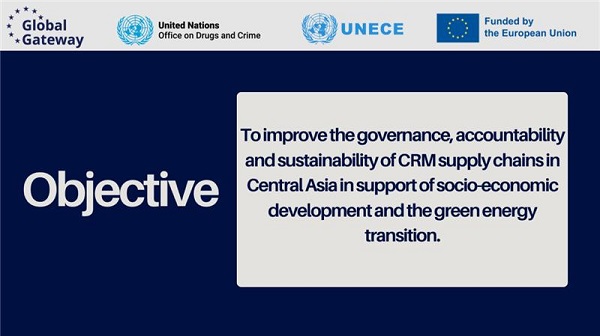
The project aims to strengthen governance, integrity, and sustainability in the supply chains of critical raw materials across Central Asia.
To achieve this, it will focus on improving the regulatory and institutional frameworks in the CRM sector, enhancing the integrity of supply chains, and reducing associated risks.
These risks include corruption, fraud, money laundering, and illegal mining activities — which is precisely why UNODC is involved, drawing on its extensive experience in combating organized crime.
Another key focus is the promotion of international standards for sustainable resource management, such as UNFC and UNRMS.
UNFC (United Nations Framework Classification for Resources) is an international system developed by UNECE for the classification, management, and reporting of reserves and resources of minerals, oil, gas, renewable energy sources, and anthropogenic resources (such as waste).
UNRMS (United Nations Resource Management System) is a voluntary global standard and comprehensive set of principles, also developed by UNECE, for the sustainable management of natural resources. It helps governments and companies use minerals, energy, water, and anthropogenic resources more effectively, while contributing to the achievement of the Sustainable Development Goals (SDGs).
Finally, the project will build capacity by training specialists and fostering knowledge exchange among the five Central Asian countries.
Ultimately, the initiative should enable Central Asia to benefit responsibly from its natural wealth — delivering gains for both the environment and the economy, rather than through shadowy schemes. It will also support the global transition to clean energy by providing Europe (and the world) with more reliable and truly “green” supplies of these essential minerals. ///nCa, 9 February 2026