


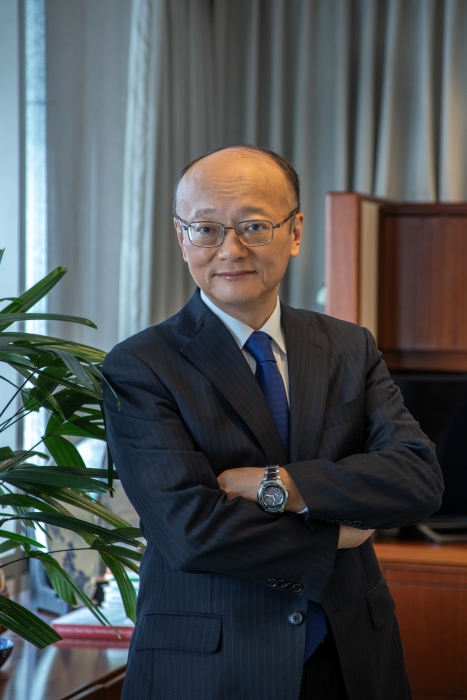
On 24 November 2026, President of the Asian Development Bank (ADB) Masato Kanda began a new term, pledging to use the bank’s expanded financial capacity to strengthen cross-border connections across Asia and the Pacific in service of shared development goals.
“Members have entrusted me with another five years, and I take that as a responsibility to deliver,” said Mr. Kanda. “Asia and the Pacific has the resources and talent to shape its own future. We must bring our economies closer together to bring affordable power to millions more people, open new opportunities for businesses, strengthen resilience, and build greater security against the shocks ahead. That will be the measure for our impact in the years ahead.”
Mr. Kanda, who was unanimously reelected by the ADB Board of Governors on 1 September, has made “One Region, One Connected Future” the central vision for his next five years. He aims to strengthen Asia and the Pacific’s economic resilience through greater cooperation across national boundaries on issues ranging from energy and trade to digital infrastructure, while making ADB faster and more responsive to the needs of its members. Drawing on ADB’s financing, expertise, and convening power, he seeks to help members unlock opportunities through stronger regional connectivity and cooperation.
During Mr. Kanda’s previous term, ADB provided a record $44 billion in development finance in 2025, including $29.3 billion from its own resources and $14.7 billion in cofinancing. He also secured the first amendment to ADB’s Charter in its 60-year history, enabling a 50% increase in annual financing capacity to more than $36 billion without requiring additional capital from shareholders.
That expanded capacity will help finance some of the region’s largest cross-border initiatives. In May, ADB launched plans to mobilize $70 billion by 2035 to connect power grids and digital networks. The $50 billion Pan-Asia Power Grid Initiative aims to improve electricity access for 200 million people, while the $20 billion Asia-Pacific Digital Highway is expected to improve connectivity for up to 650 million people, including 200 million who will gain broadband access for the first time.
Mr. Kanda is also pursuing a major expansion of ADB’s private sector operations. The bank aims to increase private sector lending fourfold by 2030, combining its own resources with financing mobilized from partners. ADB’s private sector operations generated $9.5 billion in financing for private investments in 2025, up from $6.8 billion in 2024. Under his vision, more than 40% of ADB’s public sector projects will also support private sector development.
Mr. Kanda became ADB’s 11th President on 24 February 2025. He previously served as Japan’s Vice-Minister of Finance for International Affairs and as a special adviser to the Prime Minister and Minister of Finance.
ADB is a leading multilateral development bank supporting sustainable, inclusive, and resilient growth across Asia and the Pacific. Working with its members and partners to solve complex challenges together, ADB harnesses innovative financial tools and strategic partnerships to transform lives, build quality infrastructure, and safeguard our planet. Founded in 1966, ADB is owned by 69 members—50 from the region. ///ADB, 24 November 2026