


Briefing at Foreign Office of Turkmenistan
nCa Report
A briefing that turned into a dialogue
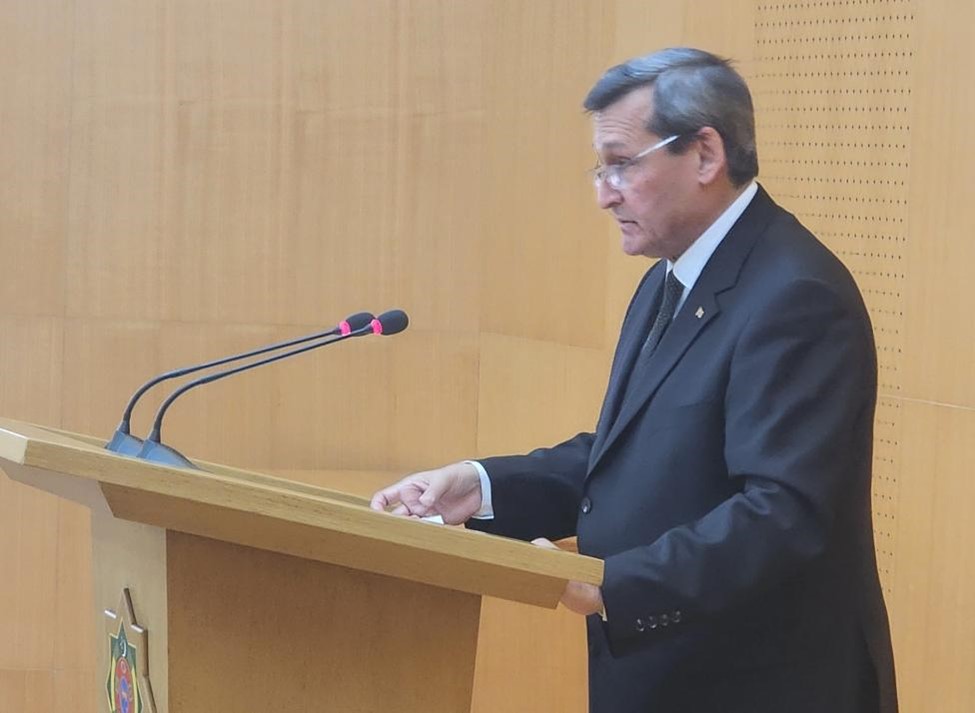
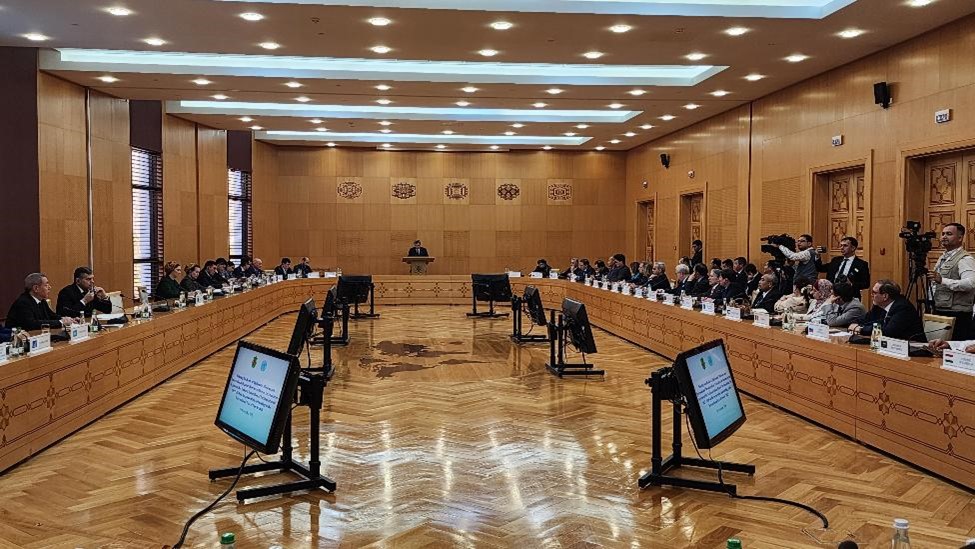
On 24 November 2026, Turkmenistan’s Deputy Prime Minister and Foreign Minister, Rashid Meredov, used a briefing for Ashgabat’s heads of diplomatic missions and international organisations to ask the diplomatic community to co-own the country’s programme for the 2028 UN Year of International Law. The event was billed as a briefing but became a candid exchange that ran nearly three hours, with little small talk.
The format explains much of its value. Meredov opened with a chronology and a six-part action plan. Eleven representatives then spoke: the UN Resident Coordinator, UNICEF, the UN Regional Centre for Preventive Diplomacy for Central Asia (UNRCCA), the OSCE Centre, the ambassadors of Azerbaijan, Russia, Pakistan and China, the EBRD, UNDP and the EU Delegation. The minister answered each in turn, and in almost every answer he converted an offer of goodwill into a specific task for 2027.
Two things were therefore happening at once. One was a practical programme-building exercise. The other was a statement about where Turkmenistan places its permanent neutrality: not as abstention from world affairs, but as a position that rests on, and actively promotes, the rules that govern them.
From a proposal at the UN to a national plan in 14 months
Meredov’s first point was about sequence. The initiative moved from a speech to an approved national plan in roughly fourteen months, and each step was formally anchored at both the international and the national level.
| Date | Step |
| September 2025 | President Serdar Berdimuhamedov proposes proclaiming 2028 the Year of International Law at the 80th UN General Assembly |
| 24 July 2026 | UN General Assembly adopts the resolution (by consensus, as the OSCE Centre’s head noted) |
| 23 September 2026 | Halk Maslahaty adopts the National Concept of International Law and Neutrality of Turkmenistan |
| 18 November 2026 | Action plan for 2027–2028 presented to the Presidium of the Halk Maslahaty |
| 22 November 2026 | President approves the action plan by resolution |
| 24 November 2026 | Plan presented to the diplomatic community in Ashgabat |
The most revealing document in this chain is the National Concept. By its title and by Meredov’s description, it treats permanent neutrality and international law as inseparable: neutrality’s practical implementation, he said, is firmly grounded in international law. That linkage is the conceptual core of the whole initiative, and the later speeches, especially the EBRD’s, tested it directly.
Meredov also warned against reading 2028 as one more entry in a list of Turkmen initiatives. He described it as a continuing, systematic process of dialogue directed at the future, and asked that preparation become a collective undertaking of states and organisations. The timing of the briefingwas consistent with that message: the plan was shared while it was still new, and partners were asked to shape their participation within it.
What the plan contains: six areas of activity
The plan covers 2027, treated as the preparatory year, and 2028. Its content is mostly convening, training and publication, with a few fixed milestones.
- Organisation and coordination. Annual calendars for 2027 and 2028 with regular monitoring, and a dedicated roadmap to be developed with the UN Secretariat’s Office of Legal Affairs.
- International cooperation. Events with UN member states, including dedicated meetings during the 82nd General Assembly session and the work of its Sixth Committee, and activities around International Law Week. Turkmen embassies abroad are to organise conferences of their own.
- Scientific and practical cooperation. An international conference, International Law, the Foundation of Global Peace and Trust, in the first quarter of 2027, followed by events on climate change, water resources, sustainable transport, digital technologies and artificial intelligence, plus research papers and methodological guides.
- Education and youth. Training courses in international law for officials and young diplomats, and an annual dialogue, Youth and International Law.
- Public information. A dedicated section on the Foreign Ministry’s website, material through youth media, and translation of key UN legal documents into Turkmen.
- The 2028 events. Opening ceremonies in Ashgabat and New York at the start of 2028, a special event during the 83rd General Assembly session (September–October 2028), and a Global Forum on International Law in December 2028.
Three features stand out. First, the thematic list in area 3 is deliberately forward-looking: water, transport, digital technology and AI are areas where norms are thin or contested, not settled. Second, the plan is built around a UN rhythm, tying Turkmenistan’s calendar to General Assembly sessions in New York. Third, the domestic dimension, particularly Turkmen-language access to legal texts and training for officials, gives the programme a purpose beyond diplomacy.
What the participants brought, and how Meredov answered
The eleven interventions fall into four groups. Each group supported the initiative, but each framed it through its own mandate or priorities, and Meredov’s replies were tailored to each.
The UN family: delivery and measurable results
The UN Resident Coordinator, Xiaojun Grace Wang, welcomed the emphasis on institutions, women and young people, multilingual and digital resources, and the link to the Sustainable Development Goals. Her central proposal was that 2028 should leave a legacy rather than a one-off commemoration, and that international law gains meaning when it is translated into policies that improve people’s lives.
UNICEF’s Jalpa Ratna made the same point with specifics. She suggested identifying a small number of measurable results in 2027, such as the government’s roadmap responding to the UN Committee on the Rights of the Child, children’s-rights education in schools, and the first national programme on child protection and justice for children, to be presented in 2028 as good practice. UNDP’s Narine Sahakyan offered capacity-building for legal professionals, public legal-awareness campaigns and expert dialogue, and tied the plan to SDG 16 on peaceful and inclusive societies and accountable institutions.
Meredov accepted these offers in kind. He proposed that 2027 events on children’s and youth rights be prepared in Ashgabat, invited UNICEF to propose joint activities, and asked UNDP to consider two forms of support: study visits by Turkmen lawyers to UN institutions abroad, and visits by international law experts to Turkmen universities and institutions. To the Resident Coordinator he added an ambitious thought: consultations on water, climate and environmental pressures could go beyond conferences and lead to proposals for new international legal norms, conventions or agreements.
Regional security bodies: preventive diplomacy and trust
The deputy head of UNRCCA placed the initiative as a continuation of the International Year of Peace and Trust, and described regional dialogues, work with young leaders, women and civil society on mediation, and attention to shared water and mountain glaciers as the Centre’s contribution. He also noted that UNRCCA will mark its 20th anniversary at the end of 2027.
Meredov asked that the Centre’s 2027 programme be coordinated with the national plan, and said the anniversary of the Centre’s headquarters in Ashgabat could advance the plan’s objectives.
The OSCE’s William Leaf anchored the initiative in the 1975 Helsinki Final Act, under which participating states undertake to fulfil obligations under international law in good faith, and offered four concrete things: carrying the initiative into OSCE bodies including the Parliamentary Assembly, help with educational resources and youth dialogues, expert input to the academic events, and support for translating legal documents into Turkmen. He mentioned a series of about ten lectures on the OSCE and international law that he is preparing. Meredov welcomed this and added a challenge: the OSCE, he said, should consider additional mechanisms and new ideas to increase its effectiveness.
Economic and European partners: rules, trade and legislation
The EBRD’s Eric Livny gave the most analytical contribution of the day (examined in the next section). Meredov’s reply was practical: Turkmenistan would organise special events on the legal system governing international economic and trade relations, and he invited the Bank to develop projects to train Turkmen specialists in commercial law, building on discussions during the EBRD President’s visit earlier in 2026.
The EU Delegation’s Maciej Madalinski confirmed continued support for Turkmenistan’s WTO accession, including assistance in the period leading to 2028, and for methane reduction. He welcomed the translation of UN documents into Turkmen as a way for people to understand their own legal rights. Meredov responded by recalling the EU’s TACIS programme of the late 1990s, which supported drafting of a new Civil Code with German legal experts, and current cooperation with the German agency GIZ, under which legislative development continues.
States: shared language on the UN, different emphases
Four ambassadors spoke, and the register was one of reciprocity. Azerbaijan’s Gismat Gozalov stressed sovereign equality, territorial integrity and the peaceful settlement of disputes, recalled that the General Assembly recognised Turkmen neutrality in 1995, and praised the 2026 CIS chairmanship, including the General Assembly resolution on UN–CIS cooperation.
Russia’s Ivan Volynkin spoke of Turkmenistan’s inclusive, non-confrontational approach, the UN’s central coordinating role, and the CIS chairmanship’s work on logistical security in the Caspian and Russia–Central Asia connectivity.
China’s Ji Shumin presented President Xi Jinping’s Global Governance Initiative and its five principles as aligned with Turkmenistan’s position.
Pakistan’s Faryal Leghari proposed that the Year develop a framework to encourage states to avoid further departures from their international legal obligations, and noted that neutrality positions Turkmenistan to promote a comprehensive plan for all member states.
The ambassadors of Azerbaijan, Russia and China each said their country co-sponsored the resolution, and Pakistan welcomed it. Meredov’s replies to each emphasised reciprocity: Turkmenistan supports their initiatives at the UN as they support its own. To Pakistan and China he added a direct invitation to take an active part in 2027–2028 events, and he welcomed the Global Governance Initiative’s ideas as consistent with Turkmen views on reforming international relations.
Reading the exchange: five observations
1. Neutrality is being argued as a legal position, not only a political one. The strongest articulation came from outside the room’s diplomatic core. Eric Livny of the EBRD argued that international law exists because states can do better under common rules, and that smaller and neutral states depend on it most. A neutral state, he said, cannot rely on alignment with one bloc; its security rests on rules that apply equally to all, and that model is hard to sustain when countries are expected to choose camps. He cited the WTO Appellate Body, unable to hear appeals since 2019 for lack of consensus on appointments, as a symptom, and drew parallels with the Concert of Europe and the League of Nations, which both ultimately failed. Reform, he acknowledged, may take longer than two years, but must start now.
This is a sober assessment, and it supports Turkmenistan’s own reasoning for making law the centrepiece of 2027–2028. Meredov did not engage the “might is right” warning directly. He took the trade-law material seriously and turned it into a training project, but his own closing remark, “Today, all of us are lacking this,” was an unusually plain acknowledgement of the gap that Livny described.
2. The minister was candid about difficulty, and steered towards the constructive. In his opening remarks Meredov conceded that even affirming the primacy of international norms and the UN Charter has become increasingly difficult. His response was not to dwell on violations but to build an institutional programme around the principle. That is consistent with Ashgabat’s long-standing style: no naming of offenders, a positive agenda, and practical mechanisms.
3. The agenda is moving from commemoration to norm development. Several remarks pointed beyond conferences. Wang and Livny both argued for a legacy beyond 2028. Meredov himself suggested that consultations with the UN system on water scarcity and climate could produce proposals for new legal norms, conventions or agreements. Given that the plan also lists water, transport, digital technologies and AI as conference topics, there is a visible path from discussion to proposals. Whether it is taken will depend on partners, particularly on the UN Office of Legal Affairs roadmap and on what emerges from the first-quarter 2027 conference.
4. Everyone endorsed the UN Charter, but not for the same reasons. Azerbaijan stressed territorial integrity and the peaceful settlement of disputes. Russia stressed the UN’s central coordinating role and the CIS. China presented its Global Governance Initiative as a parallel framework. Pakistan raised the need for a mechanism to discourage departures from legal obligations. The EBRD and the EU spoke of trade rules and WTO accession. These are overlapping but distinct readings, and the Year of International Law will be one of the few forums where they are discussed side by side under a neutral host. That is an asset for Turkmenistan, and also a reason why the substance of 2027 events will need careful design if they are to produce more than parallel statements of support.
5. Reciprocity is the working currency. Meredov told Azerbaijan, Russia and China that Turkmenistan also supports their UN initiatives, and recalled long-standing cooperation with Pakistan and the EU. UN votes, co-sponsorship and mutual support are how a state of Turkmenistan’s size maintains standing. The success of the 2028 resolution, adopted by consensus, shows the method works; the next test is whether the same breadth of support converts into participation in events.
What to watch in 2027
The briefing’s most useful outcome is a set of near-term tests. These are the points where the programme will show whether it has traction:
- The first-quarter 2027 conference, International Law, the Foundation of Global Peace and Trust, which will show who attends and at what level.
- The roadmap with the UN Office of Legal Affairs, and whether the annual calendars and monitoring promised in the plan are published.
- Concrete deliverables from offers made on 24 November: OSCE lectures, EBRD commercial-law training, UNDP-supported study visits, UNICEF’s measurable results, and Turkmen-language translations of UN legal documents.
- Any move from conferences to proposals on water and climate law, which would be the most substantive extension of the initiative.
- UNRCCA’s 20th anniversary events, which Meredov wants harmonised with the national plan.
The overall impression is of a diplomatic exercise with a clear logic: neutrality anchored in law, law anchored in the UN, and a programme designed to keep partners engaged for two years. Its credibility will rest less on the resolution already adopted than on the quality of what is delivered in 2027. /// nCa, 25 November 2026