


Liliya Zhirnova
As the late autumn chill settles over Ashgabat, most urban foliage yields to shades of gold and russet. Yet, tucked along residential fences and garden edges across the city, an occasional shrub defies the season with dense clusters of vivid orange and scarlet berries. This striking plant is the scarlet firethorn (Pyracantha coccinea), a hardy member of the rose family (Rosaceae) native to a broad arc stretching from southeastern Europe through the Caucasus and into northern Iran.
In the languages of the region, its names reflect both its botanical lineage and its fiery appearance:
- English: Scarlet firethorn, red firethorn, or simply pyracantha.
- Russian: Пираканта ярко-красная (Pirakanta yarko-krasnaya) or пираканта красная (pirakanta krasnaya).
- Turkmen: Pirakanta (пираканта — the standard botanical and horticultural borrowing from Russian), though colloquially its descriptive sense mirrors the Turkic ot tiken (“fire thorn”).
Botanical Characteristics The name Pyracantha is drawn from the Greek pyr (fire) and akantha (thorn), an apt summary of its defining traits. Growing typically as a dense, evergreen or semi-evergreen shrub reaching two to four meters in height, it is armed with stiff, needle-sharp thorns up to 2.5 centimeters long.
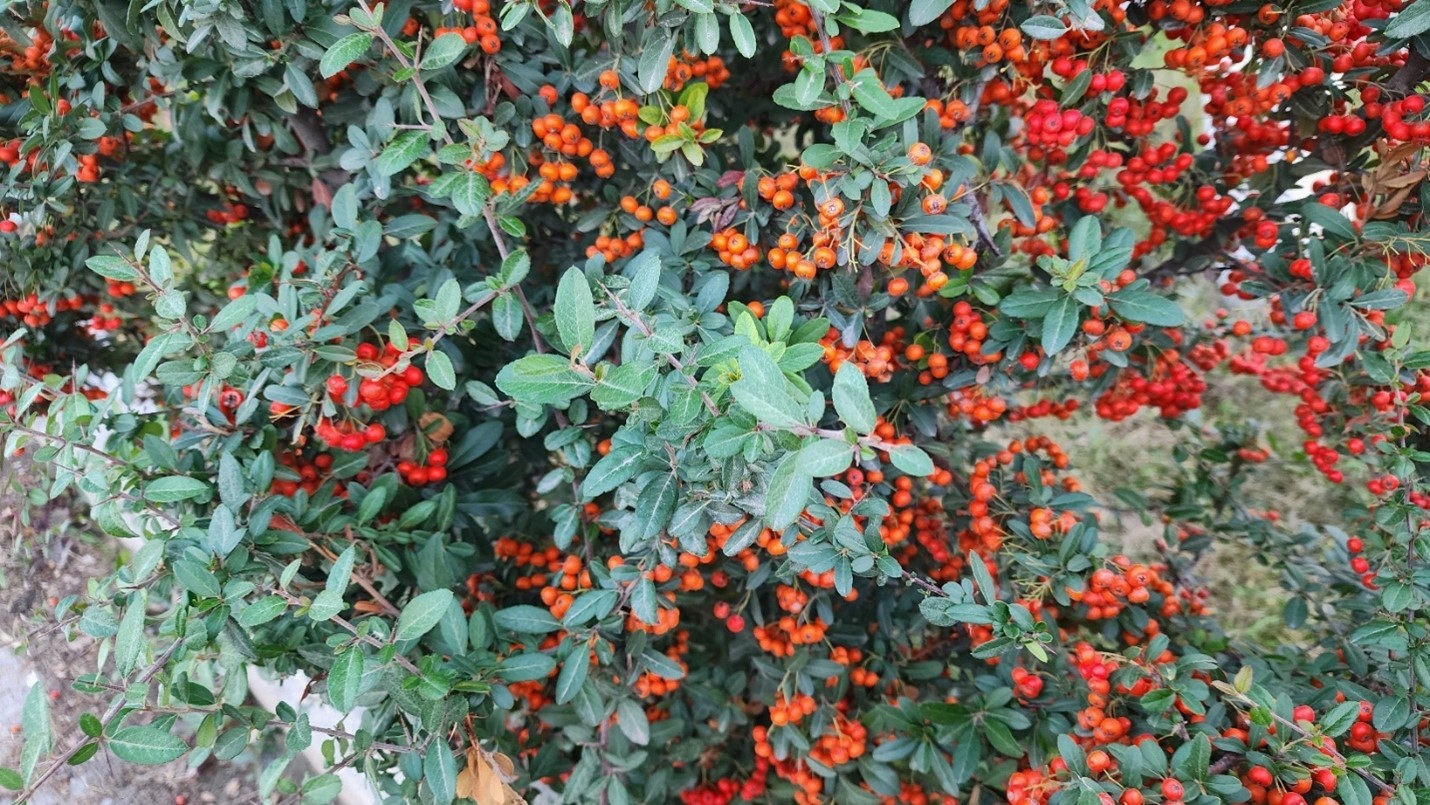
Its small, leathery, glossy dark-green leaves remain on the branches through winter. In late spring, the shrub produces flat clusters of small white blossoms, which mature by autumn into heavy, pendulous bunches of pea-sized pome fruits ranging from bright tangerine to deep crimson.
Role in Ecology and the Urban Environment In an arid, sun-drenched environment like Ashgabat, Pyracantha coccinea proves remarkably resilient. Once established, it tolerates heat, prolonged drought, alkaline or poor soils, and urban air pollution. Ecologically, it serves a vital three-fold purpose in city landscapes:
- Wildlife Sanctuary: Its dense, thorny branches offer secure nesting sites for small urban birds, shielding them from cats and birds of prey.
- Winter Pantry: Because the berries remain intact on the branches well into winter without rotting, they act as an essential emergency food reserve for resident and migratory birds when insects and other fruits are scarce.
- Soil Stabilization and Living Fences: Its deep root system helps anchor soil on slopes against wind and water erosion, while its impenetrable, thorny structure makes it an effective natural security hedge along property boundaries.
Is the Fruit Edible? Technically, the berries are not poisonous, though they are far from a choice snack. Eaten raw, the flesh is mealy, tart, and astringent, and the tiny seeds inside contain trace amounts of cyanogenic glycosides—the same bitter compounds found in apple seeds—which can cause mild stomach upset if consumed in large quantities. However, cooking neutralizes these compounds. In parts of Europe and Western Asia, the ripe berries are simmered with sugar and pectin to make tart, vibrant jellies, marmalades, and savory sauces to accompany roasted meats.
Medicinal Properties in Leaves and Fruit Beyond its ornamental charm, Pyracantha coccinea holds a modest place in traditional folk medicine and modern phytochemical research. Laboratory analyses have confirmed that the berries are rich in polyphenols, flavonoids (such as quercetin, rutin, and hyperoside), and antioxidants, giving extracts measurable antimicrobial and anti-inflammatory properties.
In traditional herbal practices across Anatolia and southeastern Europe, infusions of the dried leaves have been used as an astringent remedy to ease diarrhea and mild urinary tract inflammation, while preparations of the fruit have historically been regarded as a mild cardiac tonic—much like its close botanical cousin, the hawthorn (Crataegus). Still, because raw parts of the plant contain mild irritants and seed compounds, it remains primarily a botanical curiosity and landscape gem rather than a staple of household remedies. /// nCa, 20 November 2026