


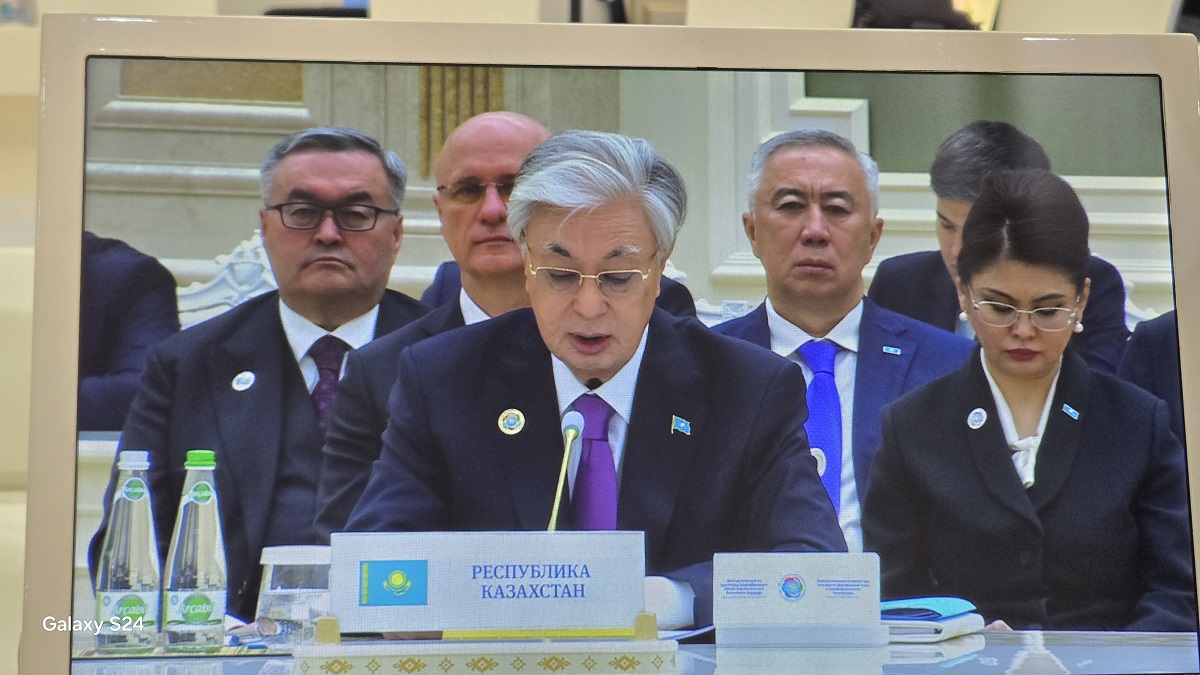
The Consultative Meeting of the Heads of State of Central Asia and Azerbaijan in the expanded “C6” format, held on 8 October 2026 in Awaza, Turkmenistan, marked a crucial transition from institutional formation toward structured execution.
In his address, President Kassym-Jomart Tokayev of the Republic of Kazakhstan framed the summit as a pivotal milestone celebrating the 35th anniversary of independence of regional states. While advancing ambitious proposals across trade, transport, water governance, and artificial intelligence, President Tokayev introduced a defining thematic shift for the C6 format: urging leaders to shift focus from the accumulation of new initiatives toward rigorous implementation, institutional inventory, and measurable, practical outcomes.
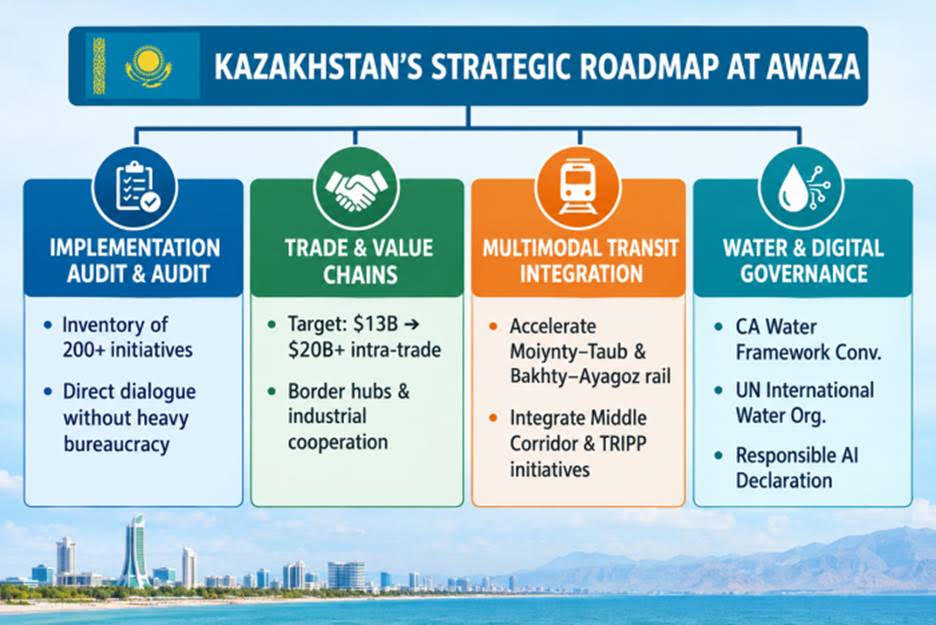
Executive Snapshot: Key Proposals by President Kassym-Jomart Tokayev
- Implementation & Institutional Audit: Perform a complete inventory of the 200+ initiatives proposed since 2018 to prioritize high-value projects, eliminate non-viable proposals, and guard the Consultative format against excessive formalization.
- Intra-Regional Trade Expansion: Increase internal C6 trade from $13 billion to at least $20 billion through border logistical hubs, removal of barriers, and regional value chains.
- Middle Corridor & Infrastructure Scaling: Complete key railway arteries (Moiynty–Taub, Darbaza–Maktaaral, Bakhty–Ayagoz) and examine expert-level integration between the Middle Corridor and regional transit initiatives.
- Transboundary Water Management: Adopt a Central Asian Framework Convention on Water Resources Management and advance the establishment of an International Water Organization under UN auspices.
- Artificial Intelligence Governance: Launch a Central Asian Partnership Program on AI and adopt a Declaration on the Responsible Use of Artificial Intelligence.
- Soft Power & Humanitarian Infrastructure: Establish a regional television channel, launch a 2027 Youth Volunteering Forum, and introduce a unified calendar of cultural, scientific, and tourism events.
The Full Speech
The complete official text and executive report of President Kassym-Jomart Tokayev’s address is available on the official website of the President of the Republic of Kazakhstan (Akorda):
Official Akorda Page — President Takes Part in the Consultative Meeting:
Analytical Breakdown of the Position of Kazakhstan
President Tokayev’s address delivered a comprehensive blend of strategic infrastructure planning, digital foresight, and a realistic critique of regional governance.
1. The Core Imperative: Quality of Execution Over Quantity of Initiatives
The most significant analytical contribution of President Tokayev’s speech was his candid evaluation of the Consultative format’s progress. Noting that over 200 initiatives had been put forward since 2018 with only a small fraction realized, Tokayev warned against bureaucratic over-expansion. He requested that foreign ministry officials carry out a comprehensive “inventory” of all past proposals to establish their ongoing viability, urging that the C6 process remain a direct, flexible platform focused exclusively on practical results.
2. Boosting Intra-Regional Commerce to $20 Billion
Highlighting that intra-regional trade currently accounts for $13 billion (only 8% of total C6 external trade), Tokayev called on member governments to adopt a joint action plan to raise this figure to at least $20 billion. This goal is to be supported by linking border trade-logistics complexes and industrial parks into continuous regional supply chains.
3. Transport Infrastructure & Trans-Caspian Connectivity
Underlining Kazakhstan’s massive infrastructure investments, Tokayev highlighted the imminent completion of key rail lines (Moiynty–Taub, Darbaza–Maktaaral, and Bakhty–Ayagoz) and major highway corridors connecting Western China to the Caspian Sea. While reaffirming the vital nature of the Middle Corridor (Trans-Caspian route) and the North-South line, he proposed expert-level discussions to integrate the Middle Corridor with wider regional transport initiatives.
4. Transboundary Water Management Framework
Pointing to shrinking water resources and climate pressures, Tokayev proposed a Central Asian Framework Convention on Water Resources Management to establish transparent, equitable management of transboundary rivers. He also reiterated support for establishing an International Water Organization under UN auspices to give Central Asia a unified voice in global water security.
5. Responsible AI & Shared Compute Networks
Capitalizing on Kazakhstan’s digital progress, President Tokayev proposed drafting a Declaration on the Responsible Use of Artificial Intelligence alongside a regional AI Partnership Program to facilitate knowledge transfer across universities, tech centers, and supercomputer clusters.
6. Humanitarian Ties, Youth & Media Space
To deepen civic integration, Tokayev proposed a regional television channel based on Silk Way, hosting a regional Youth Volunteering Forum in 2027 under the motto “Central Asia – A Shared Territory of Good Deeds,” and establishing a single C6 calendar for tourist, cultural, and sports events.
Bilateral Engagement: Kazakhstan – Turkmenistan Dialogue
In addition to his address at the plenary session, President Tokayev held a focused bilateral meeting with President Serdar Berdimuhamedov of Turkmenistan on the sidelines of the Awaza summit.
- Strategic Partnership: Both leaders reaffirmed the high dynamic of Kazakh-Turkmen relations, emphasizing trade growth, energy transit, and boundary demarcation agreements.
- Transit & Logistics Synergy: Special attention was paid to expanding freight transit along the Kazakhstan–Turkmenistan–Iran railway artery and maximizing the capacity of Caspian sea ports (Aktau/Kuryk and Turkmenbashi).
- Cultural & Energy Ties: The leaders agreed to expand joint industrial projects, energy transit coordination, and cultural exchanges, highlighting the role of Kazakh-Turkmen cooperation as a stabilizing anchor for the broader Caspian region. /// nCa, 8 October 2026