


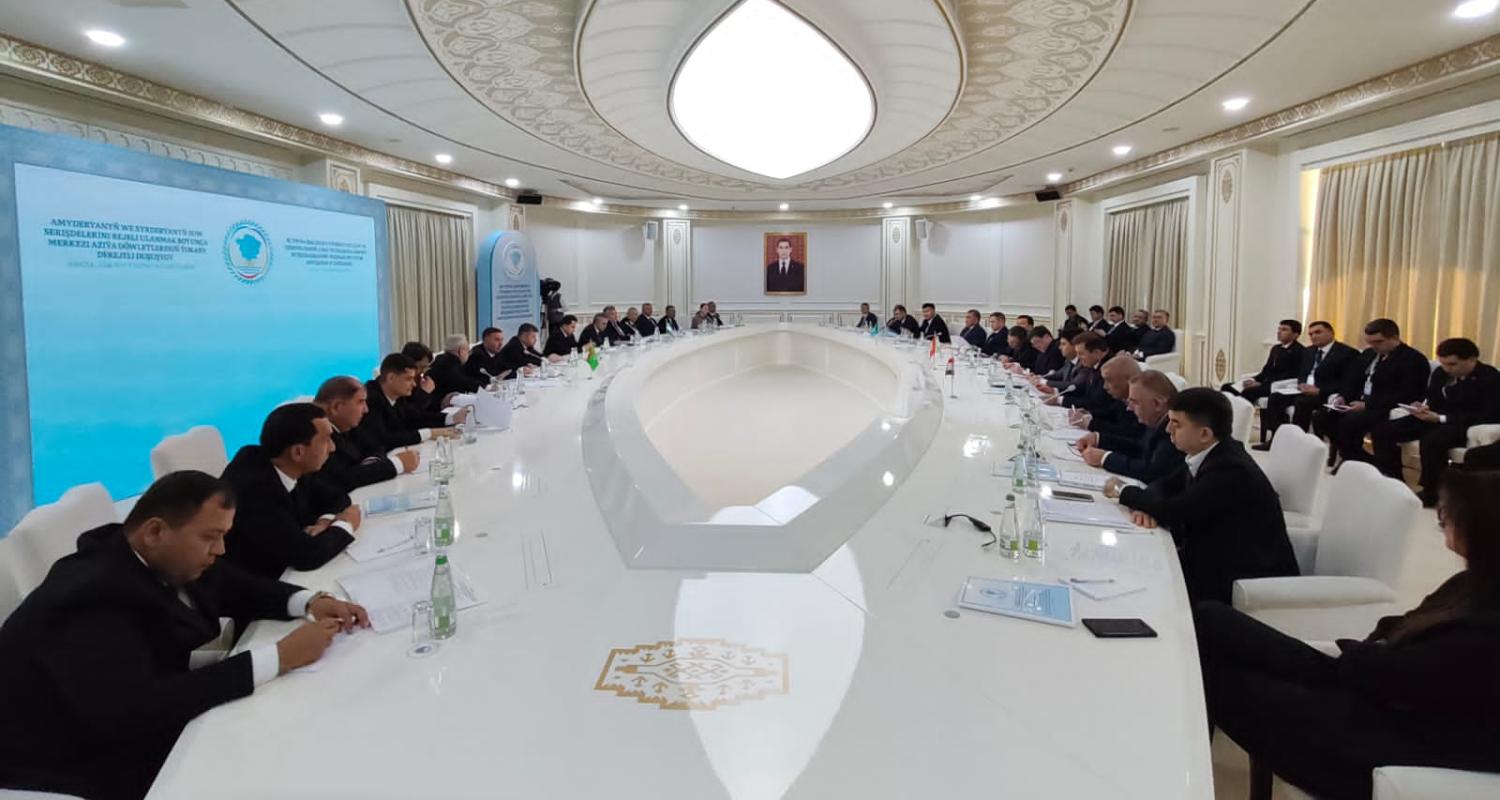
AVAZA, Turkmenistan – Central Asian countries have developed a common vision for strengthening cooperation over the Amu Darya and Syr Darya, following a high-level meeting in Avaza that placed transboundary water management, demographic and economic needs, and climate resilience at the centre of regional dialogue.
The High-Level Meeting of the Central Asian States on the Rational Use of Water Resources of the Amu Darya and Syr Darya Rivers, held on October 7, brought together ministers and senior officials responsible for water management from the Central Asian states.
The meeting was chaired by the State Committee for Water Management of Turkmenistan and provided a forum for the participating delegations to present national assessments of the current water situation, identify challenges and explain their approaches to the rational use of the two major river systems.
The discussions focused particularly on the joint management of transboundary water resources and on improving water-use mechanisms while taking account of the socio-economic and demographic development of the countries of the region. Participants also considered how to strengthen the resilience of the water sector as climate change alters the conditions under which Central Asia manages its rivers and reservoirs.
Following the exchange of views, the participants developed what the Turkmen Foreign Ministry described as a common vision of further steps to strengthen regional water cooperation.
No single new water-allocation treaty or major infrastructure agreement was announced. The significance of the meeting instead lies in bringing the political and policy dimensions of the region’s water challenge into a common discussion alongside the technical work being carried out through the ICWC.
A problem larger than seasonal allocation
The region’s water challenge is increasingly about more than deciding how much water each country receives in a particular season.
Central Asia’s major rivers originate largely in the mountainous areas of Kyrgyzstan and Tajikistan, while much of the water is consumed in the irrigated plains of Uzbekistan, Turkmenistan and southern Kazakhstan. This creates a natural interdependence between upstream water storage and downstream agricultural and environmental requirements.
Climate change adds another layer of uncertainty. The ICWC’s regional climate assessment points to rising temperatures, changing precipitation patterns and accelerated glacier loss as factors capable of altering the long-term availability and seasonal distribution of water.
The World Bank likewise identifies more frequent droughts and floods, ageing water infrastructure and limited regional data sharing as challenges to effective management of the Amu Darya and Syr Darya systems. It estimates that the region could obtain substantial economic gains from better coordination in the operation of shared water infrastructure and improved information systems.
Against that background, the Avaza meeting’s emphasis on joint management, more effective water-use mechanisms and climate resilience reflects a shift towards treating water security as a regional systems issue rather than simply a series of bilateral allocation questions.
Water, agriculture and demographic pressure
The meeting also explicitly connected water management with demographic and socio-economic development.
That connection is becoming increasingly important. Water is central to irrigation and therefore to food production and rural livelihoods, while population growth and economic development can increase demand for both agricultural and municipal water.
The World Bank estimates that agriculture accounts for around 90 percent of freshwater withdrawals in Central Asia. It also notes that relatively small changes in seasonal water availability can have substantial effects on irrigated agricultural production and the incomes and welfare of communities dependent on agriculture.
The implication is that future water cooperation will have to deal simultaneously with supply, demand and efficiency.
This is one reason why water-saving technologies and digital monitoring featured in the parallel 95th ICWC meeting held in Avaza on the same day. The five countries there agreed on water distribution and projected reservoir operating regimes for the 2026–2027 non-growing season, while also reviewing progress on water-saving and digital technologies and the implementation of ASBP-4.
From diplomacy to practical cooperation
The wider regional architecture for addressing these issues is also evolving.
The five Central Asian countries established the International Fund for Saving the Aral Sea in the 1990s as their principal regional mechanism for cooperation over the Aral Sea Basin. Its programmes have progressively broadened from addressing the immediate consequences of the Aral Sea disaster to water management, environmental protection, socio-economic development and institutional cooperation. ASBP-4, the current 2021–2030 programme, includes projects covering water infrastructure, automated water accounting, water-saving technologies, climate adaptation, environmental monitoring and ecosystem restoration.
In April 2026, the heads of the IFAS founding states met in Astana, where they reviewed the Fund’s work and highlighted the links between the Aral Sea region’s environmental condition and the wider issues of water management, food and energy security. The fourth phase of the Aral Sea Basin Programme was among the regional mechanisms highlighted in that context.
More recently, the World Bank approved its $20 million Central Asia Water Efficiency Cooperation Project, with the IFAS Executive Committee responsible for implementation. Among its objectives are digitalisation of regional water accounting, preparation of joint transboundary infrastructure projects and strengthening the capacity of regional water-management institutions.
There is therefore a growing convergence between the political dialogue taking place among governments, the operational coordination carried out through the ICWC, the environmental agenda of IFAS and the international development projects now being assembled around regional water efficiency.
Turkmenistan’s role as host
For Turkmenistan, the Avaza meeting also provides an opportunity to reinforce its longstanding presentation of neutrality and dialogue as instruments of regional cooperation.
The Foreign Ministry said that holding the meeting on Turkmen soil reaffirmed the country’s commitment to good-neighbourliness, mutual respect and constructive dialogue in addressing common regional challenges.
The timing is notable. Water is one of several interconnected regional issues being discussed in Avaza this week. The Consultative Meeting of the Heads of State of Central Asia and Azerbaijan on October 8 is expected to address environmental protection, climate adaptation and rational water use, while the October 9 programme includes the CIS summit and a Caspian Environmental Summit.
The discussions in Avaza therefore place water diplomacy alongside transport connectivity, environmental protection and regional economic cooperation—issues that increasingly overlap in practical terms.
The immediate outcome of the October 7 high-level meeting is a common vision for further cooperation, rather than a new treaty. Its importance will ultimately be measured by whether that common vision can be translated into more efficient water use, stronger data and monitoring systems, climate adaptation and sustained coordination between upstream and downstream states.
That makes the meeting less a conclusion than another step in a continuing regional effort to make the management of Central Asia’s shared water resources more predictable, efficient and resilient. /// nCa, 8 October 2026