


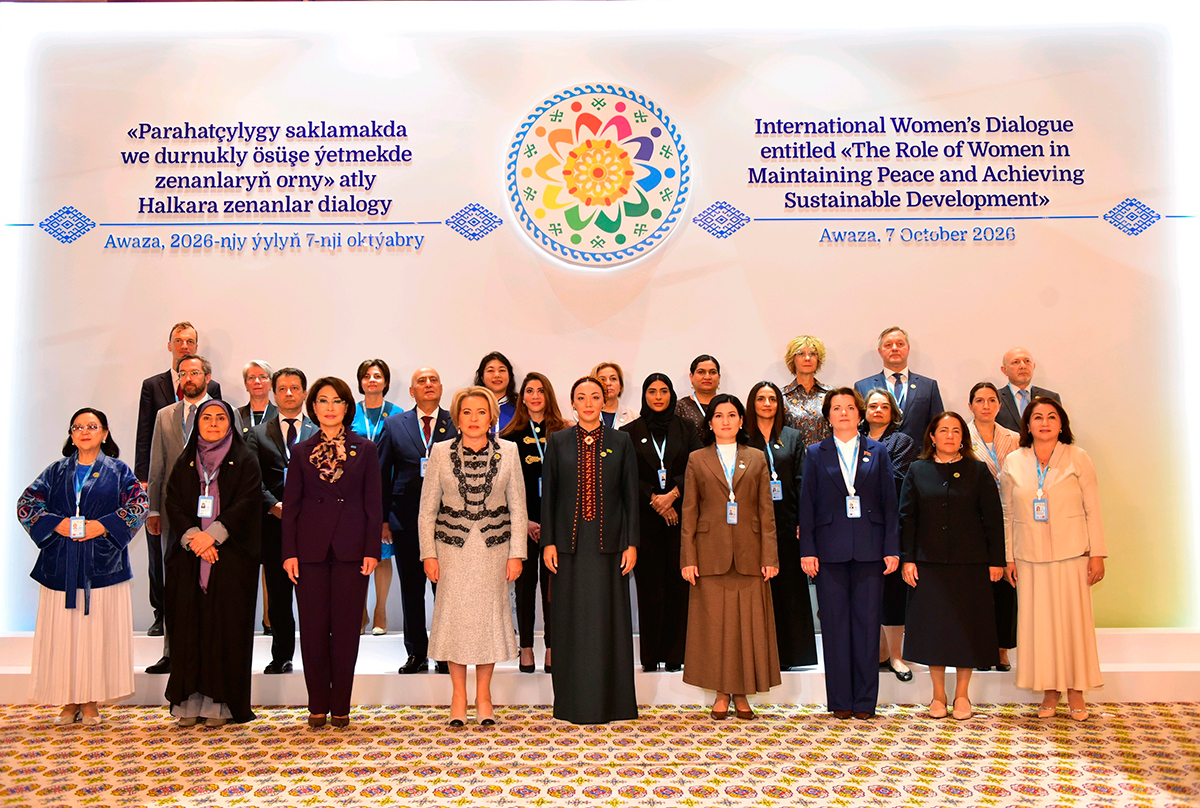
Raviliya Kadyrova at Awaza
The International Women’s Dialogue in Turkmenistan has opened with a question that goes beyond women’s rights: how can women’s participation in public life, diplomacy and economic development support peace and resilience in a region facing climate change, water and food insecurity, economic instability and social change?
The dialogue, titled “The Role of Women in Maintaining Peace and Achieving Sustainable Development,” opened on 7 October in the Avaza National Tourist Zone. Participants include representatives of parliaments, governments, diplomatic missions, United Nations agencies and expert communities, among them delegations from CIS states and Türkiye.
The agenda draws on the UN Women, Peace and Security framework and the Sustainable Development Goals. Discussions cover women’s roles in preventive diplomacy, peacebuilding and decision-making, and the legal mechanisms needed to create equal opportunities in government, economic life and international cooperation.
A range of national perspectives
Russian Federation Council Chair Valentina Matvienko said women can bring a stronger culture of dialogue and compromise to a difficult international environment. She described the meeting as timely amid what she called profound changes in the international system, and argued for a more human-centred approach to international politics and economics.
The choice of venue also carries a diplomatic message. Turkmenistan has long presented its policy of permanent neutrality as a platform for dialogue, and the dialogue places that approach alongside the international Women, Peace and Security agenda.
Mejlis Chair Dunyagozel Gulmanova said that increasing women’s role in society is becoming an important trend in social development. She pointed to national legal mechanisms and action plans intended to guarantee equal rights and opportunities.
From commitments to implementation
A UN representative called for international commitments on women’s rights to be translated into practical results. The intervention acknowledged progress but pointed to continuing systemic barriers. It stressed that gender equality is not an issue for women alone and that men and boys must be partners in the process.
The representative named three requirements for implementation: data, policy and services.
The speaker referred to Turkmenistan’s multiple indicator cluster surveys, its preparation of a third Voluntary National Review on the SDGs, and its National Action Plan on Gender Equality.
The emphasis on implementation shifts the discussion from declarations of support towards a practical test. The question is whether governments have the information, policies and public services to turn commitments into measurable improvements.
Central Asian contributions
Uzbekistan’s Deputy Prime Minister and Chair of the Committee for Family and Women, Dilnozakhon Kattakhonova, highlighted the effects of economic instability, climate change and water and food-security problems on women and children. She argued that gender considerations should be built into decision-making, negotiations and post-conflict reconstruction.
She said Uzbekistan’s approach includes wider participation by women in decision-making, expanded education and human-capital development, support for employment, stronger social infrastructure, and targeted assistance through the “Women’s Notebook” system. She also described Turkmenistan’s policy of permanent neutrality as a contribution to trust and a culture of dialogue in Central Asia.
Kazakhstan’s contribution tied the agenda to climate and human security. Health Minister Akmaral Alnazarova linked the protection of women and children to the effects of a changing climate. She said rising temperatures, extreme heat, diminishing water resources and ecosystem degradation pose particular risks to both groups. She called for preventive action and closer cooperation among regional governments, international experts and financial institutions, treating climate adaptation and gender policy as one subject.
Iran and Belarus
Iranian Minister of Roads and Urban Development Farzaneh Sadegh Malvajerd spoke about Iranian women’s role in crisis response and infrastructure reconstruction, and their contribution to science, culture, sport and entrepreneurship. She said Iranian policy includes support for families, removal of barriers to women’s professional advancement, protection of women’s rights and the promotion of social justice. Her portfolio itself links the social and economic dimensions of the discussion to infrastructure and reconstruction.
Belarus presented a family-centred approach. Natalia Pavlyuchenko, chair of a standing commission of the Council of the Republic, said support for women, motherhood and childhood is a priority of state policy. She cited figures putting women at 54 percent of the population and more than 85.5 percent of employment among women of working age. By her account, women hold almost one-third of National Assembly seats, 36 percent of senior government positions, 48 percent of local-government positions and 67 percent of judicial posts, and account for nearly 42 percent of entrepreneurship.
Belarus has designated 2026 the Year of the Belarusian Woman. Pavlyuchenko linked gender policy with the protection of the family and invited international partners to a family forum due in Polotsk later this month.
Assessment
The interventions show no single regional formula. Emphasis differs by country: preventive diplomacy in one case, climate and health in another, employment and education elsewhere, family policy and social protection in others.
A common thread is that women’s participation is increasingly discussed as part of a society’s capacity to manage crises, maintain cohesion and pursue sustainable development, rather than only as a matter of representation. That is particularly relevant in Central Asia, where climate pressure, water availability, food security, demographic change and economic transformation are closely linked. The Uzbek and Kazakh interventions illustrate how gender considerations are being brought into these broader policy fields.
The organisers say the dialogue’s conclusions will include recommendations on strengthening the legal protection of women, increasing their participation in international cooperation and advancing peace initiatives. The test will be whether those recommendations connect three levels that are often discussed separately: women’s rights and representation; women’s meaningful participation in decision-making; and the wider peace, security, climate and development challenges facing societies. /// nCa, 7 October 2026