


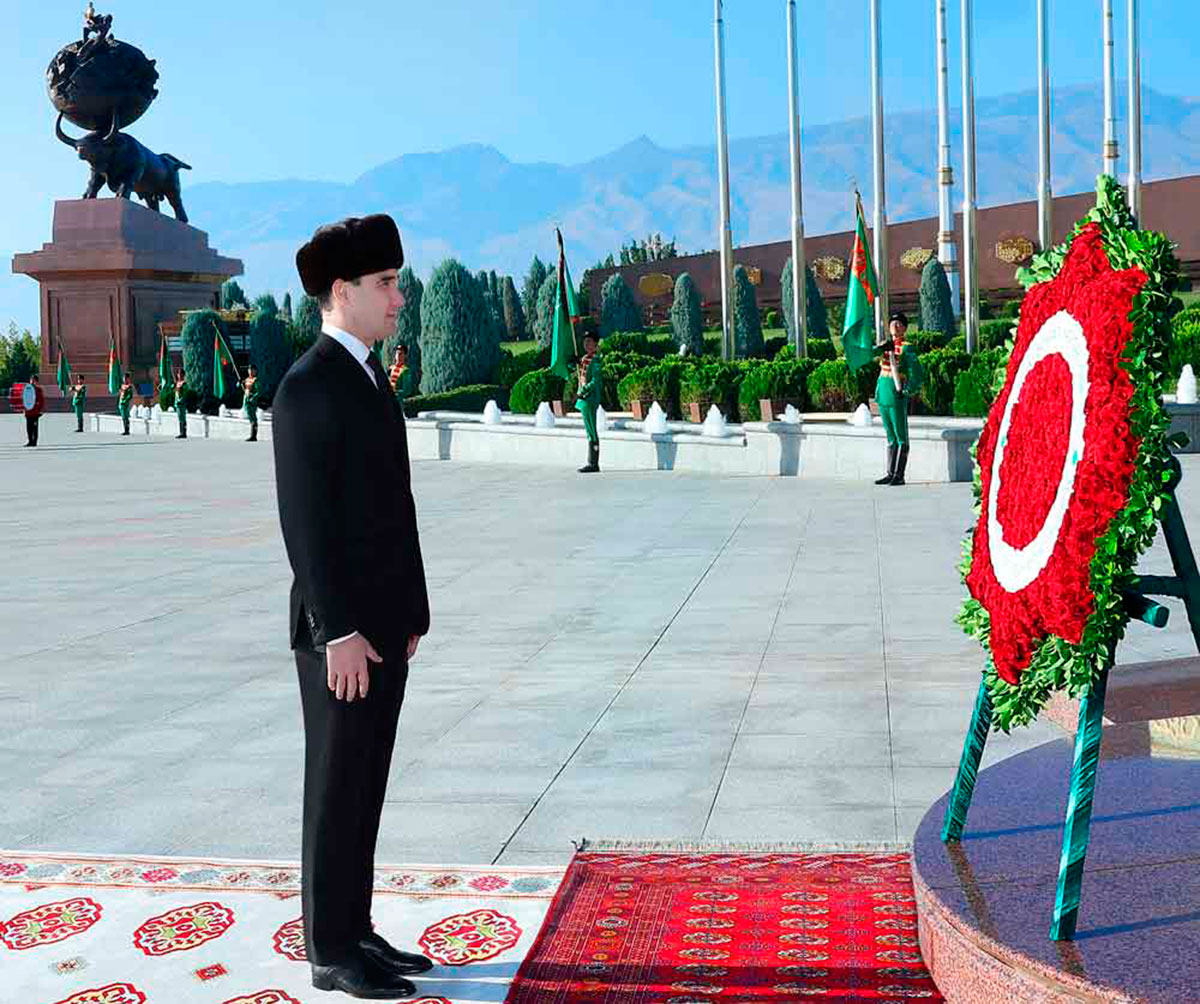
Turkmenistan on Tuesday observed Remembrance Day, commemorating the victims of the devastating Ashgabat earthquake of October 6, 1948, as well as Turkmenistan’s fallen soldiers and other national heroes.
The principal ceremony took place at the Halk hakydasy (People’s Memory) Memorial Complex in Ashgabat, where President Serdar Berdimuhamedov participated in the traditional wreath-laying ceremony.
The ceremony began with the national anthem, followed by the playing of the mournful melody Keçpelek, traditionally associated with the national remembrance of those who died in the earthquake and in the defence of the country.
The President laid a wreath at the Ruhy tagzym monument, dedicated to the victims of the 1948 earthquake, and subsequently at the Milletiň ogullary and Baky şöhrat monuments, commemorating soldiers who died in the Second World War and heroes who gave their lives in other battles for the country. The ceremony was attended by senior government officials, representatives of the military and law-enforcement agencies, diplomats and representatives of international organisations accredited in Turkmenistan, political and public organisations, elders, students and residents of the capital.
Similar remembrance ceremonies were held in Arkadag city and all the velayats, in accordance with the country’s national traditions. Memorial observances included the distribution of sadaqa and prayers for the departed.
Remembering the earthquake
The earthquake struck Ashgabat shortly after midnight on October 6, 1948. The disaster virtually destroyed the city and became one of the defining tragedies in the modern history of Turkmenistan.
The precise number of victims has been subject to differing historical estimates, but the scale of the catastrophe was enormous. Entire neighbourhoods were destroyed, while homes, public buildings, hospitals, schools and other infrastructure collapsed. The disaster also claimed the lives of people from different ethnic communities who were living and studying in Ashgabat at the time.
That multi-ethnic dimension has been emphasised in this year’s cultural commemoration. On the eve of Remembrance Day, the Alp Arslan National Drama Theatre staged Halk hakydasy, a production based on a play by Gadam Kakabayev. The production, which recently received the Grand Prix at a national theatre festival, reconstructs the events of the earthquake night and depicts the destruction of a women’s student dormitory at one of Ashgabat’s higher educational institutions.
The playwright stressed that the production is not intended as the story of a single hero or even a single nationality. Turkmen, Uzbek, Kazakh, Kyrgyz, Russian, Armenian, Tajik and other residents were among those caught up in the disaster, while doctors, soldiers and ordinary residents took part in rescue efforts.
The production therefore presents the earthquake not only as a national tragedy but also as a human catastrophe in which people of different backgrounds confronted a common disaster.
From remembrance to earthquake preparedness
This year’s commemoration also acquired a contemporary scientific dimension.
The Institute of Seismology and Atmospheric Physics of the Academy of Sciences of Turkmenistan held a scientific-practical conference dedicated to the 78th anniversary of the earthquake. Specialists discussed seismic-risk reduction, digital monitoring technologies, seismic modelling, earthquake-resistant construction and the training of specialists.
Institute Director Guljemal Saryeva reported on work under the state programme on “Seismic Risk Reduction” and the relevant action plan associated with Turkmenistan’s Science Development Strategy for 2024–2052.
Researchers also presented work carried out jointly with Chinese scientists on monitoring deformations of the Earth’s crust from space. According to reports from the conference, Turkmen specialists are combining national experience with modern international technologies in the effort to improve understanding of seismic hazards and reduce potential risks.
Another issue raised at the conference concerned the relationship between seismic hazard and seismic risk. Specialists stressed that critical infrastructure should not be constructed in the immediate vicinity of tectonic faults, highlighting the importance of incorporating seismic considerations into urban planning and infrastructure development.
The scientific discussions give the annual observance a practical dimension: remembrance of a historic catastrophe is accompanied by efforts to understand and mitigate the risks associated with future seismic events.
Memorial traditions continue
The remembrance programme also extended beyond the principal ceremony in Ashgabat.
Ahead of October 6, teachers and students of the Institute of International Relations of the Ministry of Foreign Affairs visited the Halk hakydasy complex. The visit was presented as part of efforts to preserve historical memory among younger generations.
In Arkadag, National Leader of the Turkmen people and Chairman of the Halk Maslahaty Gurbanguly Berdimuhamedov visited the Arkadagyň ruhy metjidi during a working trip and participated in prayers for the departed. The mosque, currently under construction, is designed to accommodate up to 30,000 worshippers, while its associated sadaqa facility is planned for 1,500 people.
The combination of formal state ceremonies, religious observance, educational activities, cultural productions and scientific discussions illustrates the broad place Remembrance Day occupies in Turkmenistan’s public life.
The Halk hakydasy complex remains the central physical expression of that remembrance. Its monuments bring together several strands of national memory: the victims of the Ashgabat earthquake, soldiers who died in the Second World War, and those who lost their lives in other struggles.
Seventy-eight years after the earthquake, the observance thus looks in two directions at once — toward a catastrophe that permanently changed Ashgabat, and toward the continuing responsibility to preserve historical memory while improving the country’s ability to understand and manage natural hazards.
For Turkmenistan, October 6 remains a day of mourning. But the 2026 programme also demonstrated that remembrance is increasingly accompanied by efforts to transmit the experience of the disaster to younger generations and to apply modern science and technology to the task of reducing the risks posed by earthquakes in the future. /// nCa, 7 October 2026