


Tariq Saeedi, Elvira Kadyrova, and Liliya Zhirnova
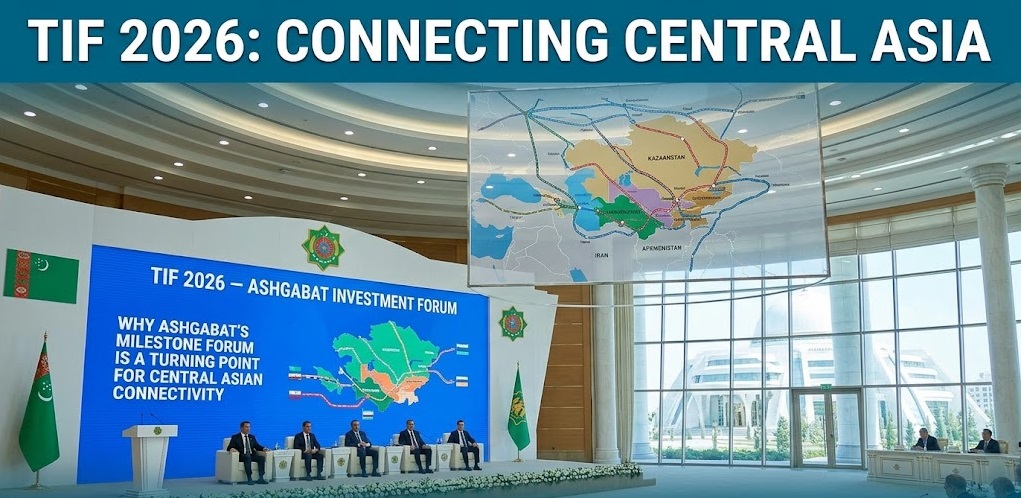
As the Turkmenistan Investment Forum (TIF 2026) opens its doors in Ashgabat today, it marks more than just a gathering of global capital.
Coinciding with the landmark celebrations of Turkmenistan’s 35th anniversary of independence, this forum represents a profound geopolitical and macroeconomic pivot. For a country historically seen as a cautious economic fortress, TIF 2026 signals a definitive transition toward deep regional integration, technological leapfrogging, and structural openness.
Scaling Beyond Extractive Wealth
For decades, the global narrative surrounding Turkmenistan revolved almost exclusively around its massive natural gas reserves and multi-billion-dollar infrastructure ventures like the TAPI pipeline. While energy remains a foundational pillar, the scope of TIF 2026 reveals an economy aggressively moving down the value chain.
Organized jointly by the Ministry of Finance and Economy and the Ministry of Foreign Affairs, the forum’s structural emphasis has shifted from raw material extraction to high-value manufacturing, petrochemical processing, and modernized agribusiness.
The presence of international manufacturing giants—ranging from Samsung C&T and Mitsubishi Heavy Industries to Siemens Energy—underscores that global industry now views Turkmenistan not just as a fuel station, but as a future manufacturing and industrial hub.
The Crossroad of Eurasian Transit
What makes TIF 2026 an event of critical relevance to the wider Eurasian continent is its focus on connectivity. As global supply chains fracture and realign, Central Asia has emerged as the indispensable transit corridor between East and West.
The forum positions Ashgabat at the nexus of several vital trans-continental corridors. By convening delegations from over 45 countries, the discussions look directly at optimizing the Middle Corridor, capitalizing on the strategic maritime logistics of the Caspian Sea, and breathing new operational life into the Lapis Lazuli corridor.
The heavy institutional backing from the World Bank, the Asian Development Bank (ADB), and the EBRD gives these infrastructural ambitions the financial teeth they need to progress from diplomatic talking points to operational reality.
Green Finance, AI, and the New Economy
Perhaps the most telling aspect of TIF 2026 is its embrace of the future. The inclusion of dedicated panels on the digital economy, virtual assets, and Artificial Intelligence reflects a government acutely aware that future competitiveness is digital.
Furthermore, as the impacts of climate change increasingly dictate economic policy in Central Asia, the forum’s focus on green finance and sustainable water resource management is timely. Rather than treating environmental sustainability as an afterthought, TIF 2026 frames the green transition as a lucrative investment frontier, particularly for the country’s rapidly modernizing private sector.
The nCa View: A Strategic Window of Opportunity
From our vantage point at News Central Asia and media partner of the event, TIF 2026 is a barometer for a new era in regional statecraft. The forum proves that Turkmenistan is systematically working to lower institutional barriers, modernize its legal frameworks for FDI, and build genuine public-private partnerships.
With over 800 delegates descending on the Ýyldyz Hotel, the composite event will likely yield a flurry of commercial contracts, joint venture agreements, and multilateral memorandums. For global investors looking for stability, untapped potential, and unparalleled geostrategic positioning, the message from Ashgabat is loud and clear: Turkmenistan is open for business, and the trajectory is firmly pointed forward. /// nCa, 1 October 2026