


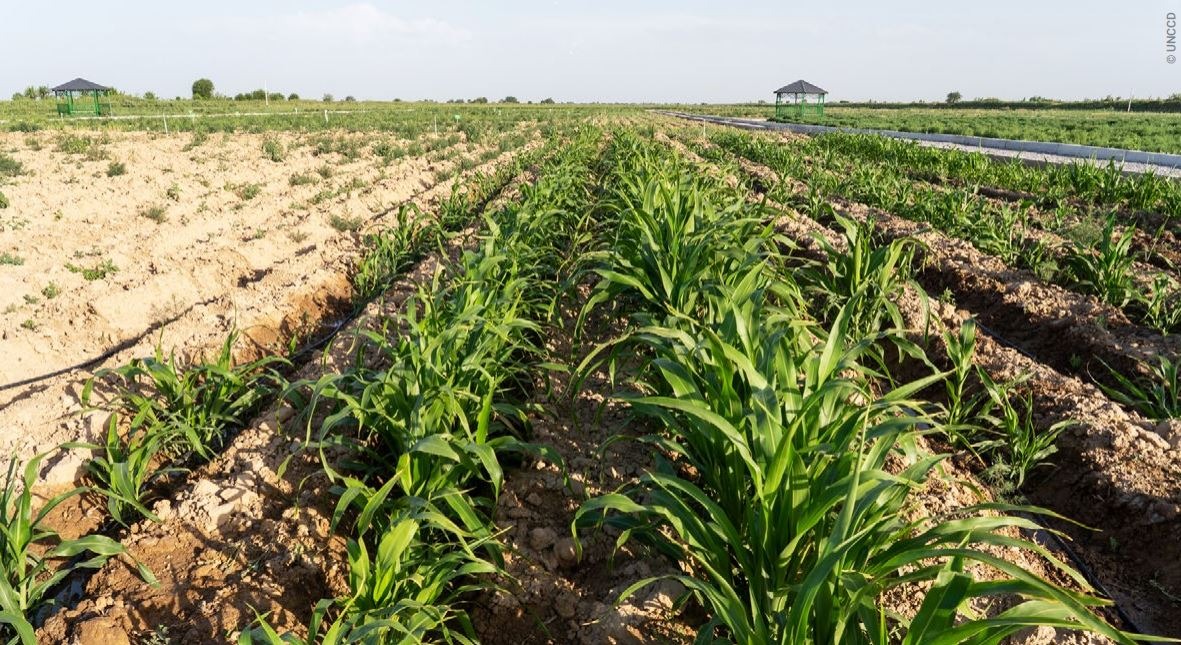
Central Asia’s land resources are facing mounting pressure from degradation caused by extreme weather conditions, rapid rates of warming, systemic resource management errors, and high rates of urbanization.
More than 80 million hectares—over a quarter of the region’s land area, or roughly four times the size of Kyrgyzstan—are already degraded, according to the authors of the Central Asia thematic report from the Global Land Outlook series.
The report was presented on 26 August 2026 in Ulaanbaatar, Mongolia, at the 17th session of the Conference of the Parties to the UNCCD (COP17). The Central Asia report was prepared with financial support from the Russian Federation under the Roadmap of the UNCCD Interregional Group “Central Asia – Russia.”
“All five Central Asian states have embraced National Voluntary LDN Targets (LDN) under Sustainable Development Goal (SDG) 15.3, and half of these targets are already met. This is not a moment of triumph – it is the end of denial. LDN has moved from theory into practice, now embedded in national green economy strategies, agricultural development plans, and climate adaptation policies,” the report states.
What is the Current Scale of Land Degradation in Central Asia?
The scale of land degradation in Central Asia today is critical, representing a severe human-induced and natural crisis that threatens the region’s environmental and food security.
More than 80 million hectares of land in the region are already degraded, accounting for over a quarter (approximately 20–24%) of Central Asia’s total territory.
The environmental crisis directly impacts nearly 30% of the region’s population (around 24 million people) living on degraded lands with declining productivity.
Land degradation inflicts colossal damage on the economies of Central Asian countries, where agriculture plays a key role in supporting livelihoods. Depending on the assessment methodology and variables included (crop yield shortfalls, livestock decline, migration, increased morbidity), the region’s annual losses range from $2 billion to $6 billion.
Extent of Degradation by Agricultural Land Types
- Critical State of Rangelands: Rangelands cover 70–80% of the region’s total area. Today, 60% to 80% of all rangelands suffer from varying degrees of degradation driven by overgrazing and the decay of seasonal livestock infrastructure. In Kyrgyzstan, meadow and pasture area has shrunk by 12,650 km² (nearly 11%), while in Kazakhstan, degraded rangeland area has passed 3,000 km².
- Secondary Salinization of Irrigated Lands: Inefficient irrigation practices and deteriorating drainage networks have subjected 40% to 60% of irrigated land to secondary salinization. This issue is especially severe in the lower reaches of the Amu Darya (Uzbekistan and Turkmenistan), as well as across specific agricultural tracts in Kazakhstan and Tajikistan.
- Desiccated Aral Sea Bed: The dried seabed spans over 5.5 million hectares (3.2 million hectares in Uzbekistan, with the remainder in Kazakhstan), creating the new Aralkum Desert. Winds annually carry between 15 and 75 million tons of salt and fine toxic dust across thousands of kilometers, accelerating glacier melt.
What unique practices does each Central Asian country apply to combat land degradation?
Each Central Asian nation possesses unique and complementary expertise in managing arid and mountain ecosystems, applying context-specific practices to combat land degradation.
Kazakhstan approaches the problem of land degradation from the perspective of long-term planning and pragmatic management. The country is a regional pioneer in carbon farming. Methods to increase soil organic carbon stocks are being introduced, the first agrometeorological carbon testing site, “KAZ AGRO CARBON,” has been launched, and a national soil carbon monitoring system is being developed jointly with the FAO. According to expert estimates, widespread adoption of carbon farming practices could enable the country to earn up to $35 billion annually on carbon markets.
Uzbekistan is focused on large-scale greening and innovative restoration of landscapes affected by the desiccation of the Aral Sea. Saxaul and other halophytes have been planted across 2 million hectares of the dried seabed. This project, the world’s largest phytomelioration initiative, traps 35–40% of salt dust and sand.
On foothill slopes where traditional agriculture is unprofitable, commercial pistachio plantations are being established in Uzbekistan. A tree capable of bearing fruit without irrigation where any other crop would require water, the pistachio is becoming a true lifeline for rainfed lands.
In Fergana, fast-growing salt-tolerant trees (Russian olive, willow, poplar) are planted on degraded cropland to act as “biological pumps.” They lower groundwater levels and desalinize the soil. Within a few years, the plot can be reintroduced into crop rotation.
With over 80% of its territory covered by the Karakum Desert, Turkmenistan is developing technologies for survival in an extremely arid climate.
Around settlements in the Central Karakum, mechanical standing barriers combined with the planting of desert vegetation (saxaul, kandym, cherkez) are successfully used to prevent sand from encroaching on infrastructure. Planting giant fast-growing reed (Arundo donax) around homesteads shields them from hot winds and dust, creating a favorable microclimate.
In the foothill zones of Turkmenistan, the construction of moisture-harvesting trenches and takyr runoff collectors is practiced. These retain snowmelt and rainwater, enabling saplings to survive without artificial irrigation during the dry season.
According to research, under Turkmenistan’s conditions, saxaul plantations with a density of roughly 500 units per hectare can sequester about 1.6 tons of CO2 annually (a single tree aged 20–25 years absorbs up to 3 kg of carbon dioxide per year).
In 2025, Turkmenistan proposed the creation of a Regional Center for Combating Desertification for Central Asian countries, coordinated in Ashgabat. This initiative aims to consolidate regional scientific and practical capacity, strengthen environmental cooperation, and support the achievement of the UN Sustainable Development Goals.
Kyrgyzstan has placed its reliance on reforming social institutions for resource management in mountain conditions. Pasture management functions have been transferred to local communities. Pasture committees independently set grazing limits, collect fees, and reinvest them in pasture infrastructure, including roads, bridges, and watering points.
Positive practices also include using groundwater for drip irrigation of orchards and vegetable gardens under surface water deficit conditions.
Given that 93% of the country’s territory is covered by mountains, Tajikistan is developing anti-erosion technologies. Stone terraces are constructed on steep, rocky slopes to stop mudflows, accumulate moisture, and transform unusable crags into productive orchards.
The country has documented 124 technologies and 57 approaches in the World Overview of Conservation Approaches and Technologies (WOCAT) international database, becoming a recognized “living encyclopedia” of survival in mountain conditions.
Among the positive practices are sunken greenhouses invented by women. Built partially underground and using stones as thermal mass, these structures enable families to maintain year-round food security.
Central Asia can reverse land degradation.
Despite the scale of environmental challenges, the report contains a wealth of encouraging data, successful case studies, and systemic shifts proving that land degradation in Central Asia can not only be halted, but reversed.
Here are several of the most optimistic facts highlighted in the report:
- Soil Stability: Satellite monitoring over recent decades shows that nearly 57% of Central Asia’s territory consists of stable land, while an additional 16.8% demonstrates signs of improvement.
- Forest Area Growth: Contrary to pessimistic forecasts, the total forested area in the region has expanded by 6.4%. Leading this trend are Uzbekistan (+39%) and Tajikistan (+23%), where active tree planting is underway across deserts and foothills.
- Recovery of the North Aral Sea: The water volume of the North Aral Sea grew from 18.4 billion m³ at the beginning of 2023 to 23 billion m³ by early 2026. The completion of the project’s second phase, including the reconstruction of the Kokaral Dam, is set to boost this capacity to 34 billion m³.
- Drought as a Manageable Risk: Regional states are shifting from reactive crisis management to proactive measures. All five nations have adopted voluntary targets to achieve Land Degradation Neutrality (LDN), with half of these milestones already accomplished. Development strategies no longer view drought as an unforeseen disaster, but treat it officially as a manageable risk.
- New Initiatives: Innovative frameworks of trust are taking shape, such as the Peace Forest Initiative (PFI), which supports joint restoration of transboundary landscapes and rangelands across Kyrgyzstan, Uzbekistan, and Turkmenistan.
Furthermore, the thematic report outlines a clear set of priority actions and systemic recommendations designed to halt land degradation in Central Asia and transition toward sustainable management of arid lands. These recommendations encompass legislative reforms, digital technologies, institutional changes, and regional cooperation.
The full text of the report is available here: https://www.unccd.int/ru/node/30906 ///nCa, 27 August 2026