


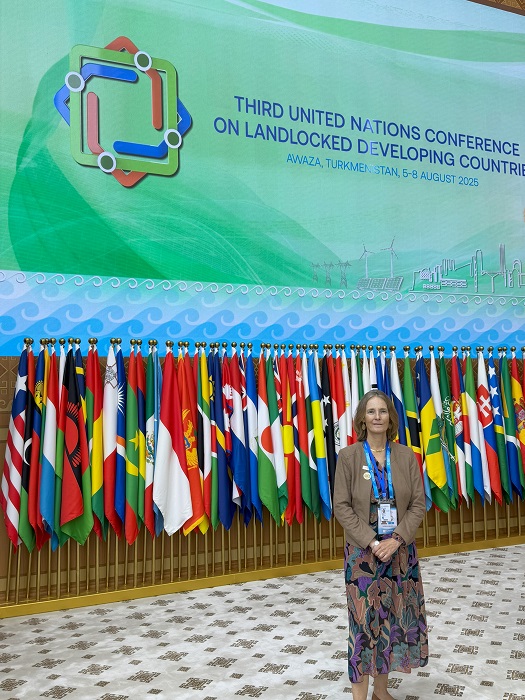
Florence Bauer, the UNFPA Regional Director for Eastern Europe and Central Asia, discusses Central Asia’s “demographic opportunity” in an interview with News Central Asia (nCa). She explained that a demographic dividend is the potential for economic growth that occurs when a country’s working-age population is larger than its dependent population. Central Asia, with its youthful population (nearly one-third under 15) and projected growth to over 114 million by 2050, is well-positioned to capitalize on this.
Question 1: Ms. Bauer, thank you for speaking with us. Could you first explain UNFPA’s presence at the Third United Nations Conference on Landlocked Developing Countries (LLDC3) in Awaza, Turkmenistan?
Answer: Thank you for having me. UNFPA is actively participating in LLDC3, a vital platform for Landlocked Developing Countries to explore solutions and forge partnerships for a more equitable and prosperous future. We consistently engage to position population and development issues broadly, demonstrating our comparative advantage in providing rights-based support. This includes focusing on the empowerment of young people, women and girls, disaster risk reduction, and helping countries collect population data that can be used to develop evidence-based policies and projections. LLDC3 is a key opportunity to discuss the demographic profiles of LLDCs, which often feature larger youthful populations alongside the aging population, both requiring targeted investments to realize a demographic dividend.
Question 2: You mentioned the opportunity for a demographic dividend. Could you elaborate on Central Asia’s demographic landscape, including Turkmenistan, and explain what is meant by the “demographic dividend”?
Answer: Absolutely. The demographic dividend refers to the economic growth potential that arises when a country’s working-age population significantly outnumbers its dependent population. This window of opportunity typically opens as countries undergo a demographic transition towards lower fertility rates. Central Asia presents a unique demographic landscape that offers this potential. Its population has grown significantly and is projected to exceed 114 million by 2050. Nearly one-third of this population is under 15, markedly higher than the global average. In Turkmenistan, for example, with approximately seven million people, about 57% are working age which is projected to increase further in the future. These trends collectively present a substantial opportunity for accelerated development and economic stability across the region.
Question 3: What can be done by countries to fully realize this demographic potential and maximize the demographic dividend of Central Asia?
Answer: To fully realize Central Asia’s demographic potential, countries must focus on strategic, people-centered investments that will ensure robust, inclusive growth. UNFPA advocates for strengthening human capital by investing in education, health, and skills for youth and women, preparing them for future green, digital, and care economies. It is crucial to empower women and girls by ensuring their access to quality reproductive healthcare and inclusive education, and by promoting their full participation in the labour force through addressing unequal care burdens and fostering equitable gender norms. We emphasize the development of rights-based population policies that support informed choices and shared responsibilities for families. Creating decent jobs aligned with future market demands, expanding social support systems that adapt to demographic shifts, addressing subnational disparities, and building climate resilience are also vital. We must harness the potential of aging populations through healthy aging and lifelong learning, and leverage robust, disaggregated data for evidence-based policy-making.
Question 4: What is UNFPA’s overarching vision for effective demographic policy in Central Asia?
Answer: Ultimately, UNFPA believes that effective demographic policy in Central Asia is about ensuring every individual can thrive in a supportive environment. This means strengthening gender equality, so that women and girls are empowered to actively shape their futures. It’s about upholding human rights within a framework that supports the well-being of a growing and dynamic population, while also ensuring that people are supported through their older years with dignity and care. To fully achieve this demographic resilience, concerted actions and significant sustainable financing are crucial, leveraging domestic resources and diversified funding. UNFPA is committed to partnering with the countries in Central Asia to truly capitalize on this unique demographic advantage, building societies that are resilient, prosperous, and inclusive for all. ///nCa, 8 August 2025