


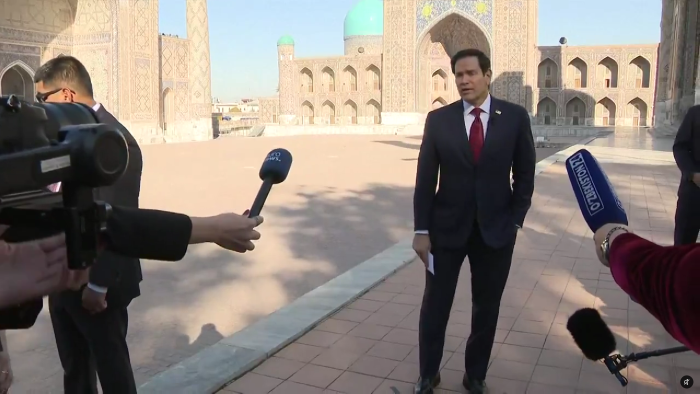
U.S. Secretary of State Marco Rubio said Central Asia had not received the attention it deserved from U.S. policymakers over the past two decades, stressing Washington’s interest in expanding trade and business ties with the region.
Speaking to the press in Samarkand on 19 October, during the C5+1 Ministerial and related business forum, Rubio said the United States wanted to become a strong partner for all five Central Asian countries.
“We just want fair competition and an opportunity,” Rubio said, responding to a question about China’s growing economic presence in Central Asia. He stressed that Washington was not seeking to discourage regional countries from cooperating with other partners.
“This is not about coming here to say stop talking to somebody else or stop working with some other country,” he said. “This is about ensuring that in every part of the world that is opening its doors to American business and American commerce that we’re available, that we’re showing up, and that we’re there.”
Rubio said nearly 300 American businesses had joined the U.S. delegation in Samarkand to explore commercial opportunities in the region. He anticipated announcements of agreements worth billions of dollars, describing the visit as the beginning of a broader effort to expand U.S. economic engagement with Central Asia.
“Central Asia has just not gotten the level of attention from our policy makers over the last 20 years that it deserves, but that’s changing,” he said.
Uzbekistan’s role and regional opportunities
Rubio described Uzbekistan as a key country in Central Asia, citing its population, economic development and potential for further growth. He referred to the country’s annual GDP growth rate of almost 8% and said Washington hoped the positive trend would continue.
The Secretary of State also pointed to opportunities to expand travel links between the United States and Uzbekistan, mentioning ongoing discussions about a possible direct flight from Miami.
Asked what Uzbekistan could expect from the visit and the participation of American companies, Rubio said that concrete business agreements were expected to be announced at the conclusion of the forum.
He emphasised that Washington viewed the current engagement as the foundation for further cooperation, rather than a one-off initiative.
Rubio also expressed interest in a possible future visit to Central Asia by U.S. President Donald Trump, saying that the matter would need to be worked out in the coming year. He did not provide a date or confirm any travel plans.
The C5+1 format brought together the United States and Kazakhstan, the Kyrgyz Republic, Tajikistan, Turkmenistan and Uzbekistan. The ministerial meeting in Samarkand was accompanied by business engagement aimed at identifying opportunities for cooperation between American companies and regional partners. ///nCa, 20 October 2026