


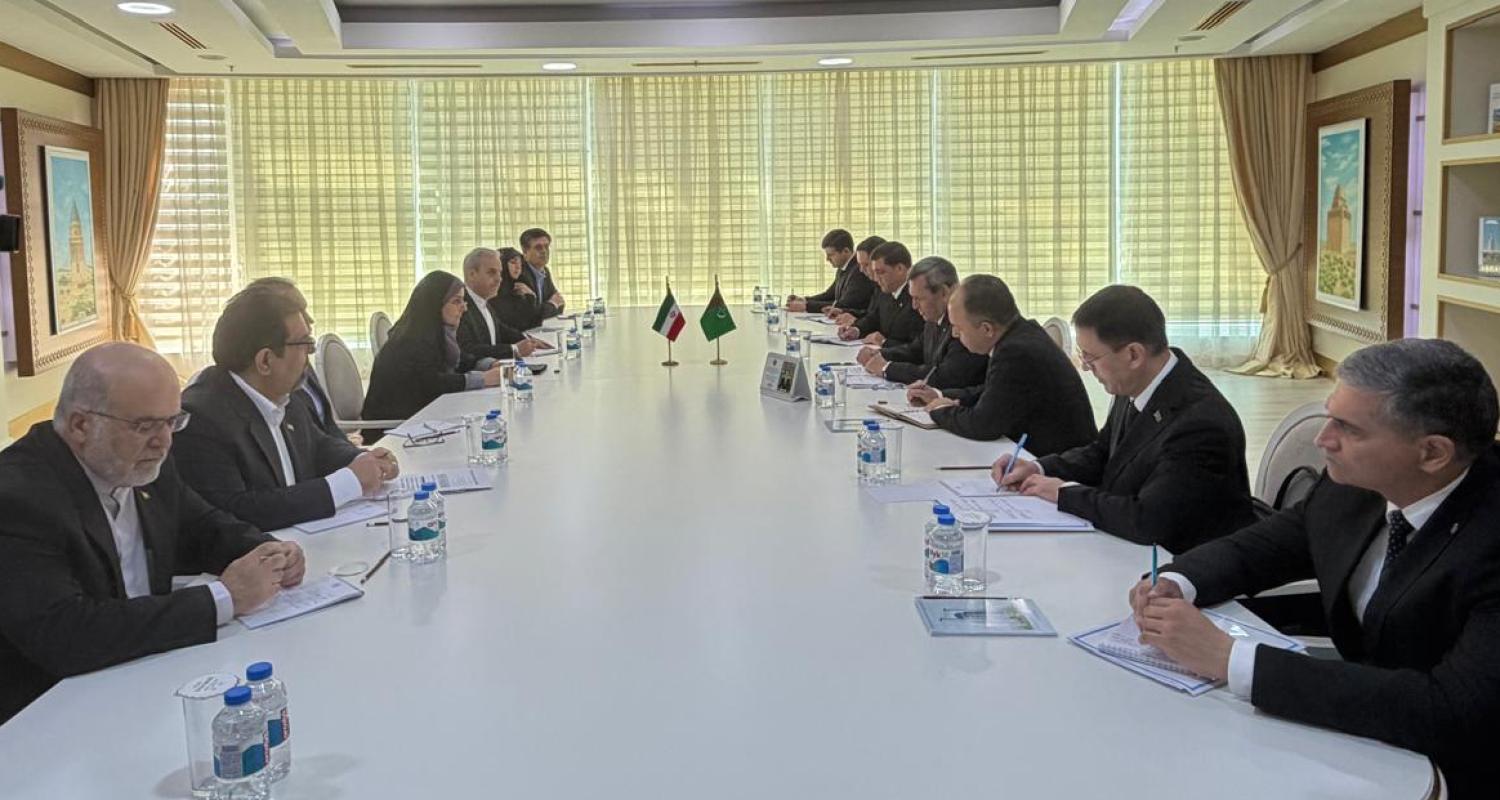
Foreign Minister Meredov and Iran’s roads minister discuss transport links in Avaza; no new agreement announced
AWAZA, Turkmenistan — Turkmenistan and Iran discussed ways to expand transport links and make better use of their transit potential on Wednesday, on the sidelines of events in Avaza marking Turkmenistan’s 2026 chairmanship of the Commonwealth of Independent States.
Foreign Minister Rashid Meredov met Iran’s Minister of Roads and Urban Development, Farzaneh Sadegh. According to the Turkmen Foreign Ministry, the talks covered transport cooperation, transit opportunities, regional connectivity and infrastructure development. The two sides also exchanged views on cooperation within regional and international transport initiatives and reaffirmed their interest in continuing dialogue.
The ministry’s account reports discussions and a restated commitment to cooperation. It does not announce a treaty, corridor agreement or infrastructure contract.
A shared border and complementary networks
Turkmenistan and Iran share a land border, and their networks can link otherwise separate transport systems. For Turkmenistan, Iran offers access southward toward the Persian Gulf. For Iran, Turkmenistan is a gateway to Central Asia. The relationship therefore matters less for bilateral trade than for the movement of goods between wider regional markets.
Ashgabat has long promoted its territory as a transit bridge between East and West and between North and South, combining rail, road and maritime routes. The Foreign Ministry names the Kazakhstan–Turkmenistan–Iran railway as one of its principal North–South projects and the Lapis Lazuli corridor, which links Afghanistan, Turkmenistan, Azerbaijan, Georgia and Türkiye, as another. The International Turkmenbashi Seaport on the Caspian is intended to connect the national rail and road network with Caspian shipping and, through it, the South Caucasus.
Building on earlier work
The Avaza meeting follows earlier bilateral efforts. At a session of the Intergovernmental Turkmen-Iranian Commission on Economic Cooperation, Turkmenistan proposed intensifying freight movement along the China–Kazakhstan–Turkmenistan–Iran route, citing its own positive experience with the corridor. The same session produced a memorandum between Turkmenistan’s State Agency for Road Construction Management and Iran’s Ministry of Roads and Urban Development on building the Gumdag–Etrek–Iran border highway.
The China–Kazakhstan–Turkmenistan–Iran route shows how bilateral infrastructure can form part of a longer chain. Cargo from China can travel west through Kazakhstan and Turkmenistan into Iran, and Iranian goods can in principle move in the opposite direction toward Central Asian and Chinese markets. The corridor is only as efficient as its slowest national section.
From infrastructure to efficiency
Notably, both sides spoke of the effective use of transit potential, not only of construction. A corridor is judged by whether cargo crosses borders at reasonable cost, with predictable transit times and manageable paperwork. For Turkmenistan and Iran, that brings customs procedures, border-crossing capacity, rail and road interoperability, logistics services and coordination between transport authorities into the picture. The Turkmen Foreign Ministry has also promoted multimodal transport and digital transit systems as part of its transport diplomacy.
Two directions, not two rivals
The Caspian adds a second axis. Through the Turkmenbashi port, cargo can reach Azerbaijan and the South Caucasus and potentially continue toward Türkiye and Europe. Through the southern border, it can reach Iran’s road, rail and port network and the Persian Gulf. The two routes need not compete. For landlocked Central Asian economies that depend on the infrastructure and policies of transit states, having more than one option has its own value, and Turkmenistan has consistently argued for multiple corridors rather than reliance on a single route.
Political context
Sadegh’s portfolio covers the infrastructure through which Iran connects with its neighbours, and the meeting offered a direct government-to-government channel at a time when many regional delegations are in Avaza. Iranian President Masoud Pezeshkian is due to take part in the CIS leaders’ programme on October 9, so transport issues raised at ministerial level could be considered alongside wider political and economic questions.
The talks also align with Turkmenistan’s investment priorities. At the Turkmenistan Investment Forum in Ashgabat earlier this month, Deputy Foreign Minister Ahmet Gurbanov named transport infrastructure and transit among the country’s priority areas for foreign investment, citing the Turkmenbashi port and participation in regional infrastructure projects.
What to watch
The practical question is whether the commitment translates into measurable improvements: better use of existing rail and road links, expanded border infrastructure, simpler transit procedures, stronger logistics services and closer coordination with other corridor participants. Both countries already have much of the physical infrastructure. What remains is making it work as a coordinated transport chain, and that is where the value of the Avaza discussion will be measured. /// nCa, 7 October 2026