


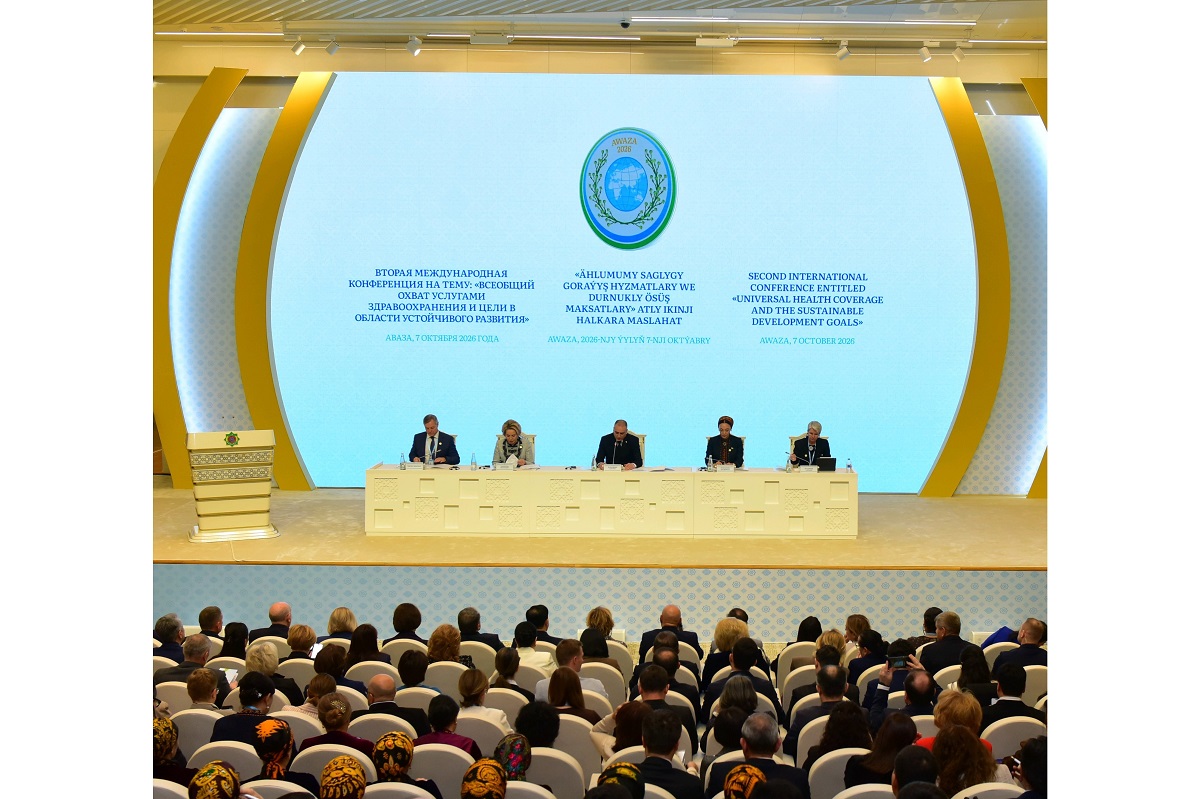
AVAZA, Turkmenistan – The second International Conference on Universal Health Coverage and the Sustainable Development Goals in Avaza has moved beyond general discussion of healthcare cooperation, with participants identifying a number of priorities for closer coordination among CIS countries, including stronger primary healthcare, improved access to medicines and more sustainable health financing.
The conference, organised by the CIS Interparliamentary Assembly, the Mejlis of Turkmenistan and the WHO Regional Office for Europe, is being held under Turkmenistan’s 2026 CIS chairmanship and the Commonwealth’s Year of Health. Its theme is “Coordinated Policy and National Strategies.”
The discussions brought together parliamentarians, government representatives and health specialists around a central question: how national health systems can be strengthened while countries cooperate more closely on challenges that increasingly cross national borders.
CIS Secretary General Sergei Lebedev, in a message to the conference, said member states had established the health and well-being of their populations as an unconditional and long-term intergovernmental priority. He also pointed to cooperation between the CIS Interparliamentary Assembly and the WHO Regional Office for Europe as an example of how expert knowledge can be translated into legislation and longer-term national strategies.
Primary healthcare and prevention
Primary healthcare emerged as one of the principal themes.
The conference is examining primary healthcare as the foundation for universal health coverage, together with disease prevention and mechanisms for ensuring access to quality medical services. A separate thematic session is devoted to the role of primary healthcare in achieving universal coverage.
The emphasis reflects a broader shift from treating illness only after it occurs towards strengthening prevention and early intervention.
WHO’s European Regional Office also highlighted the experience of cooperation with the CIS Interparliamentary Assembly over the past decade. According to the conference report, that cooperation has contributed to the preparation of model laws that national parliaments can adapt to their own circumstances, as well as expert dialogue on medicines and pharmaceutical policy.
Examples presented at the conference included reforms in Azerbaijan aimed at strengthening primary care and prevention, Armenia’s universal health-insurance reform and health-related initiatives in Uzbekistan and Turkmenistan.
Medicines and regional cooperation
Access to medicines represents another major area of discussion.
Participants are examining both the availability of essential medicines and the legislative and financial mechanisms needed to improve access. One of the priorities identified for the conference’s forthcoming declaration is joint procurement of medicines and development of regional pharmaceutical production.
If subsequently translated into practical cooperation, such approaches could potentially help participating states address common problems in pharmaceutical supply chains and reduce some duplication in procurement and production.
At this stage, however, these should be regarded as priorities under discussion rather than as adopted commitments. The conference’s work is continuing through thematic sessions, with the final form and status of any declaration still to be established.
Health financing and prevention policy
Health financing is a third major strand of the conference.
Participants are discussing sustainable financing of healthcare and the use of fiscal policy to support public health. The priorities identified for the forthcoming declaration include greater financing for primary healthcare and the use of taxes on tobacco, alcohol and sugar-containing drinks as health-protection measures.
The approach places healthcare within a wider public-policy framework, recognising that prevention is influenced not only by medical services but also by consumer behaviour, taxation, legislation and social policy.
The conference is consequently addressing both the medical and policy dimensions of universal health coverage.
From conference discussion to future action
For the CIS, the timing gives the discussions an additional regional dimension. The Commonwealth has designated 2026 as its Year of Health, while the conference is also looking ahead to the 2027 UN high-level meeting on universal health coverage, according to the CIS Executive Committee.
The Avaza meeting therefore provides an opportunity for CIS countries to compare national experience and consider areas in which common approaches may be practical.
For now, the most substantive development is the identification of shared priorities rather than the adoption of a completed regional health programme. The conference’s forthcoming declaration and any subsequent decisions will determine how far the ideas discussed in Avaza move towards coordinated implementation.
That leaves room for a second, more detailed report once the conference concludes and its final recommendations or declaration become available. /// nCa, 7 October 2026