


Tariq Saeedi
Here is a comprehensive structural breakdown of the official state visit of Chinese President Xi Jinping to Washington, D.C. from September 23 to 25, 2026.
1. The Tarmac Welcome: Framing a “Constructive Strategic Stability”
Breaking standard American protocol, President Donald Trump and First Lady Melania Trump personally traveled to Joint Base Andrews to greet President Xi Jinping and Madame Peng Liyuan on the tarmac.
- Strategic Context: This direct presidential presence at the arrival gate was highly calculated. It served as a direct reciprocity for the lavish treatment Trump received in Beijing earlier in May 2026. More importantly, it sent an immediate signal to international observers that both superpowers were mutually invested in creating a stabilizing psychological “floor” during a deeply turbulent geopolitical era marked by active conflicts in the Middle East and economic strain.
2. Micro-Analysis of Phrasing, Body Language, and Symbolic Encounters
Beneath the red carpets and military flyovers, a close reading of the official statements and physical posturing reveals a stark duality between choreographed warmth and rigid structural gridlock.
- The Phrasing Shift on Taiwan: In public and translated remarks, President Xi adjusted his rhetoric to press Washington to “handle the Taiwan question with prudence” and explicitly “oppose” Taiwanese independence. This marks a subtle but firmer linguistic demand compared to Beijing’s historical complaints, shifting from asking the U.S. not to “support” independence to demanding active opposition.
- The U.S. Response & Body Language: While President Trump warmly declared at the State Dinner that the two leaders have “never gotten along better” and gifted Xi a statue of an American bald eagle, the White House text notably maintained its traditional formulation of strategic ambiguity. Behind the scenes, Xi’s demeanor remained deeply rooted in Chinese Communist Party protocols—avoiding ostentatious personal flattery while projecting the image of a leader playing a multi-decade structural game that outlasts any single U.S. presidential administration.
- The “Diplotainment” Spectacle: The decision to spend significant time touring the Marine One helicopter, inspecting the newly styled South Lawn, and visiting the National Archives underscored that the summit was heavily optimized for optics. These highly visual, low-stakes activities allowed both sides to project a functioning relationship to global markets without having to answer difficult press questions on unresolved policy.
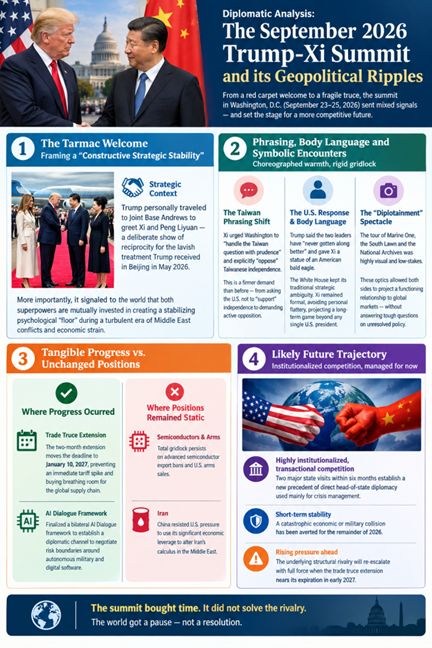
3. Tangible Progress vs. Unchanged Positions
- Where Progress Occurred: The two-month extension of the trade truce (shifting the deadline out to January 10, 2027) prevents an immediate tariff spike, buying crucial breathing room for the global supply chain. Additionally, the finalization of a bilateral AI Dialogue framework establishes an official diplomatic channel to negotiate risk boundaries around autonomous military and digital software.
- Where Positions Remained Static: Total gridlock persists regarding advanced semiconductor export bans and U.S. arms sales. Furthermore, China resisted American pressure to use its significant economic leverage to alter Iran’s calculus in the Middle East.
4. Likely Future Trajectory
The relationship is moving toward a state of highly institutionalized, transactional competition. The exchange of two major state visits within a six-month window establishes a precedent of direct head-of-state diplomacy used primarily as a crisis-management mechanism. While a catastrophic economic or military collision has been successfully averted for the remainder of 2026, the underlying structural rivalry will re-escalate with full force when the trade truce extension nears its expiration in early 2027. /// nCa, 26 September 2026