


Tariq Saeedi and Elvira Kadyrova
Twenty years ago, Turkmenistan and China laid the foundation for large-scale energy cooperation, which has today become a strategic bridge between the two countries.
A scientific and practical conference dedicated to the 20th anniversary of strategic partnership between Turkmenistan and China in the gas sector was held in Ashgabat. Leaders of the oil and gas industries of both nations not only recalled the key milestones of their joint journey but also outlined ambitious plans for the next twenty years — moving from traditional gas to green energy and high technologies.
High-ranking officials from Turkmenistan and China addressed the plenary session of the forum, including:
- Deputy Chairman of the Cabinet of Ministers of Turkmenistan, overseeing the oil and gas sector, Guvanch Agadjanov
- First Vice Premier of the State Council of the People’s Republic of China, Ding Xuexiang
- State Minister of Turkmenistan — Chairman of the State Concern “Turkmengaz”, Maksat Babaev
- Chairman of the Board of Directors of China National Petroleum Corporation (CNPC), Dai Houliang
Key Milestones of Turkmen-Chinese Strategic Cooperation
“This year marks 20 years since the signing on 3 April 2006, of the General Agreement between the Governments of Turkmenistan and the People’s Republic of China on the implementation of the Turkmenistan–China gas pipeline project and the supply of natural gas from Turkmenistan to China,” noted Vice Premier Guvanch Agadjanov.
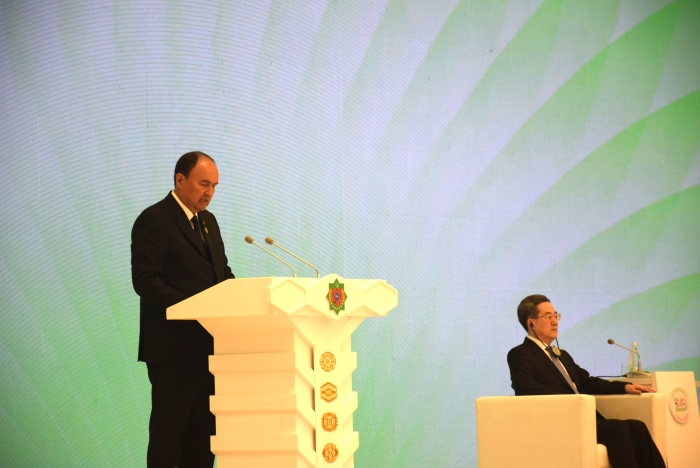
According to him, this General Agreement formed the political, economic, and legal foundation for strategic cooperation between Turkmenistan and China in the gas sector.
The Deputy Prime Minister listed the main dates in the chronicle of gas partnership between the two countries:
- July 2007 — Launch of the Turkmenistan–China gas pipeline construction project.
- July 2007 — Signing of the Production Sharing Agreement with China National Petroleum Corporation “International Ltd.” regarding the Bagtyyarlyk Contract Area.
- 14 December 2009 — Commissioning of the cross-border Turkmenistan–China gas pipeline, stretching over 7,000 kilometers.
- September 2013 — Launch of modern facilities with a capacity of 30 billion cubic meters of commercial gas per year, built as part of the first phase of industrial development of the Galkynysh gas field.
- June 2022 — Commissioning of the Gadyn gas gathering station, which collects natural gas produced from fields in the western part of the Bagtyyarlyk Contract Area.
- April 2026 — Signing of the contract for the design and turnkey construction of wells and a natural gas processing facility for Phase 4 of the Galkynysh field with a capacity of 10 billion cubic meters of commercial gas, between the State Concern Turkmengaz and CNPC Amudarya Petroleum Company Ltd.
The plenary session particularly highlighted the activities of Chinese service companies: CNPC Chuanqing Drilling Engineering Company and China Petroleum Engineering and Construction Company (CPECC). These companies continue to carry out a significant volume of work at Turkmengaz facilities, including construction, servicing, and equipment supply. Thus, Turkmen-Chinese energy cooperation covers the entire gas value chain — from drilling and field development to operation and facility management.
Trust – the Foundation of Turkmen-Chinese Cooperation
First Vice Premier of the State Council of the PRC, Ding Xuexiang, emphasized that the foundation of Turkmen-Chinese cooperation lies in strategic trust, the principles of equality, and mutual benefit. In the context of a changing global energy landscape, China is ready to work with Turkmenistan to elevate energy cooperation to a new, higher level of quality.

Key points from his speech:
- Gas partnership with Turkmenistan remains a strategic pillar of bilateral relations.
- Expansion of cooperation, including in green energy, taking into account Turkmenistan’s significant potential in wind and solar power, as well as strengthening innovation cooperation and promoting low-carbon energy.
- Deepening cooperation across the entire natural gas production and supply chain — from exploration and production to transportation and storage.
The Bagtyyarlyk Contract Area – a Model of Successful Partnership
In 2007, Turkmenistan and China signed a production sharing agreement for the Bagtyyarlyk contract area on the right bank of the Amu Darya River.
“The production sharing model applied at Bagtyyarlyk has proven its effectiveness for both sides. Over the years of project implementation, modern production infrastructure has been created in the contract area. The contractor has invested $10.7 billion in the construction of two gas processing plants, gas pre-treatment facilities, and related infrastructure,” stated Chairman of the State Concern “Turkmengaz” Maksat Babaev.
He emphasized that all investments have been fully recouped. “As of 1 April 2026, Turkmenistan’s revenue from the project has exceeded $19.2 billion,” the speaker noted.
The total volume of gas produced on the right bank of the Amu Darya has reached 190 billion cubic meters.

CNPC’s Social Investment Contribution
“We have consciously fulfilled our social obligations by investing more than $13 billion in Turkmenistan, paying $1.4 billion in taxes and fees, and creating over 8,000 local jobs,” said Chairman of the Board of Directors of China National Petroleum Corporation (CNPC) Dai Houliang.
Turkmenistan – a Reliable Partner in Meeting Financial Obligations
The Chairman of Turkmengaz recalled a significant fact that underscores Turkmenistan’s reliability and consistency in fulfilling financial commitments in international projects.
“To implement projects aimed at increasing export potential, the China Development Bank provided a loan of $8.1 billion. Turkmengaz fully repaid this loan in June 2021 — on time and in full. This is concrete proof of the financial discipline of the Turkmen side,” noted the head of Turkmengaz.
“Everything we have built over these twenty years has been based on mutual fulfillment of obligations. All key commitments regarding supplies and financial settlements have been carried out responsibly and consistently,” he added.
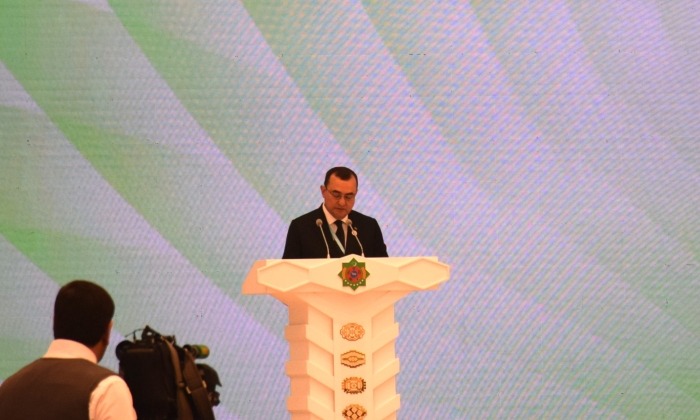
Furthermore, Turkmenistan will independently finance the fourth phase of development of the Galkynysh field. “This is a principled decision that reflects the financial stability of the concern and the strategic importance of the project for our country,” emphasized Babaev.
China’s Contribution to Personnel Training in Turkmenistan’s Gas Sector
Currently, 8,700 people work at Bagtyyarlyk, more than 90 percent of whom are Turkmen citizens. The Chinese side consistently expands the involvement of trained Turkmen specialists in the project and fulfills its obligations to train personnel by sending young Turkmen citizens to study at the China University of Petroleum.
CNPC has provided scholarships and organized internships for nearly 200 students and trained over 56,000 Turkmen employees.
Priorities for the Future
Maksat Babaev noted that Turkmengaz is entering the next twenty years of cooperation with a clear understanding of its priorities, which include:
- Implementation of the fourth phase of Galkynysh in strict accordance with project documentation and contractual obligations.
- Continuation of work in the Bagtyyarlyk contract area.
- Technological modernization: digitalization of production processes, improving the efficiency of gas production, and introducing modern management and monitoring systems.
In turn, Chairman of the Board of Directors of CNPC Dai Houliang drew attention to the strategic importance of deepening Turkmen-Chinese energy cooperation “against the backdrop of unprecedented global changes accelerating at a pace unseen in a century, the intertwining of transformations and upheavals in the international environment, and the profound transformation of the global energy landscape.”
The Chinese side sees the future of cooperation in the following areas:
- Promotion of key projects: ensuring high standards in the construction of the fourth phase of the Galkynysh field and intensifying operations at mature projects on the right bank of the Amu Darya.
- Active expansion of cooperation in new energy sources, oil refining and petrochemicals, engineering services, exploration and production technologies, green development, and the introduction of artificial intelligence.
- Humanitarian exchanges: CNPC will finance the establishment of a “Luban Workshop,” increase the enrollment of Turkmen students for study in China, and prepare highly qualified specialists.
- Risk management coordination: creation of a risk assessment, early warning, and response system covering the entire project lifecycle and production chain.

Thus, the 20th anniversary of strategic gas partnership between Turkmenistan and China is not merely a commemorative date, but an important milestone confirming the maturity and resilience of bilateral relations. Over two decades, the two sides have traveled a path from the signing of the first General Agreement to the creation of one of the largest and most effective energy chains in Central Asia.
Today, Turkmen-Chinese cooperation in the gas sector demonstrates a rare example of mutual trust, strict fulfillment of obligations, and readiness for joint development under new conditions.
The conference in Ashgabat showed that, despite the complex geopolitical and energy environment, Turkmenistan and China intend not only to maintain the high level of interaction achieved, but to elevate it to a qualitatively new stage — more innovative, diversified, and focused on long-term sustainability. /// nCa, 16 April 2026