


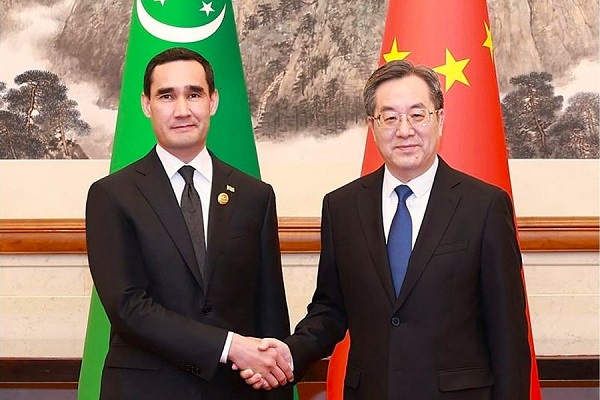
Chinese Vice Premier Ding Xuexiang touched down in Ashgabat on Wednesday at the start of a three-day visit that has quickly made clear just how central Turkmenistan has become to Beijing’s energy calculations — and how broad the two countries’ partnership has grown beyond oil and gas.
Ding is in Turkmenistan as the Special Representative of President Xi Jinping, a designation that underscores the political weight Beijing is attaching to the trip. The visit comes as China looks to Central Asia for additional energy supplies to offset shipping disruptions because of the prevailing situation in the Middle East and West Asia. [South China Morning Post]
The diplomatic centrepiece of the first day was a meeting with Gurbanguly Berdimuhamedov, the National Leader of the Turkmen people and Chairman of the Halk Maslakhaty (People’s Parliament).
According to Turkmen state media, the two sides confirmed that CNPC — China’s largest oil and gas corporation — is proceeding with the next phase of development at the giant Galkynysh field, one of the world’s largest onshore gas deposits.
The fourth phase, to be implemented by CNPC under a turnkey contract, will include construction of a facility with an annual capacity of 10 billion cubic metres of sales gas, along with the drilling and commissioning of production wells. [nCa]
The meeting also addressed connectivity, with the parties agreeing to formally integrate Turkmenistan’s road and rail infrastructure into China’s Belt and Road Initiative — effectively embedding the Turkmen section of the ancient Silk Road into the modern trans-continental corridor stretching from China to Europe.
Beyond the energy agenda, Ding Xuexiang is scheduled to co-chair the seventh meeting of the Chinese-Turkmen Intergovernmental Cooperation Committee [Global Times], which is set to take place on 16 April in Ashgabat [nCa], with the Turkmen side led by Deputy Prime Minister and Foreign Minister Rashid Meredov.
The committee’s recent subcommittee sessions have covered security, trade and economic cooperation, humanitarian cooperation in Beijing, and the transport and logistics sector [nCa], reflecting the growing breadth of ties between the two countries.
Wednesday also brought a softer but symbolically rich moment across town, when a Chinese Alternative Medicine clinic was inaugurated at the Myrat Garryev State Medical University of Turkmenistan. A delegation from Peking University of Chinese Medicine, led by rector Tang Zhishu, held talks with Health Minister Myratberdy Gaipov on traditional medicine cooperation, and the two universities signed an agreement providing for the creation of a joint centre for traditional Chinese medicine.
Tang Zhishu was awarded the title of Honorary Professor of the Turkmen medical university.
The delegation also visited the Gurbanguly Berdimuhamedov Charitable Foundation for Assistance to Children in Need of Care and attended performances by the Galkynysh National Equestrian Games Group at the Gorogly State Equestrian Circus. The Peking University delegation’s programme runs until 17 April and includes a visit to Ashgabat’s International Health and Rehabilitation Centre.
The broader backdrop to Ding’s visit is a relationship that has deepened considerably in recent years. Turkmenistan is a major gas supplier to China via the Central Asia–China pipeline [South China Morning Post], and the two countries have been steadily expanding cooperation beyond hydrocarbons into transport, education, and healthcare — as Wednesday’s events vividly illustrated.
An analyst noted that China has been systematically strengthening the resilience of its national energy system through strategic stockpiling and import diversification in the face of an unstable world order [South China Morning Post], and Turkmenistan sits squarely within that strategy. /// nCa, 16 April 2026