


Mutual trade between India and Central Asian countries has grown from $500 million in 2010 to $1.7 billion, following an upward trajectory. This is highlighted in an analytical report titled “Exploring Trade and Investment Relations between India and Central Asia: Unlocking Economic Benefits.” The report was jointly prepared by the Eurasian Development Bank (EABR) and the Export-Import Bank of India (Exim Bank of India).
The report provides a comprehensive analysis of the current state and prospects for the development of bilateral trade and investment relations between India and Central Asia, along with recommendations for deepening cooperation.
Central Asia and India among the fastest growing economies of the globe. Since 2010, their economies have expanded by about 2 times. India’s GDP has exceeded $3.6 trillion, thus making the country the world’s fifth-largest economy. Central Asia has a relatively smaller aggregate GDP (over $500 billion). Both India and the Central Asian countries continue demonstrating high rates of economic growth. This vast potential should be used by the countries to form new trade and investment ties.
There are no well-developed land routes connecting India and Central Asia. This fact predetermined the weak trade and investment ties between India and Central Asia. However, the countries have opportunities to address this issue through joint efforts and reap economic benefits.
Due to Central Asia’s strategic position as a land bridge between Asia and Europe, the region holds significant geopolitical importance for India, according to experts.
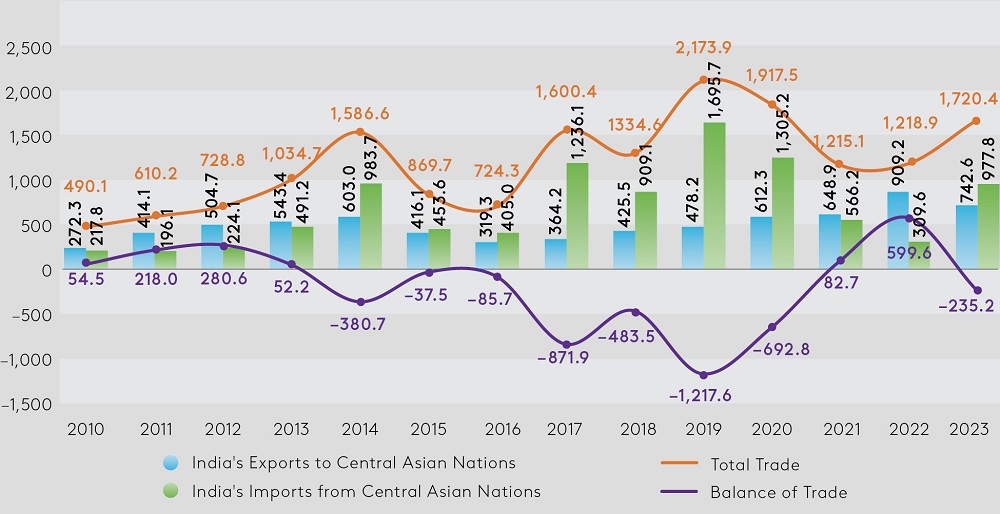
Trade between India and Central Asia.
India’s exports witness steady growth (average annual growth of 10.6%). The key commodity of India’s exports to Central Asia is pharmaceutical products (37.9% of the structure of exports in 2023). The main buyers are Uzbekistan and Kazakhstan (45.3% and 35%, respectively). In 2023, India imported mainly mineral fuels and oil from Central Asia, which accounted for 35.3% of imports.
The leading regional suppliers of goods to India are Kazakhstan (64.5%) and Turkmenistan (21.7%).
The study proposes options for expanding the range of exports and imports. In terms of exports of Indian goods to Central Asia, the list includes machine tools, land transport, electrical machinery and equipment, ferrous metal products, pharmaceutical products, optical, photographic and surgical equipment, clothing, chemical products, cereals, as well as plastics and plastic products.
Central Asian countries could significantly increase exports to India of goods such as mineral fuels, fertilizers, inorganic chemical products, rare earth metal compounds, and more.
The total volume of investments in Central Asia received from India is estimated at $1.5 billion. Reverse flows are insignificant. Indian investors have shown the greatest interest in the resource and raw materials sector of Central Asia. The total volume of their investments in the coal, oil and gas industries is 65.5%.
Indian companies have broad prospects for investment in Central Asia in sectors such as logistics and transportation, agriculture, pharmaceuticals, and the oil and gas industry, the report notes.
Additionally, India may become an important source of know-how exports. Indian companies have the experience and manpower to make a significant contribution to the development of Central Asian infrastructure in a number of areas, from financial services to subcontracting, design engineering and management consulting.
The report highlights the following promising areas for Indian investment in Central Asian countries:
• Kazakhstan: Petrochemical Industry, Mining and Metallurgical Sector, Agribusiness and Food Processing, and Healthcare.
• Kyrgyzstan: Renewable Energy, Agriculture and Food Processing, Textile Manufacturing, and Tourism and Hospitality.
• Tajikistan: Mining and Refining, Heavy Equipment, Information and Communication Technologies (ICT), and Electrical Power Systems.
• Turkmenistan: Petrochemicals Exploration and Processing, Logistics and Transportation.
• Uzbekistan: Agricultural and Food Processing, Hydrocarbon Processing, Chemical Industry, and Travel and Tourism.
Analysts from EABR and India Exim Bank provided strategic recommendations to expand cooperation between India and Central Asian countries to fully realize bilateral trade and investment potential:
- Trade development with the focus on goods with the highest export potential.
- Establishment of joint ventures and active technological cooperation in order to increase local brand recognition, technology and knowledge transfer.
- Expanding access to trade finance instruments and other financial services for small and medium enterprises on both sides.
- Improving the efficiency of transportation and logistics, trade and customs procedures.
The full text of the report, “Exploring Trade and Investment Relations between India and Central Asia: Unlocking Economic Benefits,” is available here: https://eabr.org/en/analytics/special-reports/bridging-borders-role-of-trade-finance-in-enhancing-india-central-asia-trade/
///nCa, 11 September 2025