


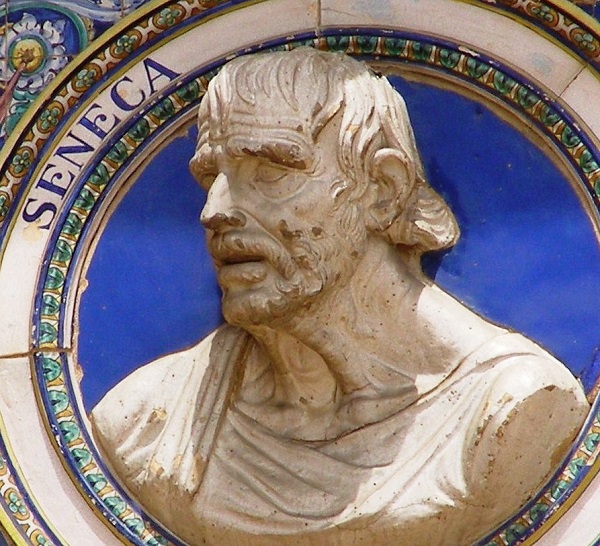
Tariq Saeedi
Across two thousand years of imperial collapse, technological upheaval, and shifting moral codes, the voice of Lucius Annaeus Seneca carries through the static with startling clarity.
Born in provincial Spain and educated in the turbulent heart of first-century Rome, Seneca lived at the intersection of high philosophy and ruthless power. He was a Stoic thinker who preached simplicity while accumulating immense wealth, a brilliant orator who survived exile, and an advisor who tried—and ultimately failed—to restrain the tyrannical instincts of Emperor Nero.
Yet it is precisely because Seneca was neither a detached ascetic nor an abstract theorist that his reflections on time, anxiety, anger, and human vanity speak so directly to the modern condition.
At the center of Seneca’s philosophy is a deceptively simple observation about how human beings squander their lives. — People guard their money, property, and physical possessions with fierce jealousy, yet they hand over their time—the one resource that can never be replenished—to anyone who cares to claim it.
In his essay On the Shortness of Life, Seneca observed that life is not inherently brief; rather, we make it brief by letting it leak away through trivial obligations, social vanity, and restless distraction. Two millennia later, in an economy explicitly engineered to monetize human attention through endless notifications, algorithmic feeds, and round-the-clock news cycles, his diagnosis reads less like ancient moralizing and more like a contemporary psychological audit. Modern life confuses constant busyness with purpose, leaving millions exhausted from motion that rarely amounts to genuine living.
Equally piercing is Seneca’s understanding of anxiety, a condition he saw not merely as a reaction to hardship, but as a habit of self-inflicted torment. Long before modern cognitive psychology formalized the link between thought patterns and emotional distress, Seneca pointed out that human beings suffer far more in imagination than in reality.
We rehearse catastrophes that have not yet occurred, borrow grief from an uncertain future, and allow rumors, status anxieties, and speculative fears to colonize the present moment.
Today’s hyper-connected world, which delivers every distant crisis and economic tremor straight into our pockets within seconds, turns the mind into an engine of perpetual anticipation. Seneca’s counsel—to separate what is actually happening from what we merely dread, and to anchor our energy only in what lies within our control—offers a quiet, disciplined counterweight to the chronic mental fatigue of the digital age.
Seneca also saw through the theater of public outrage and the seductions of ambition. Having navigated the treacherous corridors of the Roman court, where flattery and sudden ruin walked side by side, he knew how easily people surrender their inner freedom in pursuit of applause, titles, and accumulation. In his letters to his younger friend Lucilius, he repeatedly returned to the idea of owning oneself—of refusing to let external status or the approval of the crowd dictate one’s peace of mind.
In his treatise On Anger, he dismantled the notion that fury is a mark of strength or righteous conviction, defining it instead as a brief madness that hands control of our judgment over to whoever provoked us. In a contemporary culture driven by instant public reaction, tribal polarization, and performative indignation, Seneca’s insistence on pausing between provocation and response feels almost countercultural.
Of course, reading Seneca honestly requires acknowledging the contradictions of his own biography. Critics in his own time and ever since have pointed out the gap between his austere Stoic precepts and his vast fortune, or his prolonged proximity to a regime stained by cruelty. He himself never claimed to be a sage who had conquered every human weakness; rather, he described himself as a patient in the same hospital as his readers, sharing the remedies that had brought him some relief. That candor may be the deepest secret of his endurance.
Modern readers rarely inhabit moral vacuums; most must navigate imperfect institutions, competing loyalties, and quiet ethical compromises. Seneca offers no utopian escape from those pressures, nor does he provide a blueprint for reforming unjust systems.
What he offers instead is a lucid, humane manual for preserving clarity of mind, dignity of conduct, and deliberate command over our fleeting days while we walk through the noise of our own empire. /// nCa, 22 November 2026