


Liliya Zhirnova
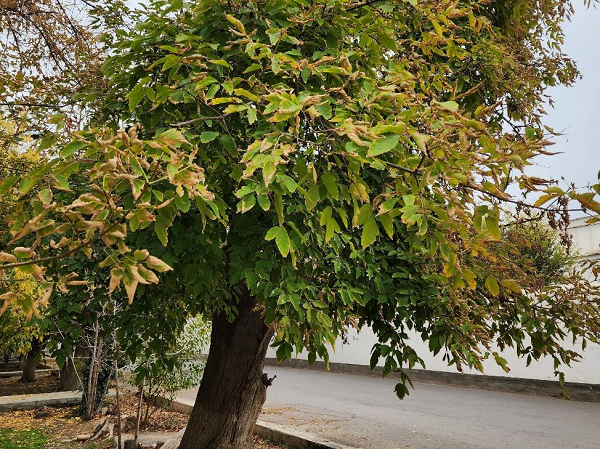
Walking along the shaded lanes and older residential quarters of Ashgabat in late autumn, one frequently encounters a broad-crowned deciduous tree whose leaves—unlike the classic palm-shaped silhouette of most maples—are divided into distinct, toothed leaflets that resemble those of an ash tree.
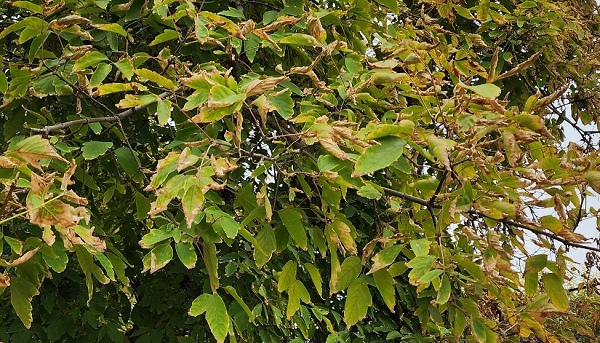
This is the boxelder maple (Acer negundo), a North American native that has become a familiar fixture of Central Asian urban landscapes.
Names Across Languages
- Botanical Name: Acer negundo L. (Family: Sapindaceae)
- English: Boxelder, Boxelder Maple, Ash-leaved Maple, Manitoba Maple
- Russian: Клён ясенелистный (Klyon yasenelistny) or Клён американский (Klyon amerikansky — “American maple”)
- Turkmen: Akgaýyn (the general Turkmen word for maple; also known locally as kerkav / kerkaw in botanical and regional usage, though kerkaw is most specifically associated with the native Turkmen maple, Acer turcomanicum, of the Kopetdag mountains)
Botanical Characteristics
- Distinctive Compound Foliage: Acer negundo is the only maple species that regularly produces pinnately compound leaves consisting of 3 to 5 (occasionally 7) separate leaflets arranged along a central stalk. The leaflets are light-to-medium green, coarsely toothed, and often shallowly lobed. In late autumn, they turn pale yellow before curling and browning at the margins.
- Form and Bark: Typically growing 10 to 20 meters tall, it develops a stout, often leaning or multi-stemmed trunk with thin, grey-brown bark marked by shallow, interlacing furrows. Young shoots are smooth and green to purplish-green, often covered with a faint waxy bloom.
- Dioecious Reproduction: Unlike most maples, male and female flowers grow on separate trees. Appearing in early spring before the leaves, the trees produce abundant V-shaped winged seeds (samaras) that hang in clusters well into winter and disperse widely on the wind.
Ecological Role: Strengths and Trade-Offs
- Urban Microclimate and Soil Tolerance: Introduced across Central Asia during the 20th century for rapid urban greening, Acer negundo thrives in Ashgabat’s hot summers, alkaline soils, and variable water conditions. Its dense summer canopy provides rapid shade, reduces local street-level heat, and traps airborne dust.
- Erosion Control and Wildlife Support: Along irrigation channels (aryks) and riverbanks, its fast-spreading root system helps stabilize soil, while its seeds provide winter forage for birds and squirrels.
- Invasive Tendencies: Because it grows rapidly, resprouts vigorously when cut, and produces massive quantities of wind-borne seed, ecologists across Eurasia classify Acer negundo as an aggressive invasive species. In unmanaged riparian zones and parks, it can crowd out slower-growing native trees and shrubs. Its wood is also relatively soft and brittle, making older limbs prone to breaking in heavy winds.
Health and Practical Uses
- Sap and Syrup: Like its famous relative the sugar maple, Acer negundo produces a sweet sap in late winter and early spring. Indigenous peoples of North America and early settlers traditionally tapped it to boil down into syrup and sugar, though its sugar concentration is lower than that of Acer saccharum.
- Traditional and Homeopathic Remedies: In North American ethnobotany, decoctions of the inner bark were historically used as a mild emetic or poultice, and extracts of the plant continue to be used in homeopathic preparations aimed at soothing venous congestion and hemorrhoidal discomfort. However, it is not a mainstream medicinal herb in modern clinical practice.
- Allergen and Veterinary Cautions: Male trees release significant amounts of wind-borne pollen in early spring, which can trigger seasonal hay fever in sensitive individuals. Additionally, while the tree poses no known toxicity risk to humans, dogs, or cats in normal contact, its seeds contain the amino acid hypoglycin A, which is toxic to grazing horses if ingested in quantity. /// nCa, 22 November 2026